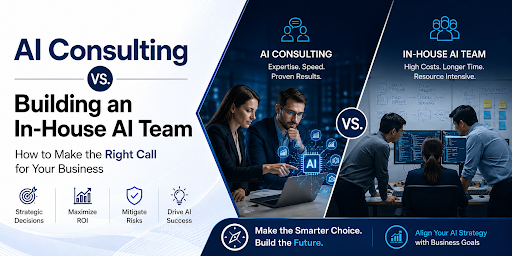
We get asked some version of this question almost every month — usually by a founder, an operations lead, or a VP who has just walked out of a budget meeting with a list of AI priorities and no clear answer on how to resource them.
Should we hire our own AI talent? Or should we bring in outside specialists?
There's no single right answer. We've seen companies thrive with a lean internal team of two data scientists, and we've seen others burn through an entire year of hiring only to end up with a half-finished model nobody trusts. The difference usually comes down to how well the resourcing decision matched the actual stage the business was at — not which option is objectively "better."
So instead of a verdict, here's how we actually think through this trade-off, based on what we've seen work in practice and what we've seen quietly fall apart.
Why This Question Keeps Coming Up
A few years ago, "AI strategy" mostly meant a slide deck. Today it means production systems: fraud detection models, customer support automation, demand forecasting engines, internal copilots that reduce manual work across departments. That shift changes the stakes considerably.
When AI was experimental, a small internal team could explore freely without much pressure. Now that AI touches revenue, customer experience, and operational efficiency directly, the cost of getting the structure wrong is higher — and the pace at which competitors are moving makes slow decisions expensive.
There's also a talent reality that's easy to underestimate. Machine learning engineers who can actually ship reliable production systems — not just notebooks — remain genuinely scarce. For mid-sized businesses competing against companies with much deeper pockets, that talent gap is one of the quiet reasons this question keeps resurfacing.
What an In-House AI Team Actually Gives You
Building internal AI capability has real, tangible advantages. It's worth being clear about them before anything else.
Institutional memory. An internal team accumulates deep context about your data, your customers, and your operational quirks. An outside firm has to relearn that context at the start of every engagement — sometimes at your expense.
Cultural alignment. Internal hires are embedded in your priorities every day, which reduces friction on smaller decisions and makes them more responsive to the shifting priorities that every business faces.
Long-term ownership. Someone internal will still be there in 18 months to maintain, retrain, and improve the system as your business evolves.
The honest downside is time and cost. Hiring a competent ML engineer in a competitive market can take four to six months — and that's before you've built the surrounding infrastructure: data pipelines, MLOps tooling, governance processes, deployment environments. We've seen companies spend an entire year assembling a team before writing a single line of production code. For a business trying to act on a specific opportunity, that timeline can be the difference between capturing a market and watching a competitor get there first.
There's also a subtler issue: a small internal team, especially the first hire or two, often lacks exposure to how other industries have approached similar problems. They're capable, but working somewhat in isolation — and that isolation tends to surface later as blind spots that cost more to fix than they would have cost to avoid.
What Outside AI Consulting Actually Solves
This is where bringing in specialised help earns its keep. It's worth being specific about what that looks like rather than treating "consulting" as a vague catch-all.
Speed to a Working System
A team that has implemented similar AI systems across multiple industries isn't starting from zero. They've already encountered the common failure modes — messy data pipelines, unclear success metrics, integration headaches with legacy systems — and know how to work around them. That experience compresses months of trial and error into weeks.
This is precisely what JanBask's AI consulting services are built around: moving from strategy to production quickly, with a methodology that accounts for the messy realities of real business data and existing system constraints — not just ideal conditions.
Cross-Industry Pattern Recognition
A consulting team that has built recommendation engines for retail, fraud detection models for fintech, and document automation for healthcare brings a wider pattern library to the table than any single internal hire realistically can. That breadth often surfaces solutions a business would never have considered on its own — and it's one of the clearest differences between a team that's solved this problem before and a team solving it for the first time.
Objective Assessment Before You Commit
There's a quieter benefit that often gets overlooked: an outside team has no incentive to tell you what you want to hear about your own data readiness. Internal teams, understandably, sometimes feel pressure to say a project is feasible even when the underlying data isn't ready yet. A dedicated AI consulting partner is generally more willing to say "this isn't ready for a model — here's what needs fixing first." That's a harder message to hear, but it saves real money and prevents the far more expensive outcome of building on a weak foundation.
None of this means consulting is automatically cheap. Engagement rates for experienced AI specialists aren't low, and a multi-month project adds up. The value proposition isn't "cheap" — it's "faster and lower-risk," which is a different calculation depending on where your business is right now.
The Middle Path Most Businesses Overlook
Most conversations skip past a third option that, in practice, is often the smartest: a hybrid model where outside specialists handle the initial build and architecture, while an internal team is trained alongside them to take over maintenance and iteration.
This looks different depending on the business, but common patterns include:
- Bringing in consultants to design the model architecture and data pipeline, then hiring one or two internal engineers to own ongoing operations
- Using outside expertise for a specific high-complexity component — say, a custom NLP model or an enterprise integration layer — while keeping simpler automation work internal
- Running a fixed-term engagement explicitly structured around knowledge transfer, with internal staff involved in every major decision from the start
This approach tends to reduce the two biggest risks simultaneously: the slow ramp-up of building a team from scratch, and the dependency risk of never developing internal capability at all.
JanBask's AI integration services are specifically designed with this handoff in mind — deploying AI into your existing CRM, ERP, and cloud infrastructure in a way your internal team can understand, manage, and build on. It does require more coordination upfront, and it's not free of friction — internal teams sometimes feel sidelined during the early handoff period, which is worth managing proactively with clear roles. But the medium-term result is a business that neither depends entirely on outside vendors nor tries to build everything cold.
The Questions That Actually Clarify the Decision
Rather than defaulting to whichever option feels more comfortable, a few questions tend to cut through the noise quickly:
How urgent is the business need? If a competitor is already deploying something similar, the six-month hiring runway may simply not be viable. In that case, outside expertise isn't a preference — it's a practical necessity.
How mature is your data infrastructure? If your data lives in five disconnected systems with inconsistent formatting, that's a significant project in itself, regardless of who's doing the AI work. An honest data readiness assessment should come before any conversation about models.
Is this a one-time build or an ongoing capability? A single automation project — say, automating invoice processing — might not justify permanent headcount. A core product feature or a recurring operational system almost certainly does.
What's your appetite for managing external vendors versus direct reports? This is more of a cultural question than a technical one, and it matters more than people expect. Some organisations work well with outside teams; others find vendor coordination draining. Both are valid responses — they just point in different directions.
Does anyone internally understand AI well enough to evaluate quality? If nobody in the room can tell a strong model from a mediocre one, that gap is worth addressing before any engagement begins — internal or external. You don't need a full ML team internally to make a good purchasing decision, but you need enough fluency to ask the right questions.
A Practical Example
A mid-sized logistics company we worked with last year needed a demand forecasting model within a quarter, ahead of a seasonal push. They had one data analyst internally, no ML engineers, and a genuinely tight deadline. Building a team from scratch wasn't realistic.
They brought in outside specialists to build the initial forecasting pipeline — and this is the part worth paying attention to — they negotiated the engagement to include structured knowledge transfer for their internal analyst throughout the build. By the time the contract ended, the model was in production and their analyst could handle routine retraining and monitoring independently. When they needed a more advanced anomaly-detection layer a year later, they engaged the same team for that specific component rather than trying to build it cold internally.
That's not a universal blueprint. But it illustrates the underlying logic: match the resourcing decision to the urgency and complexity of the specific problem, not to a general philosophy about "always build" or “always outsource.”
Where AI Initiatives Most Commonly Go Wrong
A few patterns show up consistently enough to be worth naming directly:
Expecting one hire to do everything. Hiring one ML engineer and expecting them to handle data engineering, model development, deployment, and monitoring is a common reason early AI initiatives stall. These are genuinely different skill sets, and collapsing them into one role sets that person up to fail while creating a false sense of progress.
Choosing on price alone. Selecting a consulting firm purely on rate without checking whether they've solved a comparable problem before often produces a working demo that never survives contact with real production data. The question isn't "how much does this cost?" — it's "have they done this before, with results we can verify?"
Treating the decision as permanent. The right answer for launching a pilot project is not necessarily the right answer for maintaining a mature system three years later. Revisiting the structure periodically — rather than locking into one model indefinitely — tends to serve businesses better as needs evolve.
How to Think About This If You're Making the Call This Quarter
If you're in the middle of this decision right now, here's the practical distillation:
Lean toward outside AI consulting expertise when:
- The timeline is tight and six months of hiring isn't viable
- The problem is genuinely unfamiliar territory for your current team
- You need an honest read on whether your data is actually ready
- You want production-grade implementation without the overhead of building a team first
→ Explore JanBask's AI Consulting Services
Lean toward internal hiring when:
- AI capability is becoming a core, ongoing part of your product rather than a one-off initiative
- You have the runway to hire and onboard properly without sacrificing a critical business opportunity
- You're building something so proprietary that outside involvement creates risk
Default to a hybrid structure when:
- You need to move quickly now but also want to build internal capability over time
- You have one or two internal people who could take over with the right training alongside the build
- Your AI needs span multiple systems and require deep integration with your existing stack
→ See How JanBask's AI Integration Services Work
Whatever you choose: invest in at least one person internally — even part-time — who can evaluate technical quality. That single decision prevents a surprising number of downstream problems, whether your implementation work is done in-house or by outside specialists.
A Final Thought
The build-versus-buy question around AI isn't going to resolve into a single best practice anytime soon. What we do think will continue to shift is the baseline expectation: businesses that treat this as an ongoing, evolving decision — revisited as their needs change — rather than something settled once and forgotten, tend to end up with AI systems that actually hold up over time.
Less time debating the abstract question. More time mapping your actual timeline, your data readiness, and how much ongoing ownership you realistically want. Once those three things are clear, the right structure tends to become obvious.
If you're working through this decision right now and want a practical read on where your business stands, our AI consulting team is available for a no-obligation strategy call. We'll tell you honestly what we think — including if the answer is to build internally.
Views: 27 · 30s+ reads: 0