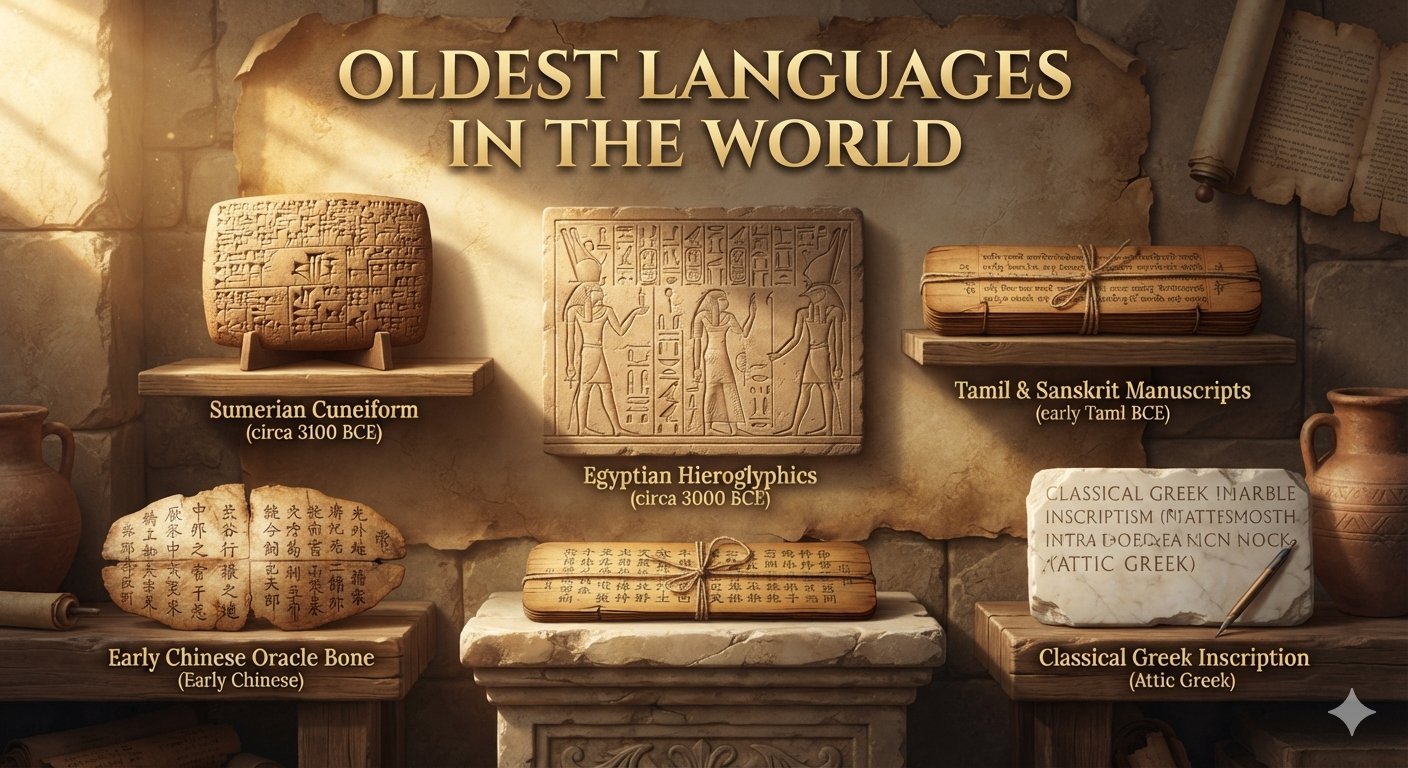
People learning the world's oldest language usually want a trivia answer, a way to settle a debate, or a language worth learning for its history. All three run into the same problem: languages don't have birthdays.
Spoken language is far older than writing, and it never stops changing. Latin didn't "die" one day; it slowly became French, Spanish, Italian and more. So "oldest" can mean very different things:
- Oldest written record: the earliest surviving text of a language still spoken.
- Oldest continuous use: an unbroken chain of speakers from ancient times.
- Oldest lineage: a language with no known relatives, suggesting a deep, independent history.
Each test crowns a Learning oldest language in the world, which is why online claims contradict each other. The honest answer is a shortlist.
The top contenders at a glance
Dates are approximate, and scholars debate some.
| Language | Earliest records | Still spoken today? | Main caveat |
|---|---|---|---|
| Greek | Linear B tablets, roughly 14th–13th century BCE | Yes, around 13 million speakers | Modern Greek differs a lot from Mycenaean Greek |
| Chinese | Oracle bone inscriptions, around 1250 BCE | Yes, the largest native-speaker population of any language | "Chinese" is a family of varieties; modern Mandarin is far from ancient forms |
| Hebrew | Inscriptions from around the 10th century BCE | Yes, several million speakers, mainly in Israel | Everyday speech stopped for centuries and was revived in the 19th–20th centuries |
| Tamil | Tamil-Brahmi inscriptions from around the 3rd century BCE; classical literature about 2,000 years old | Yes, well over 70 million speakers | Some argue for earlier dates; those claims are debated |
| Basque | Roman-era names and inscriptions; first printed book in 1545 | Yes, under one million speakers | Little early written evidence, so its age is inferred |
Greek: the longest documented history
The oldest deciphered Greek writing is Linear B, found on Bronze Age clay tablets. Michael Ventris deciphered it in 1952 and showed it recorded an early form of Greek. From there the language is documented through Homer, classical Athens, the New Testament and the Byzantine era, all the way to modern Greek.
If "oldest" means the longest documented, continuously used language still spoken by millions, Greek is the strongest answer.
Tamil: an ancient living literary tradition
Tamil belongs to the Dravidian family, separate from Indo-European. Its earliest inscriptions are in Tamil-Brahmi, and its classical literature, including the Sangam poems, is roughly two thousand years old. Unlike many ancient languages, it is spoken daily by tens of millions of people in India, Sri Lanka, Singapore, Malaysia and beyond.
Some archaeologists propose older dates for Tamil writing based on excavated pottery. Treat those as ongoing scholarly debate, not settled fact.
Hebrew: the revival story
Hebrew was written in ancient times and preserved for centuries as a language of prayer and scholarship, but it stopped being a community's everyday mother tongue. In the late 19th and early 20th centuries, figures such as Eliezer Ben-Yehuda helped turn it back into a spoken language. Modern Hebrew is both very old and a modern revival, which makes it a favorite example in linguistics.
Chinese: ancient records, enormous reach
Chinese writing appears on Shang dynasty oracle bones from around 1250 BCE, and characters have been used in some form ever since. Spoken Chinese, however, has changed dramatically, and varieties such as Mandarin, Cantonese and Wu are not mutually intelligible. The writing tradition is ancient, while today's spoken language has evolved considerably.
Basque: the survivor with no relatives
Basque, spoken in parts of Spain and France, is the only surviving language isolate in Western Europe. It is unrelated to Spanish, French or any other known language. Most linguists think it descends from languages spoken in the region before Indo-European arrived, but its early history has thin written evidence, so "oldest" here is an inference.
Honorable mentions
- Sanskrit: The Vedic texts were composed orally thousands of years ago. Today Sanskrit is used mainly in religion, scholarship and education, with very few native speakers.
- Aramaic: Ancient Aramaic is documented from roughly the 9th century BCE. Modern Neo-Aramaic varieties survive but are endangered.
- Sumerian and Ancient Egyptian: Both have older written records than any language above, but neither is spoken today. Coptic, a descendant of Egyptian, survives mostly in church liturgy.
So which language is the oldest still spoken?
- Longest documented and still widely spoken: Greek.
- Oldest written tradition with the most speakers: Chinese.
- Oldest living classical language of South India: Tamil.
- Ancient language brought back to everyday life: Hebrew.
- Deepest independent lineage in Western Europe: Basque.
If someone claims one language is "the oldest in the world," ask how they're defining the term. The claim usually rests on that choice.
What is the most spoken language in the world?
This is a separate question with two answers,
- By total speakers (native plus second-language): English is generally ranked first, followed by Mandarin Chinese, Hindi and Spanish, according to Ethnologue.
- By native speakers: Mandarin Chinese is generally ranked first, followed by Spanish and English.
Numbers shift with each survey edition, so check the latest figures at Ethnologue before quoting them. Chinese is notable for being both among the oldest documented languages and the largest by native speakers.
Learning the oldest language in the world: where to start
The best language to learn is the one you'll keep practicing.
- Decide your goal. Reading ancient texts, travel, family connection and curiosity each point to a different language.
- Match language to goal. Greek for classical and biblical literature or travel in Greece and Cyprus. Tamil for South Asian culture and literature. Hebrew for religious study or Israel. Basque for a unique linguistic challenge. Mandarin for work, travel and the largest native-speaker community.
- Learn the script early. Greek has an alphabet you can learn in a few days. Hebrew is written right to left. Tamil has its own script with many consonant-vowel combinations. Mandarin requires characters and tones.
- Choose modern or ancient. Modern Greek and Ancient Greek are different courses; pick the one that fits your goal.
- Practice a little every day. Short daily sessions of listening, reading and speaking beat occasional long ones.
- Find real speakers. Language exchange partners, community classes and native audio help most with unfamiliar-sounding or tonal languages.
For an English speaker, Greek's alphabet and abundant learning materials make it the most approachable of the group. Basque and Tamil will feel more foreign because their grammar and vocabulary are unrelated to English.
FAQ's
1. What is the oldest language still spoken today?
There's no single agreed answer. Greek, Chinese, Tamil, Hebrew and Basque are the main contenders, depending on whether you value written records, continuous use or lineage.
2. Is Tamil the oldest language in the world?
That can't be proven. Tamil is one of the oldest living classical languages, with roughly 2,000 years of literature, but Sumerian and Egyptian have older written records.
3. Is Sanskrit the oldest language?
Sanskrit is very old and historically important, but it isn't the oldest, and it has very few native speakers today.
4. Is Greek older than Chinese?
Greek's earliest deciphered records (Linear B) are somewhat older than Chinese oracle bones, but both are around 3,000 years old or more. Which is "older" depends on how you treat change over time.
5. What is the oldest language in Europe?
Basque is usually called Europe's oldest surviving language by lineage, since it predates Indo-European languages in the region. Greek has the longest written history.
6. What was the first language ever spoken?
Nobody knows. Speech developed long before writing, and no direct evidence of the first language exists.
7. What is the most spoken language in the world?
English has the most total speakers, while Mandarin Chinese has the most native speakers, according to Ethnologue.
8. Can I learn an ancient language like Greek or Hebrew today?
Yes. Modern Greek and Modern Hebrew are living languages with plenty of courses, and ancient forms are also taught at universities and online.
9. Why did Hebrew return to daily use when other ancient languages didn't?
A strong cultural and national movement, plus schools and everyday institutions, made it a community language again.
10. Which ancient language is easiest to learn?
It depends on your native language. For many English speakers, Greek's alphabet is a gentle start, while tonal Mandarin and unrelated Basque tend to feel harder.
Conclusion
The oldest language still spoken today isn't a single clear winner but a short list of remarkable survivors. Greek offers the longest documented history, Chinese and Tamil pair ancient writing with huge living communities, Hebrew shows a language returning to daily life, and Basque stands alone with no known relatives.
Views: 1 · 30s+ reads: 0