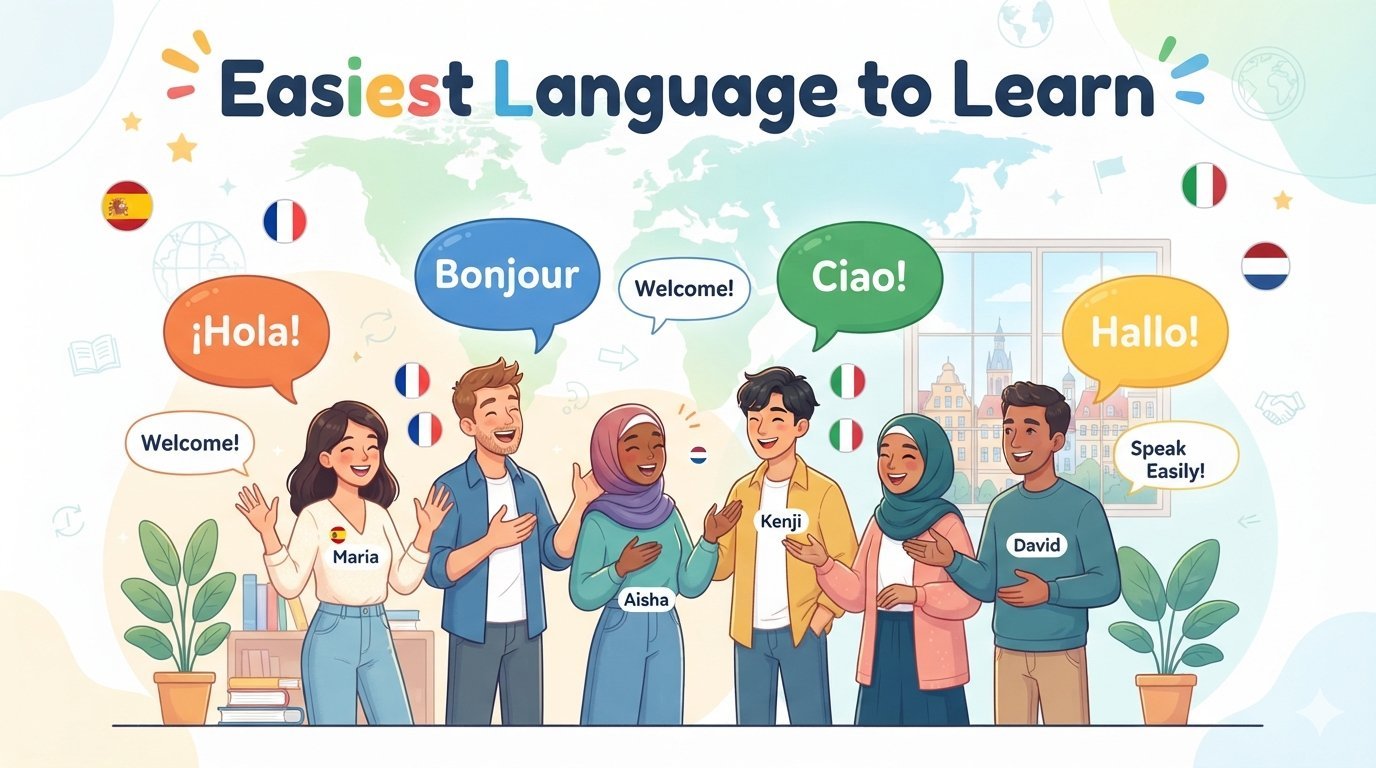
The Easiest Language to Learn for English speakers to learn are Spanish, Norwegian, Dutch, Swedish, Portuguese, Italian, and French. They share vocabulary, grammar patterns, or the Latin alphabet with English, and the U.S. Foreign Service Institute (FSI) places them among its quickest languages to learn, at roughly 24 to 30 weeks of full-time study.
What Makes a Language “Easy” for English Speakers?
People searching for the Simple Easiest Language to Learn language to learn usually want fast, visible progress. Whether a language delivers that depends on how close it sits to English.
Four factors matter most:
- Shared roots. English is a Germanic language that borrowed heavily from French and Latin. Languages in either family feel familiar.
- Cognates. Words like information, family, or animal look almost identical across many European languages.
- Writing system. Languages that use the Latin alphabet remove a major hurdle.
- Grammar and pronunciation. Fewer cases, regular verbs, and phonetic spelling make a language easier to pick up.
The FSI sorts languages into difficulty categories based on how long its students typically need to reach professional working proficiency. Category I, the easiest group, takes around 600 to 750 class hours. This measures diplomats in intensive programs, so your own timeline will depend on your schedule, motivation, and practice time.
The 10 Easiest Languages for English Speakers
1. Spanish
Spanish is the classic first choice. Pronunciation is highly phonetic, so you can read a word aloud correctly almost from day one. Thousands of cognates, such as importante, hospital, and popular, give beginners a vocabulary head start.
Watch out for: verb conjugations and the subjunctive mood.
Best for: travel, careers, and the sheer amount of learning material available.
2. Norwegian
Norwegian is often called the easiest Germanic language for English speakers. Verbs do not change by person (one form covers “I am,” “you are,” “he is”), and word order feels familiar. Many everyday words resemble English, like hus (house) and bok (book).
Watch out for: regional dialects and the pitch accent.
3. Dutch
Dutch sits very close to English in vocabulary and sentence structure. Ik drink water reads almost like its English equivalent. Dutch is often described as a blend of English and German.
Watch out for: the guttural “g” and long compound words.
4. Swedish
Swedish pairs simple grammar with friendly vocabulary. Verbs do not conjugate by person, and clear audio resources are widely available. Words like vänlig (friendly) and sommar (summer) are easy to guess.
Watch out for: vowel sounds and melodic intonation.
5. Portuguese
Portuguese shares most of its vocabulary with Spanish, so learning one speeds up the other. It also has many English cognates.
Watch out for: nasal vowels and the gap between European and Brazilian pronunciation. Pick one variety to start.
6. Italian
Italian is melodic, phonetic, and consistent. Once you learn the spelling rules, you can pronounce almost any word correctly. Vocabulary overlap with English is substantial, especially in food, music, and art.
Watch out for: verb tenses and gendered nouns.
7. French
French has influenced English for centuries, so much of its written vocabulary will feel familiar. Reading French is often easier than speaking it.
Watch out for: silent letters, nasal sounds, and spelling that does not match pronunciation.
8. Afrikaans
Afrikaans is one of the most underrated options. It developed from Dutch and has simplified grammar: no grammatical gender and no verb conjugation by person.
Watch out for: fewer courses and apps than Spanish or French.
9. Indonesian
Indonesian is the easiest non-European option here. It uses the Latin alphabet and has no verb conjugation, grammatical gender, or complicated tenses. Time is shown with words like sudah (already) and akan (will).
Watch out for: unfamiliar vocabulary and the affix system that changes word meanings.
10. German
German is harder than the others on this list, but it earns its place. As a close relative of English, it shares many basic words, like Hand, Wasser, and Haus. The FSI places it in a slightly harder category than Spanish or French.
Watch out for: three genders, four cases, and long compound words.
Quick Comparison Table
| Language | Family | Main Advantage | Main Challenge |
|---|---|---|---|
| Spanish | Romance | Phonetic spelling, many cognates | Verb conjugations |
| Norwegian | Germanic | Simple verbs, familiar words | Dialects, pitch accent |
| Dutch | Germanic | Close to English structure | Guttural sounds |
| Swedish | Germanic | Simple grammar | Vowel sounds |
| Portuguese | Romance | Overlaps with Spanish | Nasal vowels |
| Italian | Romance | Consistent pronunciation | Verb tenses |
| French | Romance | Large shared vocabulary | Spelling vs. sound |
| Afrikaans | Germanic | No gender or verb conjugation | Fewer resources |
| Indonesian | Austronesian | No conjugation or gender | New vocabulary base |
| German | Germanic | Shared basic words | Cases and genders |
How to Choose the Best Language to Learn
The easiest language is not always the best one for you. Ask yourself:
- Why are you learning? Travel, career, family, or culture point to different languages.
- Who will you speak with? A language is easier when you can practice with real people.
- What materials exist? Spanish and French have the most courses, podcasts, and tutors.
- What do you enjoy? Motivation beats difficulty. If you love Italian films, Italian will feel easier than Dutch.
If you are unsure, start with Spanish. It balances learning resources, speaker numbers, and beginner-friendly features better than most.
Practical Tips to Learn Faster
These habits work across all ten languages:
- Study a little every day. Fifteen to thirty minutes of regular practice usually beats one long weekly session.
- Learn high-frequency words first. The most common few hundred words cover a large part of everyday speech.
- Speak from the start. Talk to tutors or language partners early, even if you make mistakes.
- Use real content. Listen to podcasts, watch shows with subtitles, and read simple articles.
- Review with spaced repetition. Flashcard apps help words reach long-term memory.
- Track small wins. Aim for goals like holding a five-minute conversation.
Example: a learner studying Spanish for 30 minutes a day might spend 10 minutes on vocabulary, 10 on listening, and 10 on speaking or writing. This split keeps all skills moving together.
FAQ's
What is the easiest language for English speakers to learn?
Spanish and Norwegian are most often named as the easiest. Spanish has phonetic spelling and many cognates, while Norwegian has simple verb forms and familiar vocabulary.
How long does it take to learn an easy language?
The FSI estimates about 24 to 30 weeks of full-time study (600 to 750 class hours) for its easiest category. Part-time learners should expect longer, depending on how consistently they practice.
Is Spanish easier than French?
For most beginners, yes. Spanish pronunciation follows clear rules, while French has more silent letters and spelling exceptions. French can be easier to read, though.
Which language is easiest to speak?
Spanish, Italian, and Indonesian are often easiest to speak because pronunciation is consistent and grammar is relatively simple.
Is Norwegian really easier than German?
Generally, yes. Norwegian has no grammatical cases and no verb conjugation by person, while German has cases, three genders, and more complex word endings.
Can I learn a language in three months?
You can reach a basic conversational level in three months with consistent daily practice. Fluency usually takes much longer.
Which easy language is most useful?
Spanish is widely useful because of its geographic spread and learning resources. French and Portuguese also offer strong international reach. The most useful language is the one that matches your goals.
Is Indonesian easy for English speakers?
In many ways, yes. It uses the Latin alphabet and has no verb conjugation or gender. The main challenge is vocabulary, which has little overlap with English.
Are apps enough to become fluent?
Apps are excellent for vocabulary and habit-building, but fluency also requires listening, speaking with real people, and reading authentic material.
Is it easier to learn a second language after the first?
Often, yes. Learners get better at spotting patterns, using study strategies, and tolerating mistakes, and related languages like Spanish and Portuguese reinforce each other.
Conclusion
The simplest languages to learn are the ones closest to English in vocabulary, grammar, or writing. Spanish, Norwegian, Dutch, Swedish, Portuguese, Italian, and French lead the list, with Afrikaans, Indonesian, and German as strong alternatives.
Views: 11 · 30s+ reads: 1