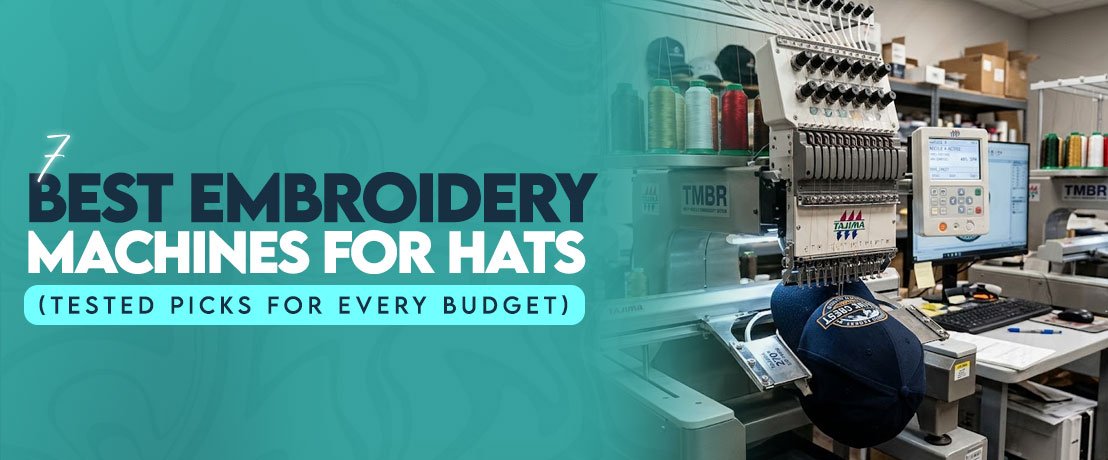
Two hat machines can sit at the same price, and one of them still wrecks your caps. I’ve seen it happen. What separates them is the cap frame, the needle count, and how well the machine handles a curved surface. So I picked seven machines and I’ll tell you where each one fits. If you’re hunting for the best hat embroidery machine for 2026, start here.
Every pick comes with a real dealer price and a note on the cap frame. I also point out where the design file matters, because custom embroidery digitizing can make or break a cap, even on a great machine.
How We Picked the Best Hat Embroidery Machines
I didn’t pick by brand name. I read the manufacturer specs, checked dealer prices from late 2026, and looked at what people complain about most when they start stitching caps.
Cap Frame Support, Needle Count, and Stitch Quality
Five things decided each pick.
- Cap frame support. Some machines include the frame and driver, and others sell them on the side. That gap can add over a thousand dollars.
- Needle count. More needles mean fewer thread swaps. The list goes from one needle up to 15 per head.
- Stitch quality at cap speed. Brother lists 400 to 600 stitches per minute for caps on its six-needle PR670E, while flat frames hit 1000. So cap speed tells you more than the top speed on the box.
- Price and what comes in the box.
- File format. Ricoma and Tajima shops mostly use DST, and Brother machines read PES.
What Real Users Struggle With Most on Caps
Most complaints sound the same.
- The cap frame costs extra, and nobody mentioned it at checkout.
- Needles break near the bill.
- Logos land low or crooked because the center seam missed the frame mark.
- Soft caps pucker when the backing is wrong.
- Cap speed turns out slow. People expect 1000 stitches per minute and get about 400.
In my experience, the last four come from setup and the design file, not from the machine itself.
Quick Comparison Table: 7 Best Embroidery Machines for Hats
Prices come from dealer listings in late 2026. They change often, so confirm before you buy.
| Machine | Needles | Cap system | Price signal | Best for |
| Ricoma MT-1501 | 15 | 270° cap system, kit included | About $12,600 to $15,000 reported | Overall pick |
| Ricoma EM-1010 | 10 | Cap kit in the box | Near $5,000 on promo | Beginners on a budget |
| Brother PR1055X | 10 | Optional wide and flat brim cap frames | Dealer quoted, cap frame extra | Small businesses |
| Tajima TMAR-KC | 9, 12 or 15 per head, 2 to 8 heads | Wide and semi-wide cap frames | Quote only | Bulk cap orders |
| Brother PR1X | 1 | Cap frame sold separately | About $6,500 to $7,000 | Compact home use |
| Tajima TMBP2-SC | Single head | Large shaft for easy cap frame install | Quote only | Easy cap setup |
| Melco EMT16X | 16 | 270° cap driver included | Dealer quoted, five |
The 7 Best Embroidery Machines for Hats Reviewed
1. Best Overall Machine for Hats
If I had to pick one machine for most people, it’s the Ricoma EM-1010. It has 10 needles, stitches up to 1000 per minute, and covers a 12.2 by 8.3 inch flat area. Dealer guides list it from about $5,500 to $8000. Many packages come with a cap driver and four hoops, but check what’s in yours before you pay.
Pros, Cons, and Who Should Buy
- Pros: 10 needles, a cap driver in many packages, and a fair price for what you get.
- Cons: Dealer prices jump around, and the flat area is smaller than Ricoma’s MT machines.
- Who should buy: Small shops or hobbyists who outgrew a single needle.
2. Best Budget Pick for Beginners
The Brother Persona PRS100 is the easy way in. It has one needle, a free arm, an 8 by 8 inch area, and a top speed of 1000 stitches per minute. Brother’s US site lists it between roughly $4000 and $4500. The free arm gets under caps, sleeves, and bags. A few bundles include the PRCF3 cap frame, and others sell it separately.
Pros, Cons, and Who Should Buy
- Pros: It’s the cheapest machine on this list, and it’s compact.
- Cons: You stitch one color at a time, and the cap frame may cost extra.
- Who should buy: Hobbyists who stitch one or two color logos in small batches.
3. Best Multi-Needle Machine for Small Businesses
The Brother PR680W has six needles, an 8 by 12 inch area, and wireless connectivity. US dealers list it between about $11,500 and $13,000. You add a cap frame for hats, and cap speed drops to around 400 stitches per minute. Some dealers bundle in the PRCF5 flat brim frame, and that saves real money.
Pros, Cons, and Who Should Buy
- Pros: Automatic color changes, wireless setup, and bundles that include cap frames.
- Cons: Cap frames often cost extra, and six needles limit your colors.
- Who should buy: Home-based shops with steady weekly orders.
4. Best for High-Volume Cap Orders
The Ricoma MT-1502 has two heads with 15 needles each, so it stitches two caps at once. Dealers list it around $14,900 to $15,000. Top speed is 1000 stitches per minute, and it handles caps, flats, and bags.
Pros, Cons, and Who Should Buy
- Pros: Two caps at once, and 15 needles on each head.
- Cons: It takes more floor space, and it’s overkill if your orders are light.
- Who should buy: Shops that stitch big batches for teams, brands, and events.
5. Best Compact Machine for Home Use
The Janome MB-4S has four needles. Several US dealers list it at $4,999 on sale, down from a $7,999 list price, and some bundles come with a hat hoop. The jumbo bobbin holds 1.4 times more thread than a regular one, so you stop to change it less.
Pros, Cons, and Who Should Buy
- Pros: Four needles at a hobby price, and fewer bobbin changes.
- Cons: Designs with more than four colors need a manual thread swap.
- Who should buy: Home stitchers with limited space and multi-color logos.
6. Best Machine With Easy Cap Frame Setup
The Brother PR1055X has 10 needles, an 8 by 14 inch flat area, and a built-in camera that helps with placement. Its PRCF5 flat brim cap frame makes hooping and centering simple, and it stitches closer to the brim than older frames. A wide cap frame reaches 360 by 60 mm for bigger designs. Brother’s US site lists the machine near $20,800, so get a few dealer quotes.
Pros, Cons, and Who Should Buy
- Pros: Easy cap framing, camera placement, and a wide cap frame option.
- Cons: It costs the most of the Brother machines here, and the cap frames cost extra.
- Who should buy: Busy shops that switch between caps and flat items all day.
7. Best Upgrade Pick for Growing Shops
The Tajima TMAR-KC is a multi-head machine with 2 to 8 heads, and 9, 12, or 15 needles. Top speed sits around 1,100 stitches per minute. Tajima built it for logos on sports uniforms and hats in large quantities. Its cap driver adds a lower shaft and a third locking pin to steady the cap, and a steeper tilt head angles the bill so you stitch closer to the edge. Dealers price it by quote.
Pros, Cons, and Who Should Buy
- Pros: Strong cap stability, high speed, and room to add heads later.
- Cons: Quote only pricing, and a big investment.
- Who should buy: Shops with steady cap orders that max out a single head.
How to Choose the Right Hat Embroidery Machine for You
The best embroidery machine for hats depends on how many caps you stitch each week. Start there and work backward.
Home Hobby vs Selling Custom Hats
Doing it for fun or gifts? The PRS100 or the MB-4S covers you. Selling on the side? Look at the EM-1010 or the PR680W. Once orders pile up and customers want fast turnaround, a commercial hat embroidery machine like the MT-1502 or a Tajima head starts to pay off.
Do the math on blanks, thread, and your own time. If you turn down orders because the machine is slow, the next step up pays for itself.
Hat Embroidery Mistakes That Make Good Machines Look Bad
Most of the ruined caps I see come from habits, not broken machines.
- Wrong backing for the cap style.
- Stitching too fast on the curve.
- Buying before checking the cap frame.
- Sending a shirt file to a cap.
- Stitching with a dull needle.
- Skipping the test stitch on a scrap cap.
Fix these first. Your results get better fast, and you save money on blanks.
Get Better Results on Hats With Properly Digitized Designs
Well, I see this pattern all the time. A shop buys a solid machine, sends a shirt file to a cap, and blames the machine. Caps curve and have a seam down the middle, so the file needs center-out stitching, extra pull compensation, and firm underlay.
When you order a file, tell the digitizer the cap style and your machine brand. Ricoma and Tajima shops want DST, and Brother machines read PES. Ask for a test stitch on a real cap before you approve it. And of course, send clean vector art, since a sharp source file leaves less for the digitizer to guess.
FAQs
1. Which embroidery machine is best for hats?
The Ricoma EM-1010 is the best all around pick for most shops. If you’re a beginner on a budget, go with the Brother PRS100.
2. Do I need a multi-needle machine to embroider caps?
No. A free-arm single-needle machine with a cap frame stitches caps fine. A multi-needle machine saves time once your logos use several colors.
3. Can I sell embroidered hats using a home embroidery machine?
Yes, as long as the machine takes a cap frame and the quality holds up. Check your local business rules too.
4. How much does a good hat embroidery machine cost?
Expect about $4,000 to $5,000 for a single-needle or four-needle start, and $5,500 to $13,000 for six or ten needles. Commercial heads sell by quote, and cap frames add to every price.
Author Bio
Matthew Davis
Senior Embroidery Digitizer
I'm Matthew Davis, a skilled embroidery digitizer with more than 15 years of practical experience. I specialize in logo digitizing, 3D puff embroidery designs, applique digitizing, custom embroidery digitizing, and working with difficult fabrics. Over the years, I have worked with different fashion brands and production teams worldwide. I always share simple tips and useful techniques to help both beginners and businesses improve their embroidery work.
Views: 7 · 30s+ reads: 1