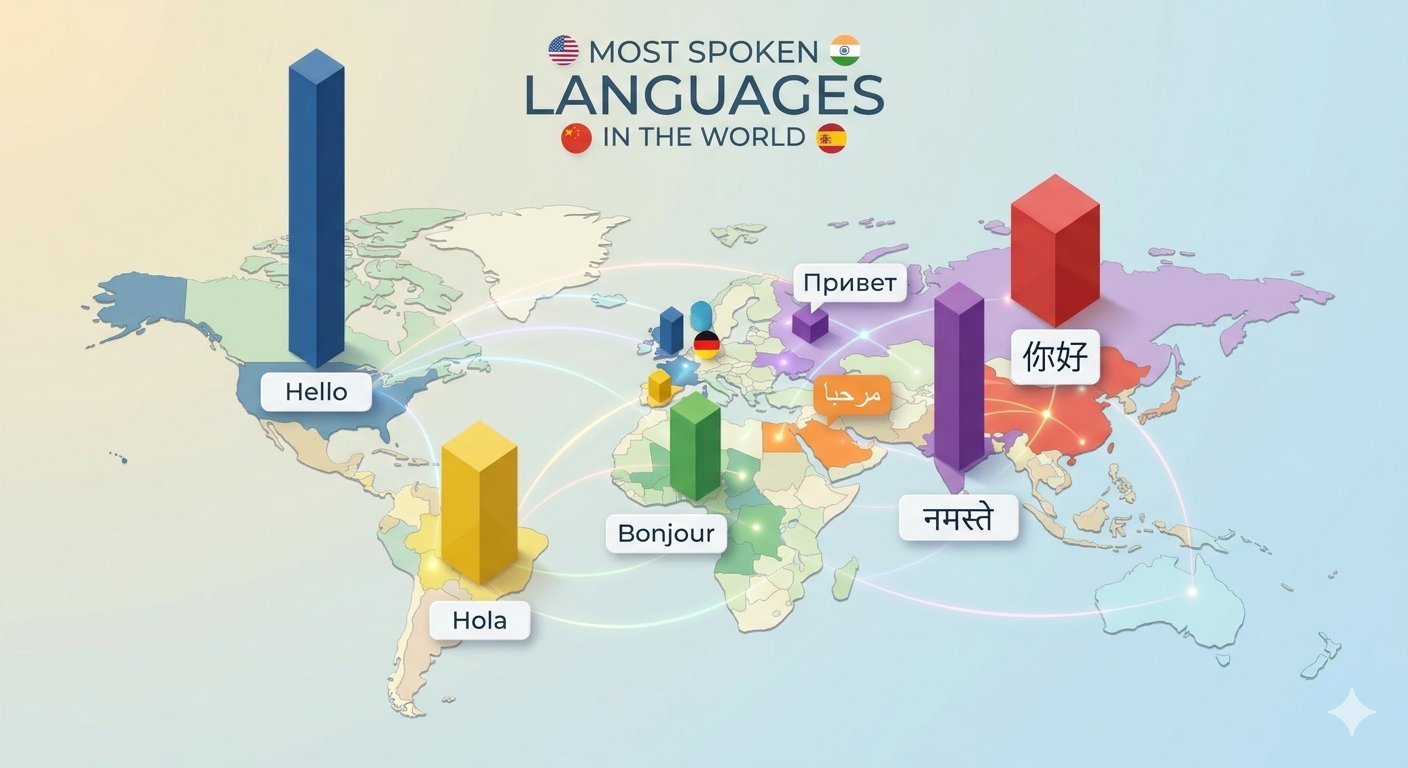
Discover the most spoken languages in the world in 2027, ranked by native and total speakers, with a clear table, key facts, and an FAQ.
English, Mandarin Chinese, Hindi, Spanish, and French are the most widely spoken languages in the World by total speakers, based on Ethnologue’s recent estimates. English leads with roughly 1.5 billion speakers, mostly second-language users, while Mandarin has the most native speakers. Standard Arabic, Bengali, Portuguese, Russian, and Urdu complete the top ten.
What “Most Spoken” Actually Means
Ultimate Most Spoken Languages in the World: Before the list, one distinction explains why different websites give different rankings. There are two ways to count:
- Native speakers (L1): people who grew up speaking the language at home.
- Total speakers (L1 + L2): native speakers plus people who learned it as an additional language.
By native speakers, Mandarin Chinese comes first, and Spanish usually follows. By total speakers, English comes first because so many people learn it for school, work, and travel. This article ranks by total speakers, and notes where the native-speaker picture differs.
Counts are also estimates. Censuses differ by country, and the line between a “language” and a “dialect” is partly political. Treat every number below as approximate.
The Most Popular Languages in the World: Ranked
The figures below are rounded approximations drawn from Ethnologue’s recent editions. Always check the latest edition before quoting exact numbers, since they update yearly.
| Rank | Language | Approx. total speakers | Main regions |
|---|---|---|---|
| 1 | English | ~1.5 billion | Global; UK, US, India, Nigeria, Australia |
| 2 | Mandarin Chinese | ~1.1 billion | China, Taiwan, Singapore |
| 3 | Hindi | ~600 million | India |
| 4 | Spanish | ~550 million | Latin America, Spain, US |
| 5 | French | ~310 million | France, Africa, Canada |
| 6 | Standard Arabic | ~330 million | Middle East, North Africa |
| 7 | Bengali | ~280 million | Bangladesh, India |
| 8 | Portuguese | ~260 million | Brazil, Portugal, Angola, Mozambique |
| 9 | Russian | ~255 million | Russia, Central Asia, Eastern Europe |
| 10 | Urdu | ~245 million | Pakistan, India |
Indonesian also appears near the top ten in some rankings, Complete Most Popular Languages In The World with around 250 million speakers, because it is widely used as a second language across Indonesia. Where it lands depends on the source and edition.
1. English
English is the world’s most widely spoken language, but only about a quarter of its speakers are native. The rest use it as a second or working language. It dominates international business, aviation, science, and the internet, which is why it works as a global lingua franca.
2. Mandarin Chinese
Mandarin has the largest number of native speakers of any language. It is the official language of China and one of the working languages of Singapore. Learners often find the tones and character writing system demanding, but the grammar is simpler than many expect: no verb conjugations or grammatical gender.
3. Hindi
Hindi is the most widely spoken language of India and, together with English, an official language of the Indian government. It is closely related to Urdu in everyday speech, though the two use different scripts (Devanagari for Hindi, a Perso-Arabic script for Urdu).
4. Spanish
Spanish is the second most spoken native language and the official language of about 20 countries. It is also the most studied foreign language in many school systems, and it has a large and growing community in the United States. Its mostly phonetic spelling makes it one of the more approachable languages for English speakers.
5. French
French is spoken on five continents and is an official language in dozens of countries. A large share of French speakers now live in Africa, and that trend is expected to continue. It remains a working language of the United Nations and many international institutions.
6. Standard Arabic
Standard Arabic (Modern Standard Arabic) is the formal written and broadcast form used across the Arab world. Everyday spoken Arabic varies widely from country to country, and the dialects can differ enough to be hard for speakers from distant regions to understand. Many counts treat Arabic varieties as one language, others split them, and that choice changes the ranking.
7. Bengali
Bengali is the national language of Bangladesh and a major language in India’s West Bengal state. It has a rich literary tradition, and Bangladesh’s International Mother Language Day (21 February), recognized by UNESCO, grew out of the Bengali language movement.
8. Portuguese
Most Portuguese speakers live in Brazil, not Portugal. It is also official in Angola, Mozambique, and several other countries, which makes it one of the fastest-growing languages in Africa.
9. Russian
Russian remains a widely used second language across Central Asia, the Caucasus, and Eastern Europe, a legacy of the Soviet era. Its Cyrillic alphabet is easy to learn, though the grammar, with its case system, takes real practice.
10. Urdu
Urdu is the national language of Pakistan and is also spoken widely in India. Many of its speakers use it as a second language alongside a regional mother tongue, which is why its total count is much larger than its native-speaker count.
Honorable Mentions
Several other languages carry major influence and sit just outside most top-ten lists:
- Indonesian: huge as a second language in a country of more than 270 million people.
- Japanese: over 100 million speakers, mostly in one country.
- Swahili: a major lingua franca across East Africa.
- German: the most widely spoken native language in the European Union.
- Turkish, Korean, Vietnamese, and Tamil: each with tens of millions of speakers.
Why Language Rankings Keep Changing
Rankings shift for a few practical reasons:
- Population growth. Languages in fast-growing regions, such as Hindi, Urdu, Bengali, and many African languages, gain speakers faster than those in slower-growing regions.
- Education. Expanded schooling spreads second-language learning, which lifts English, French, and Standard Arabic.
- Migration. Spanish in the US and Arabic in Europe grow through migration.
- Counting rules. Whether a source merges or splits dialects can move a language several places.
How to Choose a Language to Learn
Popularity is only one factor. A practical way to decide:
- Define your goal: travel, career, family, or culture.
- Check your local needs. In many US cities, Spanish has immediate everyday use.
- Consider difficulty. The US Foreign Service Institute groups languages by estimated learning time for English speakers. Spanish, French, and Portuguese are generally easier than Mandarin or Arabic.
- Match your career field. Mandarin for trade with China, Portuguese for Brazil, Arabic for diplomacy and energy, French for international organizations.
Example: A nurse in Texas who regularly meets Spanish-speaking patients will likely get more daily value from Spanish than from a language with more total speakers worldwide.
FAQ's
1. What is the most spoken language in the world?
English, with about 1.5 billion total speakers, if you count native and second-language speakers.
2. What language has the most native speakers?
Mandarin Chinese.
3. What is the second most spoken language in the world?
Mandarin Chinese by total speakers, and Spanish is typically second among native languages after Mandarin.
4. Is Hindi more spoken than Spanish?
By total speakers, Hindi is usually ranked slightly above Spanish. By native speakers, Spanish typically ranks higher.
5. Why is English ranked first if few people speak it natively?
Because rankings by total speakers include the very large number of people who learned it as a second language.
6. How many languages are there in the world?
Ethnologue catalogs more than 7,000 living languages, though the exact number depends on how languages and dialects are defined.
7. Which language is easiest for English speakers to learn?
Languages closely related to English, such as Spanish, French, Portuguese, and Dutch, tend to be easier.
8. Which language is growing fastest?
Languages in regions with high population growth, including many African and South Asian languages, are growing fastest in absolute numbers.
9. Is Arabic one language?
Modern Standard Arabic is one formal standard, but spoken dialects vary a great deal, and sources count them differently.
10. Where can I find the latest official numbers?
Ethnologue updates its figures yearly, and national census offices publish country-level data.
Conclusion
English, Mandarin, Hindi, Spanish, and French lead the ranking by total speakers, but the “most spoken” title depends on whether you count native speakers, second-language users, or both. Use the rankings as a guide, not a verdict. The best language to learn is the one you will actually use. Before you quote any figure, check the latest edition of a source like Ethnologue, since the numbers shift every year.
Views: 4 · 30s+ reads: 0