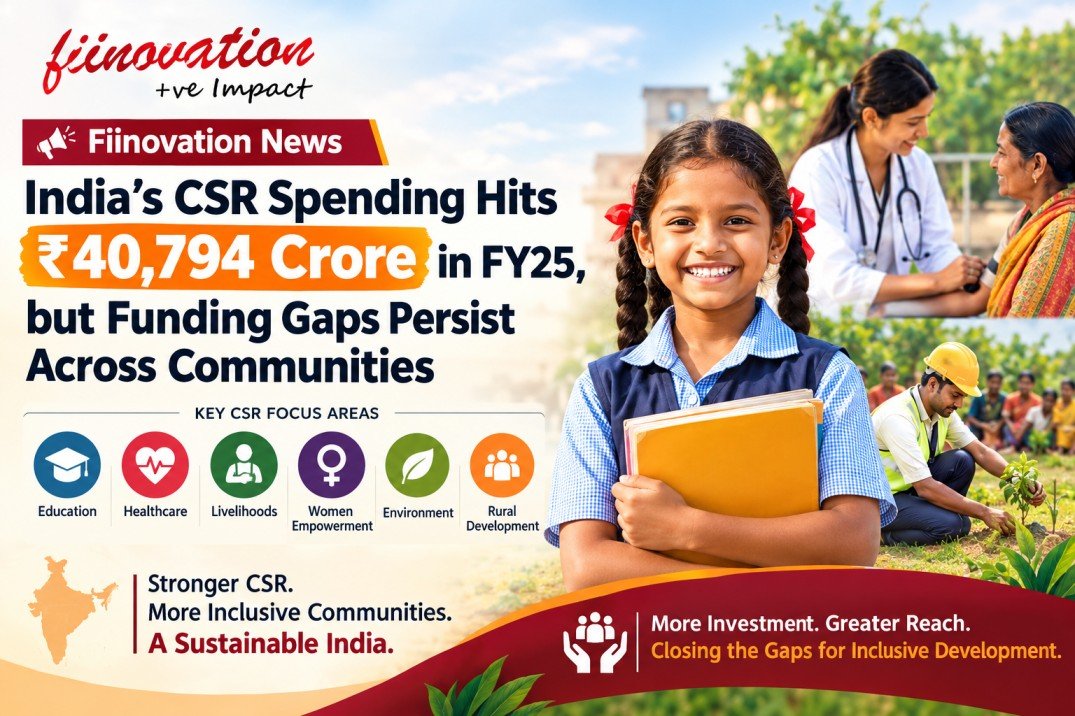
India’s Corporate Social Responsibility (CSR) sector continues to play an important role in supporting social development, community welfare, and sustainable growth. In FY25, India’s CSR spending reached ₹40,794 crore, highlighting the growing contribution of corporate India toward addressing social challenges. However, despite this significant investment, funding gaps persist across communities, particularly in regions where access to education, healthcare, livelihood opportunities, sanitation, and environmental resources remains limited. This development highlights the need for effective CSR planning, transparent fund allocation, and impact-driven implementation to ensure that social investments reach the communities that need them most.
According to the reported figures, the rise in CSR expenditure reflects the continued participation of companies in social development initiatives. Nevertheless, the overall amount spent does not automatically translate into equal development opportunities for every community. The geographical distribution of projects, identification of local needs, availability of capable implementing organizations, and monitoring of project outcomes remain important factors in determining the effectiveness of CSR investments.
Understanding India’s CSR Spending in FY25
Corporate Social Responsibility has become an important part of India's development framework. Under Section 135 of the Companies Act, 2013, eligible companies are required to comply with CSR provisions, including spending at least 2% of their average net profits from the preceding three financial years on qualifying CSR activities, subject to applicable rules.
India's CSR spending of ₹40,794 crore in FY25 demonstrates the scale of corporate participation in social welfare and development. Companies across different sectors are supporting initiatives related to education, healthcare, rural development, environmental sustainability, women’s empowerment, skill development, and livelihood generation.
These investments can help strengthen public services, improve access to essential resources, and create opportunities for underserved populations. However, the impact of CSR spending depends on how effectively companies identify development priorities and align their projects with the needs of local communities.
For organizations working in the CSR ecosystem, the focus must extend beyond the amount of money allocated or spent. Long-term outcomes, measurable improvements, community participation, and the sustainability of projects should remain central to CSR program planning.
Why Funding Gaps Persist Despite Higher CSR Investment
Although India's CSR expenditure has reached a substantial level, the benefits of corporate funding are not necessarily distributed evenly across geographical areas or social groups. Some communities continue to experience difficulties accessing essential services and development opportunities.
One major challenge is the uneven distribution of CSR projects. Industrialized states and districts with a strong corporate presence may attract significant investments, while remote, rural, and economically disadvantaged regions can struggle to secure adequate funding. Although local-area preferences and other applicable CSR provisions influence project planning, companies must also consider wider social needs when selecting eligible initiatives.
Another challenge is the limited capacity of some nonprofit organizations to develop strong project proposals, meet compliance requirements, and demonstrate measurable outcomes. Smaller NGOs working in underserved communities may have a deep understanding of local problems but lack the technical expertise, institutional resources, or corporate connections required to secure CSR partnerships.
In addition, inadequate needs assessments can result in projects that do not fully address the priorities of beneficiaries. Without reliable baseline information and community consultation, CSR programs may focus on short-term activities instead of addressing the underlying causes of social and economic challenges.
These issues demonstrate why effective CSR implementation requires collaboration between companies, nonprofit organizations, local institutions, and professional CSR consultants.
The Importance of Needs Assessment and Strategic CSR Planning
A comprehensive needs assessment is an essential first step in developing effective CSR programs. It helps identify the specific challenges faced by communities and provides evidence for selecting suitable interventions.
For example, an education initiative may require more than the construction of classrooms. It may also need trained teachers, digital learning resources, improved sanitation facilities, and student retention programs. Similarly, a healthcare project may achieve better outcomes when medical infrastructure is supported by awareness campaigns, preventive healthcare services, and regular community outreach.
Strategic CSR planning enables companies to direct resources towards clearly identified priorities. It also helps organizations establish measurable objectives, define implementation timelines, allocate budgets appropriately, and develop monitoring frameworks.
By using data-driven planning and engaging beneficiaries throughout the project lifecycle, companies can improve the relevance and effectiveness of their CSR initiatives. This approach can also help identify communities that have historically received limited support.
How Fiinovation Supports Effective CSR Implementation
Fiinovation, a CSR consulting organization in India , works within the corporate social responsibility ecosystem, supporting efforts to connect corporate resources with development priorities. Professional CSR consulting can help companies and implementing organizations improve project planning, identify suitable interventions, and strengthen program management.
Effective CSR consultancy involves several interconnected activities, including needs assessment, project design, implementing agency evaluation, monitoring and evaluation, and impact assessment. These services can help organizations make informed decisions about where funds should be directed and how project outcomes should be measured.
For NGOs, structured project development and documentation can improve readiness for corporate partnerships. Organizations must also understand applicable CSR eligibility requirements, registration processes, governance expectations, and reporting obligations before participating in CSR-funded programs.
For companies, a well-defined CSR strategy can improve alignment between social objectives, community priorities, and regulatory requirements. Regular monitoring can identify implementation challenges, while impact assessments can provide evidence of whether a project has generated meaningful improvements.
Fiinovation News highlights developments across India's CSR sector, including corporate investments, social initiatives, policy developments, and approaches to improving development outcomes. Such information can help companies, NGOs, and other stakeholders understand emerging opportunities and challenges within the CSR landscape.
Key Sectors Requiring Greater Attention
Addressing persistent CSR funding gaps requires continued attention to sectors that directly influence community well-being.
Education : Investment in school infrastructure, teacher training, digital education, learning outcomes, and access for disadvantaged children can help strengthen educational opportunities.
Healthcare : CSR programs can support healthcare facilities, medical equipment, preventive healthcare, maternal and child health, and awareness initiatives in underserved locations.
Skill development and livelihoods : Vocational training, local employment opportunities, entrepreneurship support, and market-linked skill development can help communities improve their economic prospects.
Women’s empowerment : Initiatives supporting education, financial inclusion, entrepreneurship, health, and employment can contribute to greater social and economic participation.
Environmental sustainability : Water conservation, waste management, renewable energy awareness, biodiversity protection, and climate resilience projects can help communities respond to environmental challenges.
The success of these initiatives depends on understanding local requirements and developing programs that produce sustainable benefits rather than focusing exclusively on immediate outputs.
Improving Transparency, Monitoring, and Impact Measurement
As CSR spending grows, transparency and accountability become increasingly important. Companies need reliable systems to track expenditure, assess implementation progress, and evaluate project performance.
Monitoring and evaluation frameworks can measure indicators such as school attendance, healthcare access, employment outcomes, water availability, and beneficiary participation. Baseline and end-line studies can help compare conditions before and after an intervention, while independent impact assessments can provide deeper insights into the effectiveness of eligible CSR projects.
Technology and data analytics can further support these processes by improving information management, identifying implementation gaps, and strengthening reporting practices. However, data collection must be accurate, relevant, and used responsibly.
Companies should also maintain clear communication with implementing agencies and beneficiaries. Transparent reporting, proper documentation, and regular reviews can strengthen stakeholder confidence and help organizations identify opportunities for improvement.
Conclusion : Turning CSR Spending into Meaningful Social Impact
India's CSR spending of ₹40,794 crore in FY25 represents a significant level of corporate investment in social development. Yet persistent funding gaps demonstrate that the effectiveness of CSR cannot be measured by expenditure alone. The distribution of resources, quality of project planning, institutional capacity, and long-term outcomes are equally important.
Closing these gaps requires a coordinated approach involving companies, NGOs, communities, and CSR consulting professionals. Needs-based planning, transparent fund allocation, stronger implementation partnerships, and evidence-based impact assessment can help ensure that CSR initiatives address genuine development priorities.
Through greater collaboration and accountability, India's CSR sector can work towards more inclusive and sustainable development. Fiinovation News continues to highlight important CSR developments and the role of strategic planning in helping corporate social investments deliver meaningful benefits to communities across India.
Views: 5 · 30s+ reads: 0