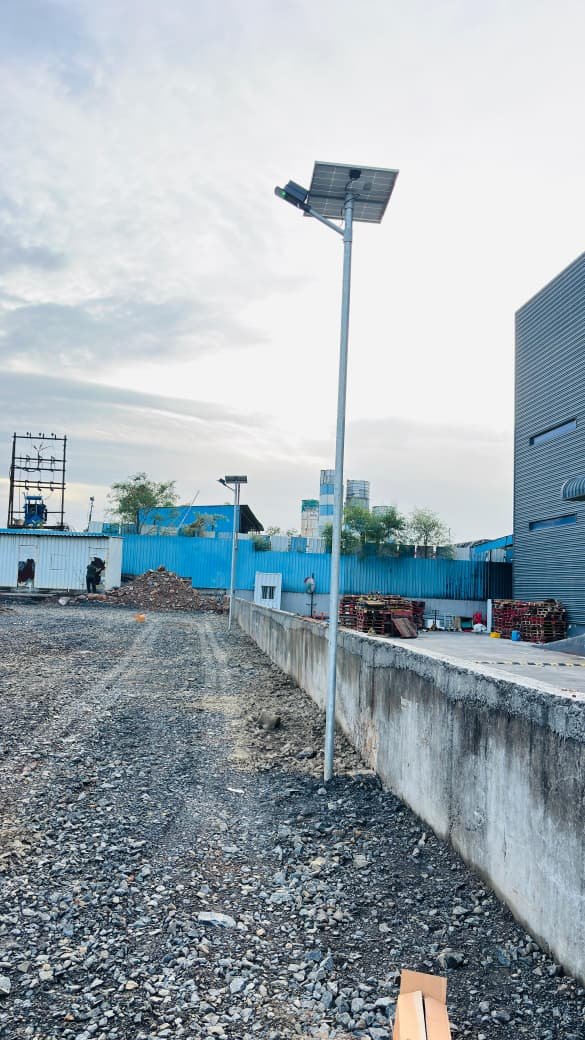
Outdoor lighting plays an important role in road safety, workplace visibility, and the everyday use of public and commercial spaces. In India, solar street lighting is being considered for locations where reducing grid electricity use or avoiding extensive electrical cabling may be useful. From factory roads and parking areas to campuses and selected road projects, solar-powered systems can provide lighting when they are planned around the needs of the site.
How Does Solar Street Lighting Work?
A typical solar street light combines a solar panel, battery, LED luminaire, and charge controller. During daylight, the panel converts sunlight into electricity. The battery stores energy for use after sunset, while the controller manages charging and helps protect the battery. Depending on the model, the light may include automatic dusk-to-dawn operation, dimming, or other controls.
Because the system can operate without a continuous grid connection, it may be useful in remote areas, developing sites, and places where trenching or wiring would be difficult. Performance still depends on adequate solar charging, suitable battery capacity, and correct system sizing.
Start With the Lighting Requirements
Before choosing equipment, identify the area that needs illumination and how it will be used. A factory road, residential pathway, warehouse yard, and public parking area do not necessarily require the same brightness or light distribution. Consider the width of the area, pole height, spacing between poles, operating hours, and any safety or site standards that apply.
Wattage alone does not tell the whole story. Ask for lumen output, beam distribution, and a layout recommendation for the intended space. For larger projects, a lighting assessment can help determine the number of poles and their positions. Proper planning reduces the risk of dark patches, uneven illumination, or unnecessary expenditure on oversized equipment.
Check Solar Panel and Battery Capacity
The solar panel must collect enough energy to support the expected lighting schedule. Local weather, seasonal sunlight, panel orientation, shading, and dust can affect charging.
Battery capacity is equally important because it determines how much stored energy is available at night. Ask the supplier about expected operating hours and backup during periods of limited sunlight. Battery chemistry, temperature conditions, charging management, and replacement availability can all influence the system’s useful life. Avoid relying on broad claims alone; review the specifications and warranty for the exact model being considered.
Choose Suitable LED and Weather Protection
LED luminaires are commonly used because they can provide effective illumination with relatively low energy consumption. The correct choice depends on the area, mounting height, desired brightness, and beam pattern. A road may need light directed along its length, while a yard may need broader coverage.
Outdoor equipment should also be suited to local environmental conditions. Check the stated ingress protection rating, housing material, corrosion resistance, and the supplier’s guidance for rain, dust, heat, or coastal exposure. Poles and foundations should be designed for the installation site, including relevant wind conditions. Qualified installation and secure mounting are essential for safety.
Understand Costs Beyond the Purchase Price
Solar lighting may reduce grid electricity use and the need to extend power cables, but the initial cost can be higher than some conventional options. Compare the full cost of ownership rather than focusing only on the quoted unit price. Include equipment, transport, foundations, installation, cleaning, inspection, battery replacement, and servicing.
The payback period varies with local electricity costs, usage patterns, installation requirements, and system performance. A realistic comparison should use the conditions of the actual project rather than a general savings estimate.
Select a Supplier Carefully
A reliable solar street light manufacturer in India should provide clear product specifications and help buyers match the system to the application. Request information about solar panel ratings, battery capacity, LED output, expected runtime, weather protection, warranty terms, and maintenance. If the project is large, discuss the site layout and installation requirements before confirming an order.
A solar street light supplier in India should also explain limitations honestly, including how performance may change during extended cloudy periods. Technical support and access to replacement parts can matter just as much as the initial purchase price.
Where Solar Street Lights Can Help
Solar street lights can be considered for industrial premises, campuses, internal roads, parking areas, warehouses, and selected infrastructure locations. Their suitability depends on the required illumination, available sunlight, operating schedule, and project budget. High mast solar lighting may be considered for larger open areas, but it requires a separate assessment of pole height, lighting distribution, foundations, and energy demand.
For businesses exploring options, Zitroen provides solar lighting products for different outdoor applications. Buyers can review product information and discuss their site requirements before choosing a configuration. More information is available at https://zitroen.in/.
Plan for Long-Term Performance
Monitor whether lights operate for the expected duration and report changes in performance promptly. Do not open electrical enclosures or service batteries unless qualified to do so.
The most suitable system is one that meets the site’s lighting needs, can charge reliably under local conditions, and has support available over time. By checking specifications, planning pole placement, comparing whole-life costs, and selecting a knowledgeable supplier, buyers can make an informed decision about solar street lighting for roads, industrial spaces, and other outdoor projects.
Views: 4 · 30s+ reads: 0