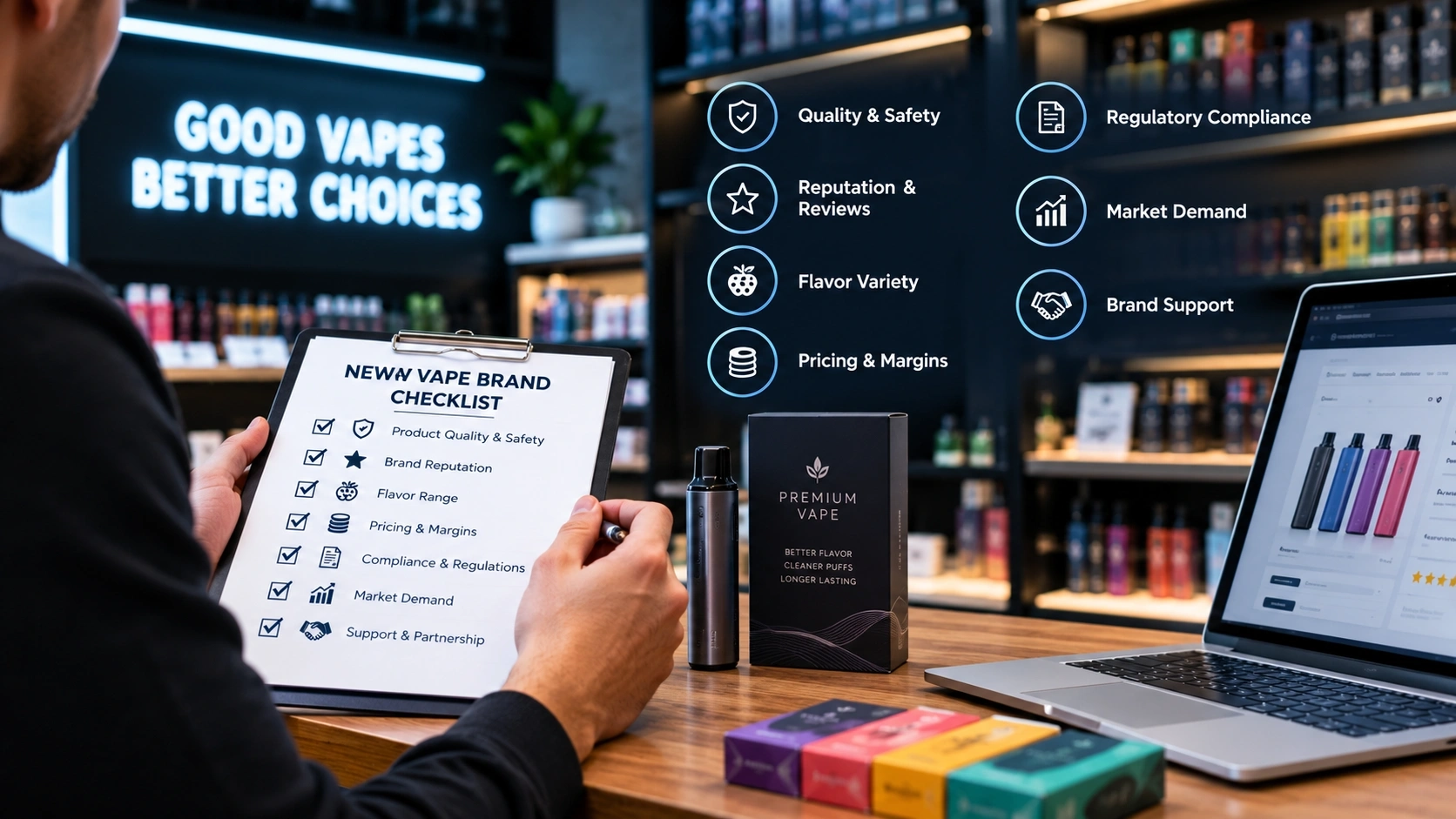
A new vape brand can create an opportunity for a retail store, but unfamiliar products deserve more scrutiny than established sellers with a reliable sales history. Attractive packaging, social media attention, or an appealing wholesale offer may generate interest, yet none of these factors guarantees that a product will suit a store's customers or make commercial sense.
For vape shop owners and smoke shop operators, the decision should involve more than asking whether a brand looks promising. Retailers need to understand what distinguishes the brand, whether its products can legally be sold in the intended market, how dependable the supply arrangement is, and what evidence supports an initial purchase.
A structured evaluation process helps retailers separate promising additions from unnecessary inventory risks.
1. Establish a Clear Reason to Consider the Brand
Before reviewing individual products, identify why the brand deserves attention in the first place.
A retailer might be considering a new brand because customers have requested it, an existing category lacks meaningful alternatives, a current supplier has limited availability, or a new product format appears relevant to the store's audience.
Each reason calls for a different evaluation.
Customer requests can justify investigating a brand, but a handful of inquiries does not necessarily establish sustained demand. A category gap may represent an opportunity, but only if enough customers are likely to purchase the products. A new supplier option may improve sourcing flexibility, although the actual commercial benefit depends on its terms and reliability.
Write down the specific opportunity the brand is expected to address. This creates a reference point for deciding whether the proposed products deliver a genuine benefit.
A useful starting question is: If this brand were not new or unfamiliar, what practical reason would justify adding it to the current product range?
If that question has no clear answer, postpone the purchase until the business case becomes stronger.
2. Investigate the Brand Behind the Product
A product listing can provide useful information, but retailers should investigate the brand itself before committing inventory funds.
Start with the company's official website and available business information. Check whether product names, specifications, packaging details, and brand descriptions are consistent across the materials provided. Look for clear identification of the responsible business and a practical way to request additional product information.
Review the quality of the available documentation rather than judging credibility by website design or promotional language.
Retailers should investigate:
- Whether the brand's identity and product information are consistent.
- Whether the manufacturer or responsible business can be identified.
- Whether product specifications are sufficiently detailed for purchasing decisions.
- Whether relevant documentation can be obtained and verified.
- Whether product claims are specific, supportable, and consistent with the available evidence.
- Whether the supplier can clarify questions about the products being offered.
A polished online presence is not proof of product quality, regulatory eligibility, or business reliability. Equally, a relatively unfamiliar brand should not be rejected automatically if its products and documentation can be evaluated properly.
The objective is to establish what can be verified before deciding whether the opportunity merits further investment.
3. Confirm Product Eligibility Before Assessing Commercial Potential
Commercial appeal should never take priority over determining whether a product can lawfully be sold.
Vape products may be subject to federal, state, and local requirements that differ by product type and destination. Retailers should not assume that a product is eligible simply because a wholesaler lists it, another store carries it, or the brand is widely discussed online.
Before purchasing, verify the requirements applicable to the exact product and the jurisdiction where it will be marketed and sold. This includes checking relevant authorization or marketing requirements, state restrictions, age-related sales obligations, and any applicable distributor or retailer requirements.
The review should be product-specific. A brand may offer several models, but eligibility for one item does not establish eligibility for every product under the same name.
If documentation is incomplete, a product's legal status is unclear, or the supplier cannot resolve a material question, pause the purchasing decision until the issue is addressed.
This step belongs near the beginning of the evaluation process. There is little value in forecasting demand for inventory that the store cannot lawfully sell.
4. Determine Whether the Brand Has a Distinct Position in Your Market
A new brand needs a reason to occupy space in a retailer's existing range. That reason does not have to be novelty alone; it may involve a product format, customer segment, design, price point, or category that is currently underserved.
Compare the proposed products with the items already on your shelves.
For example, if the store already carries several products that appeal to the same customer and offer similar features, another nearly identical option may simply divide existing demand. On the other hand, a brand that addresses a genuine customer preference or fills an identifiable category gap may deserve a controlled trial.
Consider these questions:
- What distinguishes the brand from the closest alternatives?
- Is that distinction meaningful to the store's customers?
- Does the product serve a different need, or is it mainly another version of an existing item?
- Can staff explain the differences accurately?
- Is there evidence of demand beyond the brand's own promotional claims?
Competitor research can help establish context, but avoid treating online visibility as a direct measure of local purchasing behavior. A product that attracts attention nationally may not suit the preferences of customers in a particular neighborhood.
The strongest candidate is one with a clear reason to exist in your store's assortment.
5. Compare Wholesale Suppliers Before Choosing Where to Buy
The same brand may be available through different wholesale channels, while one supplier may offer a wider selection of other products worth evaluating alongside it. Retailers should compare the actual purchasing options rather than assuming that every distributor offers identical stock, terms, or service.
The following five companies are potential starting points for wholesale supplier research. Their current catalogs and terms should be verified directly, and inclusion in this list does not constitute independent certification of any product or supplier.
1. World Vape USA
Website: https://worldvapeusa.com/
World Vape USA is a prominent name in the U.S. vape wholesale market, with an advertised catalog spanning more than 10,000 products. Its published selection covers disposable vapes, e-liquids, nicotine salts, pod systems, kits, batteries, chargers, tanks, accessories, and smoke shop supplies.
The company's listed brands include Geek Bar, Mr Fog, Lost Mary, RAZ, Off Stamp, Oxbar, Foger, Naked 100, Candy King, Juice Head, and Coastal Clouds. Actual availability can vary, so retailers should confirm the specific products offered through the current wholesale account process.
For a store evaluating an unfamiliar brand, World Vape USA provides a useful starting point for researching a broad range of existing products and comparing potential additions with established categories. A retailer can assess whether a proposed brand introduces a meaningful alternative or overlaps heavily with products already represented in the supplier's catalog.
Its wholesale-focused model makes it relevant to retailers who want to evaluate product opportunities in the context of their wider purchasing strategy rather than treating each new brand as an isolated decision. As with any supplier, buyers should confirm product-specific eligibility, documentation, availability, and applicable ordering terms before placing an order.
2. Shefa Distribution
Website: https://www.shefawholesale.com/
Shefa Distribution is another wholesale business retailers can investigate when researching vape and smoke shop supply options. Before choosing it for a new brand, buyers should review its current catalog and determine whether the relevant products are available through its business purchasing process.
The evaluation should focus on the exact products under consideration, including their specifications, documentation, and current availability. Retailers should also compare the applicable account requirements, order quantities, shipping arrangements, and other purchasing terms.
This kind of supplier review is especially useful when a retailer wants to establish whether an additional wholesale relationship provides a practical alternative to its current sourcing arrangements.
3. eJuice Resellers Wholesale
Website: https://ejuiceresellerswholesale.com/
eJuice Resellers Wholesale is a wholesale sourcing option worth investigating when a retailer is evaluating products within the e-liquid market. Its current product selection and business terms should be checked to establish whether it carries the specific brands and formats being considered.
For a store assessing a new e-liquid brand, the purchasing review should go beyond flavor names and promotional descriptions. Retailers should compare product specifications, packaging information, applicable eligibility requirements, order quantities, and the information available to support responsible product selection.
A supplier's relevance ultimately depends on whether its current offerings fit the retailer's target category and whether the purchasing arrangement works for the business.
4. Friendly Vape Distribution
Website: https://friendlyvapelv.com/
Friendly Vape Distribution is another company retailers can include in their wholesale research. Buyers should inspect its current catalog and verify which product categories and brands are available to approved business customers.
When considering an unfamiliar brand, retailers can use this review to compare sourcing options and identify questions that need to be answered before an order is placed. These may include stock availability, product documentation, purchasing requirements, shipping arrangements, and the process for resolving order discrepancies.
The key is to evaluate the supplier against the specific needs of the store rather than assuming that a wholesale listing alone establishes suitability.
5. Huckster Sales
Website: https://huckstersales.com/
Huckster Sales is an additional wholesale supplier retailers can research when comparing sourcing options for vape and related retail products. Its current catalog and business purchasing requirements should be reviewed directly before selecting products for a new-brand trial.
Retailers should establish whether the desired items are actually available, whether their documentation meets the store's requirements, and whether the associated order terms suit the intended purchase size.
Comparing several suppliers can help retailers avoid making a decision based solely on a product's promotional appeal. The best sourcing option is the one that meets the relevant product, compliance, availability, and commercial requirements.
6. Evaluate the Supplier's Ability to Support the Brand
A promising product can still become a difficult inventory decision if the supply arrangement is unreliable or poorly documented.
Before placing an order, determine how the supplier handles the practical details that affect day-to-day retail operations.
| Evaluation area | Questions to resolve |
|---|---|
| Product identification | Are model names, specifications, and package details clear? |
| Availability | Is the item currently available, and how are stock changes communicated? |
| Documentation | Can the supplier provide the information needed to evaluate the exact product? |
| Order accuracy | How are incorrect, missing, or damaged items handled? |
| Purchasing terms | Are minimum quantities, payment conditions, and shipping charges clear? |
| Support | Is there a defined way to raise product or order questions? |
| Repeat purchasing | Is there a reasonable basis for expecting future availability? |
Do not confuse a supplier's assurances with a demonstrated track record. Where possible, use previous orders, written terms, and documented responses to assess performance.
For an unfamiliar brand, a small and carefully reviewed transaction can provide useful information about the purchasing process, provided the product has already passed the necessary eligibility checks.
7. Calculate the Financial Risk of the First Order
Even a promising brand can become a poor investment if the retailer commits too much cash before demand is established.
The first purchase should reflect the strength of the evidence, the store's budget, and the minimum quantities required by the supplier.
Calculate the total acquisition cost, including the product price, shipping, applicable taxes and fees, and other relevant expenses. Then estimate the selling price, expected gross profit, and number of units that must sell to justify the purchase.
For example, suppose a retailer is evaluating an illustrative product with a total acquisition cost of $10 per unit and a planned selling price of $16.
- Selling price per unit: $16
- Acquisition cost per unit: $10
- Gross profit per unit before other operating expenses: $6
- Gross margin: 37.5%
This example does not predict actual margins for vape products. It demonstrates why retailers should calculate the economics of a specific item before ordering and account for other costs that affect the final result.
Next, assess how much inventory the store can afford to hold if the product sells more slowly than expected. Consider whether the initial order would leave enough cash available to replenish established sellers and cover ordinary operating expenses.
A new brand should not jeopardize the products that already support the business.
8. Design a Small Test With Clear Success Criteria
When a product passes the initial checks, the next question is how to test its commercial potential without taking unnecessary inventory risk.
Establish the evaluation criteria before the first order arrives. Depending on the product and sales cycle, these might include:
- Units sold during the evaluation period.
- Gross profit generated by the initial quantity.
- Customer questions and requests for additional stock.
- Sell-through relative to comparable products.
- Returns, defects, or other product concerns.
- The amount of cash remaining tied up in unsold inventory.
Set an appropriate review date rather than making a decision after only a few days. The right period depends on customer traffic, product price, purchase frequency, and the quantity stocked.
For instance, a retailer might begin with a limited quantity, review the results after several weeks, and compare performance with similar products already carried. If the item shows promising demand, the retailer can consider a measured expansion. If sales are weak, the next step may be to investigate pricing, visibility, customer fit, or the original demand assumption.
Do not increase order quantities simply because the brand is receiving attention online. Commercial decisions should reflect the store's own evidence.
9. Create a Decision Rule for Keeping or Rejecting the Brand
A consistent evaluation framework makes it easier to compare opportunities across different product categories.
After the test period, classify the brand into one of three outcomes.
Expand cautiously: The product has demonstrated meaningful demand, acceptable commercial performance, reliable sourcing, and continued eligibility for sale.
Continue testing: The initial evidence is promising but insufficient to justify a larger commitment. Maintain a limited position while gathering additional information.
Decline or discontinue: The product does not meet the store's commercial requirements, lacks adequate documentation, creates unacceptable sourcing concerns, or cannot lawfully be sold in the intended market.
A decision to decline a brand is not necessarily a failure. Avoiding an unsuitable inventory commitment can be just as valuable as identifying a successful new product.
Document the reason for the decision. That record helps the purchasing team recognize similar opportunities and risks when reviewing future brands.
New-Brand Evaluation Checklist for Vape Retailers
Before approving a new brand for the store, use the following checklist to confirm that the important questions have been addressed.
Pre-purchase review
0 of 10
A clear customer or category need has been identified.
The brand and responsible business have been researched.
Product specifications and relevant documentation have been reviewed.
Applicable product and sales requirements have been verified.
The product offers a meaningful distinction from current inventory.
Wholesale availability and purchasing terms have been confirmed.
Total acquisition cost and expected gross margin have been calculated.
The initial order fits the store's cash-flow limits.
Success criteria and a review date have been established.
A decision process exists for expanding, continuing the test, or discontinuing the product.
Copy checklist
Final Thoughts
Introducing a new vape brand should be a deliberate business decision, supported by product research, legal eligibility checks, customer evidence, supplier evaluation, and a realistic financial plan. Retailers who follow a consistent process can explore new opportunities without allowing unfamiliar products to dominate their purchasing budgets.
Wholesale suppliers are part of that assessment, but the presence of a product in a catalog should never replace independent verification of its suitability for the intended market. Companies such as World Vape USA, Shefa Distribution, eJuice Resellers Wholesale, Friendly Vape Distribution, and Huckster Sales provide starting points for researching wholesale options, subject to their current offerings and terms.
Ultimately, a brand earns a lasting place in a retail store by meeting a genuine customer need, satisfying the retailer's requirements, and demonstrating that it deserves continued investment.
Views: 6 · 30s+ reads: 0