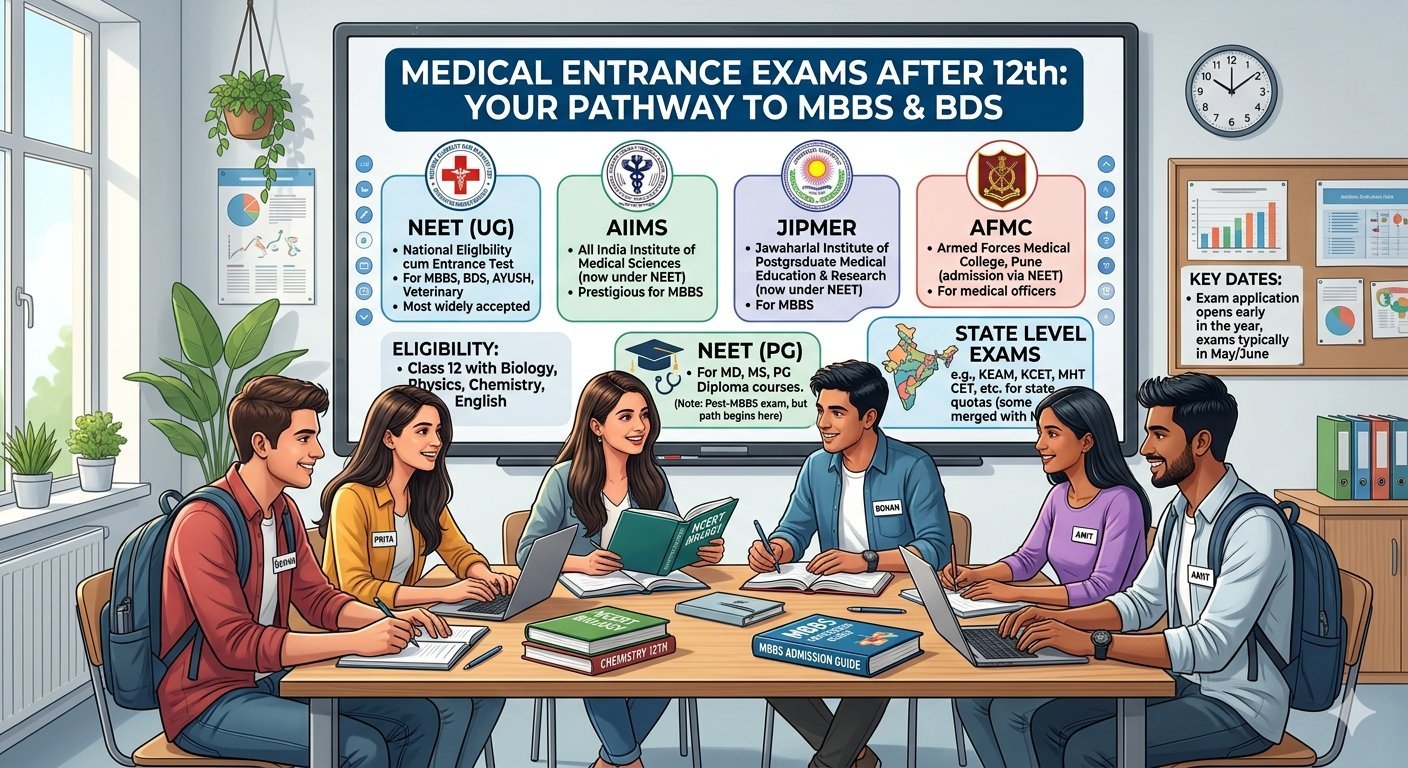
Explore government medical entrance exams after 12th, from NEET UG to allied health tests. Compare top medical courses, eligibility, and career paths.
NEET UG is the main entrance exam for government medical courses after 12th. It covers admission to MBBS, BDS, BAMS, BHMS, BUMS, BSMS, and BVSc & AH, including AIIMS and JIPMER. Nursing, physiotherapy, pharmacy, and other allied health courses use state CETs, CUET UG or university-level tests.
What Students Really Want to Know
Most students searching for government medical entrance exams after 12th are asking three things: which exam to write, which courses it opens, and what to do if a doctor's seat is out of reach. This guide answers all three, so you can plan your route into healthcare with clear, current information.
One caution first: dates, fees, seat numbers, and eligibility rules change. Always confirm them in the official information bulletin before applying.
Government Medical Entrance Exams After 12th at a Glance
| Exam / Route | Courses It Covers | Conducted By | Best For |
|---|---|---|---|
| NEET UG | MBBS, BDS, BAMS, BHMS, BUMS, BSMS, BNYS, BVSc & AH | National Testing Agency (NTA) | Students aiming to become doctors, dentists, AYUSH practitioners or veterinarians |
| NEET UG score for AIIMS and JIPMER | MBBS at AIIMS and JIPMER | Admission through MCC counselling | Top rankers targeting premier government institutes |
| NEET UG for Armed Forces Medical College (AFMC) | MBBS at AFMC | Qualification in NEET UG, then AFMC's own selection process | Students interested in a military medical career |
| NEET UG for Military Nursing Service | BSc Nursing in Army nursing colleges | NEET UG, then selection by the Armed Forces | Students who want nursing with service in the armed forces |
| CUET UG | Some nursing, allied health and life science programmes at participating universities | NTA | Students applying to central or participating universities |
| State CETs and university tests | BSc Nursing, BPT, B.Pharm, MLT and other paramedical courses | State agencies and universities | Students seeking allied health careers |
NEET UG: The Gateway to Government Medical Colleges
Since the National Medical Commission (NMC) Act came into force, NEET UG has been the single national entrance test for MBBS and BDS in India, in government and private colleges alike. AYUSH degrees and BVSc & AH also admit students through NEET UG scores. Indian students who plan to study medicine abroad also need to qualify NEET under NMC rules.
Basic Eligibility
- Class 12 (or equivalent) with Physics, Chemistry, Biology or Biotechnology, and English.
- Minimum age of 17 years on 31 December of the year of admission.
- Minimum marks in Class 12 PCB: generally 50% for the general category, 40% for reserved categories and 45% for general PwD candidates.
- Qualifying NEET percentile, which is separate from your board marks.
Category rules, nationality conditions and age norms are updated periodically, so read the latest bulletin on the NTA website.
Exam Pattern in Brief
- Subjects: Physics, Chemistry and Biology (Botany and Zoology).
- Format: multiple-choice questions, conducted once a year, usually around May.
- Marking: +4 for each correct answer and -1 for each incorrect answer, for a maximum of 720 marks.
- Syllabus: based on NCERT Class 11 and 12 and the syllabus prescribed by NMC.
The number of questions, duration and mode have been adjusted in recent years, so treat the current bulletin as the final word.
How Government Seats Are Allotted
A good NEET rank alone does not secure a seat. You must also register for counselling.
- All India Quota (AIQ): The Medical Counselling Committee (MCC) fills 15% of seats in state government colleges, along with seats in AIIMS, JIPMER, central universities, deemed universities and ESIC institutions.
- State quota: States conduct their own counselling for the remaining 85% of government seats, usually with domicile and reservation rules.
- AYUSH counselling: The AYUSH Admissions Central Counselling Committee (AACCC) handles AIQ seats for AYUSH courses.
In practice, students often register for both MCC and their home-state counselling to widen their options.
Top Medical Courses After 12th
When people search for the top medical courses after 12th, MBBS gets the attention, but several well-regarded paths lead into healthcare.
| Course | Typical Duration | Usual Entry Route | Career Paths |
|---|---|---|---|
| MBBS | 5.5 years (including internship) | NEET UG | Doctor, specialist after PG, public health, research |
| BDS | 5 years (including internship) | NEET UG | Dental surgeon, orthodontist, academia |
| BAMS (Ayurveda) | 5.5 years | NEET UG | Ayurvedic physician, wellness, research |
| BHMS (Homeopathy) | 5.5 years | NEET UG | Homeopathic physician, clinical practice |
| BUMS (Unani) | 5.5 years | NEET UG | Unani physician, AYUSH services |
| BVSc & AH | About 5.5 years (including internship) | NEET UG | Veterinary doctor, animal husbandry, research |
| BSc Nursing | 4 years | State entrance, university test, CUET UG or NEET UG for specific institutions | Staff nurse, nursing education, public health |
| BPT (Physiotherapy) | About 4.5 years | State or university process (varies) | Physiotherapist, sports rehabilitation |
| B.Pharm | 4 years | State CETs or university tests | Pharmacist, drug regulation, pharma industry |
| BSc MLT | 3 years | University or state process | Lab technologist, diagnostics |
Durations follow common regulatory norms, but institutions can differ, so verify with the college and its regulator.
Healthcare Careers Beyond MBBS
If you miss a medical seat, you still have strong options. Healthcare depends on far more than doctors.
- Nursing: Constant demand across hospitals, community health and teaching.
- Physiotherapy and rehabilitation: Growing with sports medicine and elder care.
- Pharmacy: Opportunities in hospitals, manufacturing and regulatory work.
- Medical laboratory and radiology technology: Essential for diagnosis.
- Optometry and audiology: Specialised, often less crowded fields.
- Public health and health informatics: Suitable even for some PCM students.
Students who did not take Biology in Class 12 cannot sit for NEET, but can still explore pharmacy, biomedical engineering, health informatics and similar fields. Check each course's subject requirements.
A Practical Example: Choosing After the Result
Imagine a student, Riya, who aimed for a government MBBS seat. Her NEET rank is decent but falls short of the MBBS cut-off in her home state. Instead of treating the result as a failure, she can:
- Check previous-year counselling data from MCC and her state for MBBS, BDS and AYUSH seats.
- Fill her choices in a deliberate order, such as government MBBS first, then government BDS or AYUSH, then private options she can afford.
- Decide in advance whether a drop year makes sense, weighing the cost and her mental readiness.
This example is illustrative. Actual cut-offs vary every year and by category, so always rely on official counselling records.
A Simple Step-by-Step Plan
- Start early. Begin NEET preparation in Class 11 and treat NCERT Biology as your base.
- Read the official bulletin. Note the exam dates, eligibility, syllabus and document requirements.
- Practise with past papers and timed mock tests to build accuracy and manage negative marking.
- Keep documents ready. Class 10 and 12 certificates, category certificates and domicile proof are commonly needed.
- Register for counselling on time, with MCC and your state.
- Keep a backup plan in nursing, pharmacy, allied health or another course that fits your interests.
Common Mistakes to Avoid
- Relying on coaching-centre rumours instead of official notices.
- Ignoring state counselling deadlines.
- Choosing a college only for its brand, without checking NMC recognition.
- Paying for admission through unofficial agents. Genuine seats are allotted only through official counselling.
FAQ's
1. Which is the best government medical entrance exam after 12th?
NEET UG. It is the single route to MBBS and BDS in India, and also to AYUSH and BVSc & AH degrees.
2. Can I get a government MBBS seat without NEET?
No. Government MBBS admission in India, including AIIMS and JIPMER, requires a NEET UG score.
3. Which subjects do I need in Class 12 for NEET?
Physics, Chemistry, Biology or Biotechnology, and English, with the minimum marks set in the bulletin.
4. Is NEET required for BSc Nursing?
It depends on the institution. Some, such as armed forces nursing colleges, use NEET UG, while many states and universities use their own tests, CUET UG or merit. Check the specific college.
5. Which courses besides MBBS can I get through NEET UG?
BDS, BAMS, BHMS, BUMS, BSMS, BNYS and BVSc & AH, among others, depending on counselling.
6. Can I take NEET more than once?
Candidates can generally reappear, but attempt and age rules can change, so confirm them in the current bulletin.
7. Can PCM students build a healthcare career?
Yes. Options include B.Pharm in many states, biomedical engineering and health informatics. MBBS and NEET-based courses need Biology.
8. Do I need NEET to study medicine abroad?
Yes. NMC rules require Indian students to qualify NEET to be eligible for primary medical qualifications abroad.
9. Who conducts counselling for government medical seats?
MCC conducts counselling for AIQ and central institutes, state authorities handle state quota seats, and AACCC handles AYUSH AIQ seats.
10. When should I start preparing?
Class 11 is the ideal time, but a focused plan with NCERT revision and regular mock tests can work even if you start later.
Conclusion
For most students, the road to a government medical seat starts with NEET UG and continues through MCC and state counselling. But medicine is not the only door into healthcare. Nursing, physiotherapy, pharmacy and allied health courses offer meaningful careers through state CETs, CUET UG and university tests.
Views: 2 · 30s+ reads: 0