The procurement department performs several tasks each day. These involve suppliers, purchase orders, approvals, invoices, and contract management. Manual procedures might interfere with the performance of these tasks. This could result in mistakes and a lack of visibility.
This is where a procurement solution comes in handy. The right software can automate processes. This will improve purchase management and provide useful information. Firms can choose either cloud or on-premises solutions.
Each system offers its own advantages. Each system has its disadvantages too. The best choice depends on individual company considerations.
Let us compare both deployment models in detail.
What Is Procurement Software?
Procurement software allows organizations to organize the purchasing process. This software centralizes procurement activities. The business will be able to manage its suppliers, purchase orders, requisitions, and invoices.
Modern procurement management software can automate the entire approval process. It can also help in supplier management and spending analysis.
Most platforms allow businesses to integrate procurement activities with accounting and financial systems. This improves data flow within different departments.
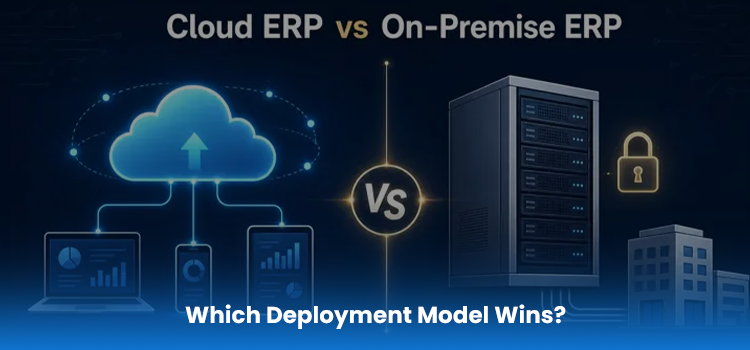
There are two deployment options for procurement solutions in organizations. One can either deploy cloud-based procurement software or install software internally.
What Are Cloud-Based Procurement Solutions?
Cloud-based procurement solutions run through internet-connected infrastructure. The software provider usually manages the hosting environment. Users can access the system through approved devices.
This model reduces the need for internal server infrastructure. It can also reduce the workload for internal IT teams.
A cloud-based procurement solution often uses subscription-based pricing. Businesses may pay monthly or annually. Pricing can depend on users, features, or transaction volume.
Updates are usually managed by the software provider. Users can access new features without major internal installations.
What Is On-Premise Procurement Software?
It involves installing the software in the company’s internal systems. The company takes care of the maintenance of the server and the software system. The IT team will handle this.
This mode offers the business greater flexibility regarding the technical environment. Customization of certain parts of the software system is possible.
On-premises deployment might work for companies with strict infrastructure policies. On-premises software deployment might work for companies with good IT departments.
The software requires more initial costs. This is because companies may need servers, licenses, security features, and technical staff.
Cloud vs. On-Premise: Cost
Cost is a critical factor that procurement leaders take into account.
Solutions that are cloud-based have much less initial cost. There is no need for a business to buy special servers. There is also a lack of infrastructure costs.
Subscription-based models of pricing make budgeting easier. Businesses are able to scale according to needs.
Software that is installed on-premises involves higher initial costs. Implementation and hardware require substantial investment. Technical support will also be required internally.
On-premises software can be beneficial for some businesses. In case of long-term use of software, it will make sense.
The overall cost includes more than just the software itself.
Scalability and Business Growth
Business needs can change very fast. The procurement systems have to accommodate the growth.
Cloud-based procurement platforms allow for easy scalability. This allows a business to grow in terms of users in accordance with its growth. A business can also scale in terms of usage according to its needs.
This will allow for the accommodation of growing businesses. This will also allow for businesses that operate in multiple locations.
For on-premise systems, more infrastructure may be required with the growth in the use of the system. Additional hardware may be needed. More configurations may also be necessary.
Accessibility and Remote Work
Modern teams often work across different locations. Procurement users may need access outside the corporate office.
Cloud procurement software supports access through internet-connected devices. Users can work from offices, branches, or approved remote locations.
This can support distributed procurement teams. It can also help managers approve requests faster.
On-premises systems can support remote access too. They may require additional network configurations.
Security controls may also need careful management.
Cloud systems often make remote accessibility easier to implement.
Security and Data Control
Security is key in all procurement processes. Procurement processes might contain sensitive information on suppliers and financials.
Cloud service providers develop infrastructure for security purposes. The providers might provide encryption, monitoring, backup, and access control services.
Differences exist in security between different cloud providers.
Organizations need to take into account the security of all providers. It is necessary to look at the compliance certificates and policies on the use of data from the provider.
On-premises infrastructure enables full control of the infrastructure by the organization. Internal teams determine security policies and access control.
Full control of the infrastructure might be essential for some industries. This means more responsibilities for the internal teams.
Neither option guarantees automatic security. Security requires architecture, controls, processes, and monitoring.
Customization and Integration
Every company has its own procurement process flow. Some companies require many customizations.
The on-premises procurement solution will give more configuration possibilities. Customized development may be possible for businesses.
Cloud-based procurement software has been developed well in this respect too. API integration is available for many systems.
Integration of a cloud procurement system can be done with the ERP system, accounting system, HR, and payments system. Different approval workflow configurations can also be done.
Companies should consider the integration needs while choosing the procurement solution.
Updates and Maintenance
Software needs regular updates. These updates can improve functionality and address security issues.
With cloud deployment, the provider usually manages updates. This reduces the maintenance burden for internal IT teams.
Cloud users can often receive new features automatically. The process can also reduce the need for manual installations.
On-premises software requires internal teams to manage many updates. Businesses may need testing before applying changes.
This can provide more control over update schedules. It can also increase the workload for IT departments.
Implementation Speed
Deployment time can impact procurement transformation projects.
Procurement systems based on the cloud can be generally easier to deploy. Companies do not have to set up an infrastructure first.
Deployment will nonetheless still require preparation. Data transfer, integration, user training, and process design can be time-consuming.
Deployment of systems in-house can also require further preparation of the infrastructure. Hardware installation could add to the process.
Deployment time will depend on the complexity of the system. Business size and customization requirements will be important.
Which Model Should Businesses Choose?
There is no one-size-fits-all solution for all organizations.
A cloud-based procurement software works well for businesses looking for flexibility. It also works well for companies with less IT capability.
Organizations with remote teams may take advantage of cloud access. Expanding companies can also appreciate scalability.
On-premises software works well for businesses that need full control of their infrastructure. It also works for organizations with good IT capability.
Highly customized systems may need more detailed technical analysis. Regulatory considerations must also be considered before deciding.
A Practical Decision Checklist
There are many things that businesses need to consider when choosing a deployment model for their applications.
These are:
- Evaluate your existing IT infrastructure.
- Determine the total cost of ownership.
- Evaluate data security concerns.
- Evaluate integration requirements.
- Determine anticipated user growth.
- Evaluate customization requirements.
- Evaluate remote access requirements.
- Evaluate internal IT capabilities
- Evaluate vendor support services.
- Evaluate contract and pricing terms.
This will make the software selection process much more objective and will reduce chances of hidden costs.
The Future of Procurement Software Solutions
Technology in procurement evolves constantly. Automation is becoming more and more popular in procurement processes.
AI can help to gain insights on spend and suppliers. Automation can help to cut down the amount of administrative tasks. Analytics can also help in getting insights on purchasing habits.
Cloud platforms are very well positioned for such changes. Additional capabilities can be introduced with updates of platforms.
Each vendor needs to be assessed separately. Capabilities and services can differ dramatically. Deployment model is only one of the aspects.
Final Thoughts
Cloud-based and on-premises procurement management software have their individual purposes. Cloud implementation gives flexibility, accessibility, and scalability. It also lowers infrastructure-related obligations.
On-premises implementation ensures more control over internal infrastructure. On-premises implementation could work well for companies having particular customization or control requirements.
Which method should be chosen depends on your company's priorities. Cost, security, scalability, integrability, and internal IT capacities need to be taken into account.
An in-depth assessment will help to determine which option is the best one. Companies need to analyze several procurement solution options before making a decision.
For many organizations, cloud-based procurement platforms provide a good foundation. The right solution will be the one that meets business needs.
Procurement technology should enable better purchases. It also should streamline processes and improve visibility.
That is why you need to choose which implementation method will allow you to achieve these objectives.
Views: 3 · 30s+ reads: 0