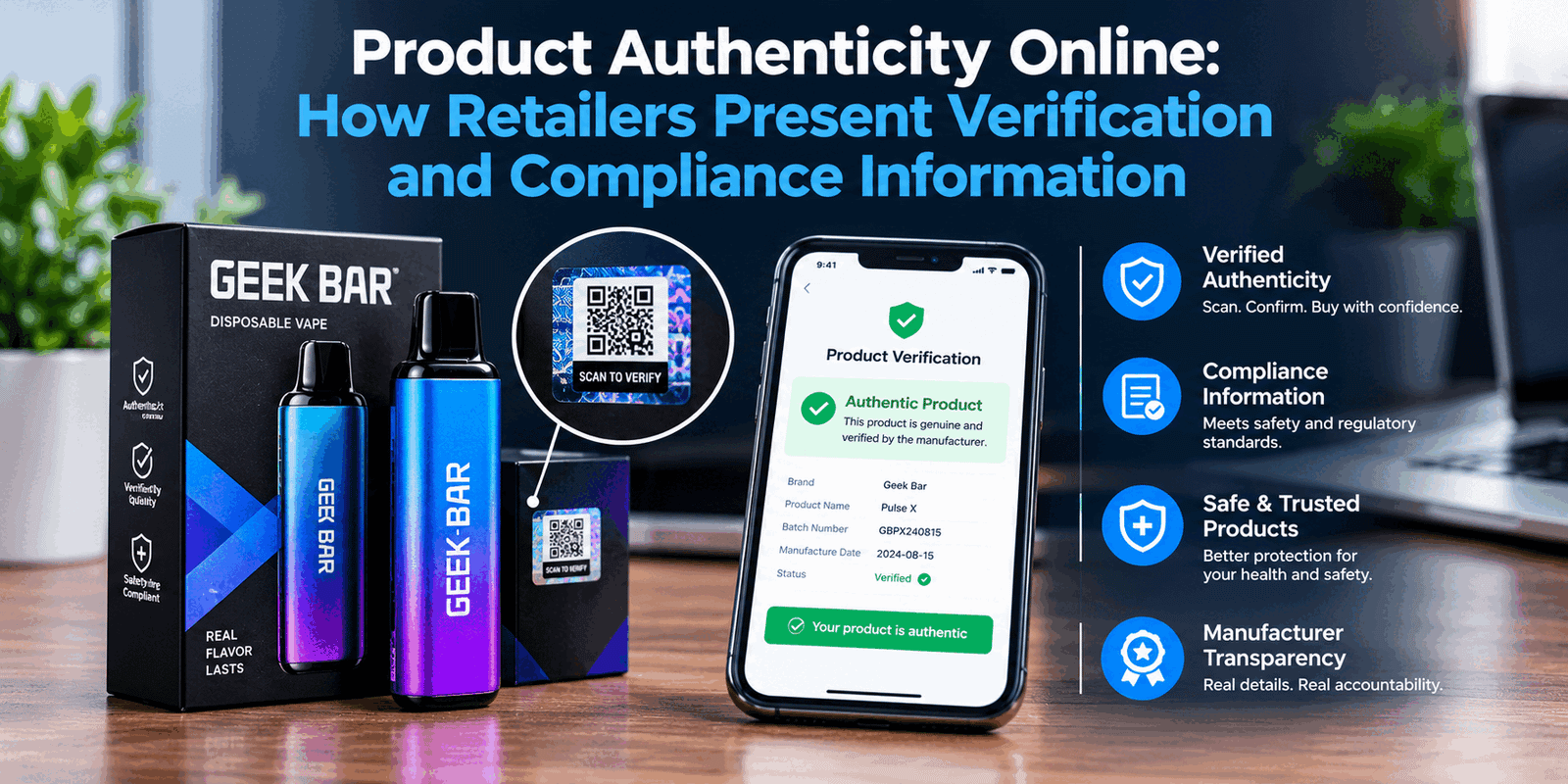
Online shopping gives consumers access to a wide range of vape products, brands, and device formats. However, a large catalog alone does not answer every question a shopper may have. Customers also need clear product information, identifiable manufacturer details, understandable purchasing policies, and reliable explanations of applicable age-verification and sales requirements.
For online vape retailers, communicating these details is an important part of the customer experience. Product authenticity, accurate descriptions, and regulatory compliance are related subjects, but they are not interchangeable. A detailed product page does not automatically prove authenticity, and an age-verification process does not independently establish that a product is genuine.
Understanding these distinctions helps consumers evaluate online retailers more carefully and recognize the types of information that can support a more informed purchasing decision.
Product Authenticity Starts With Clear Information
Product authenticity concerns whether an item is genuine and accurately represented as the product supplied by its stated manufacturer or brand. Online shoppers cannot physically inspect an item before ordering, so the information presented by a retailer becomes an important part of their initial evaluation.
Useful product information may include the manufacturer's name, the complete product designation, model or version details, relevant specifications, package contents, and applicable compatibility information. Consistent descriptions and identifiable product references can help shoppers determine whether a listing corresponds to the item they intend to research.
However, these details should be treated as starting points rather than conclusive proof. A professional-looking website, recognizable brand name, or detailed photograph does not independently verify the authenticity of a product.
When a manufacturer provides an official verification service or instructions for checking a product, consumers can consult those resources where available. They should also review the retailer's published policies and contact the appropriate business if product information appears inconsistent.
How Retailers Present Their Product Catalogs
Online retailers differ in how they organize their products and communicate information. Some concentrate on particular product formats, while others bring multiple categories and manufacturers together in one storefront.
123Vape represents the multi-category retail model, with an assortment that includes disposable vapes, devices, e-liquids, pods, coils, and accessories. Its catalog features recognizable brands such as Geek Bar, Lost Mary, RAZ, Elf Bar, Mr Fog, and Foger.
For a retailer with this breadth, clear category organization and consistent product descriptions are especially relevant. Shoppers researching different manufacturers or product types benefit when listings identify the item clearly and make its relevant characteristics easy to understand.
The presence of a recognizable brand in a catalog, however, should not be confused with independent verification of every individual item. Authenticity questions may require additional evidence, such as manufacturer-provided verification tools, where available, or confirmation from an appropriate authorized source.
The same principle applies across the retail market: catalog breadth can support product discovery, while accurate listing information helps customers understand what a retailer is offering.
Manufacturer Information and Product Identification
A product listing is more useful when customers can identify exactly what is being offered. Generic descriptions may leave important questions unanswered, particularly when different versions of a product have similar names or packaging.
Retailers can help reduce this uncertainty by presenting relevant details consistently, including:
- Manufacturer and brand: The identity associated with the product.
- Product name and version: Enough detail to distinguish the item from similar products.
- Specifications: Information relevant to the product's format and intended compatibility.
- Package contents: An explanation of what is included and what may be sold separately.
- Product limitations: Relevant compatibility restrictions or other important qualifications.
These details support informed comparisons, but they do not all serve the same purpose. Specifications explain a product's characteristics; manufacturer verification may help establish authenticity; and compatibility information helps customers determine whether components work together.
Keeping these concepts separate makes product information easier to interpret and reduces the risk of treating a retailer's description as proof of something it does not establish.
Comparing Retailer Approaches to Product Information
Different online stores provide useful examples of how product catalogs and customer information can be presented.
Element Vape operates a broad online retail catalog covering multiple vaping product categories. When evaluating a retailer of this type, shoppers can examine whether individual listings clearly identify products and whether supporting information is accessible without requiring extensive searching.
VaporDNA provides another point of comparison within online vape retail. As with any retailer, customers can review product descriptions, available specifications, and published purchasing information to understand how individual items are represented.
MyVaporStore offers another example of an online catalog that includes devices and related hardware. In categories involving replacement components, clear model identification and compatibility information are especially important because products that look similar may not be interchangeable.
These examples illustrate different retail catalogs rather than establish a ranking of authenticity standards. A retailer's assortment, website design, or years in the market cannot independently prove the authenticity of a specific product. Verification requires evidence relevant to the item in question.
What Online Age Verification Does—and Does Not—Prove
Age verification is a separate part of responsible online retailing. In the United States, federal law prohibits the sale of tobacco products, including covered e-cigarette products, to people under 21. Applicable requirements may also involve identity checks, delivery procedures, and additional state or local restrictions.
Online retailers may use different procedures to meet the requirements that apply to their sales and fulfillment processes. Customers should review the applicable terms and provide accurate information when completing required checks.
It is important to understand the distinction between age verification and product authentication:
- Age verification concerns whether a purchaser meets the applicable age requirements.
- Product authentication concerns whether an item is genuine.
- Regulatory compliance concerns whether the relevant business activities meet applicable legal requirements.
One does not automatically establish the others. A successful age check does not prove that a product is genuine, and a genuine product does not automatically mean that its sale or delivery is permitted in every jurisdiction.
Clear communication about these separate responsibilities helps shoppers understand the role of each process.
Compliance Information Should Be Specific and Understandable
Compliance is broader than displaying a notice at checkout. Depending on the product and location, legal requirements may affect whether an item can be sold, how it can be marketed, and whether it can be delivered to a particular destination.
For consumers, useful information includes clear statements of relevant restrictions, accessible purchasing terms, and instructions for completing required verification procedures. Retailers should avoid suggesting that every product is available in every state or that a single verification step resolves all legal considerations.
Shipping eligibility deserves particular attention. Product availability on a website does not necessarily mean the item can legally be delivered to every address. Customers should check current restrictions and the retailer's applicable delivery terms before placing an order.
Retailers also need to present product descriptions responsibly. Unsupported claims about product safety, health effects, or regulatory approval can create a misleading impression. Descriptions should communicate relevant product facts without implying guarantees that the available evidence does not support.
Practical Steps Consumers Can Take
Shoppers can use a consistent process when evaluating product listings and retailer information.
First, identify the product precisely. Check the brand, model, version, and relevant specifications rather than relying only on a product image or abbreviated title.
Second, compare the listing with manufacturer information. Where official product pages, verification tools, or other manufacturer resources are available, use them to check whether the details are consistent.
Third, examine the retailer's published policies. Review the information available about returns, damaged items, warranties where applicable, and customer support. These policies do not prove authenticity, but they help clarify how the retailer handles purchasing issues.
Fourth, distinguish evidence from marketing language. Statements such as “authentic,” “genuine,” or “verified” should not automatically be treated as independent confirmation. Look for specific supporting information and determine who provides it.
Fifth, check applicable legal requirements. Confirm age eligibility, relevant sales restrictions, and delivery availability for the intended destination.
Finally, seek clarification when information conflicts. If product identifiers, packaging details, or manufacturer information appear inconsistent, contact the retailer or manufacturer through an appropriate official channel before relying on assumptions.
This approach is more reliable than using a retailer's reputation, catalog size, or website appearance as the sole basis for evaluating a product.
Why Transparency Benefits the Retail Relationship
Clear product information serves both shoppers and retailers. Customers can compare products more efficiently, while businesses can reduce confusion caused by incomplete descriptions, unclear policies, or ambiguous product names.
For multi-category stores such as 123Vape, consistency across different product types can be particularly valuable. Customers exploring devices, disposables, pods, and accessories may need different specifications for each category, but they still benefit from clear product identification and accessible purchasing information.
Other retailers operate with their own catalog structures and customer-information practices. The most meaningful comparison is therefore based on what each website actually communicates and what supporting evidence is available—not on assumptions that all stores follow identical procedures.
Transparency is also an ongoing responsibility. Product availability, retailer policies, legal requirements, and manufacturer resources can change. Customers should consult current information rather than assume that an older article or product listing reflects present conditions.
Conclusion: Evaluate the Evidence, Not Just the Presentation
Product authenticity, age verification, and regulatory compliance are important but distinct parts of online vape retail. Accurate listings help consumers understand what is being offered, manufacturer resources may provide ways to check product details, age-verification procedures address purchaser eligibility, and compliance information explains relevant sales and delivery requirements.
Retailers can support better-informed decisions by presenting product information clearly, maintaining accessible policies, and communicating applicable restrictions without unsupported claims. Consumers, in turn, can make more careful comparisons by checking product identifiers, reviewing current terms, and distinguishing a retailer's statements from independent evidence.
Ultimately, a polished website or a familiar brand name should be only the beginning of the evaluation. The stronger approach is to examine the available information, verify important details through appropriate
Views: 7 · 30s+ reads: 1