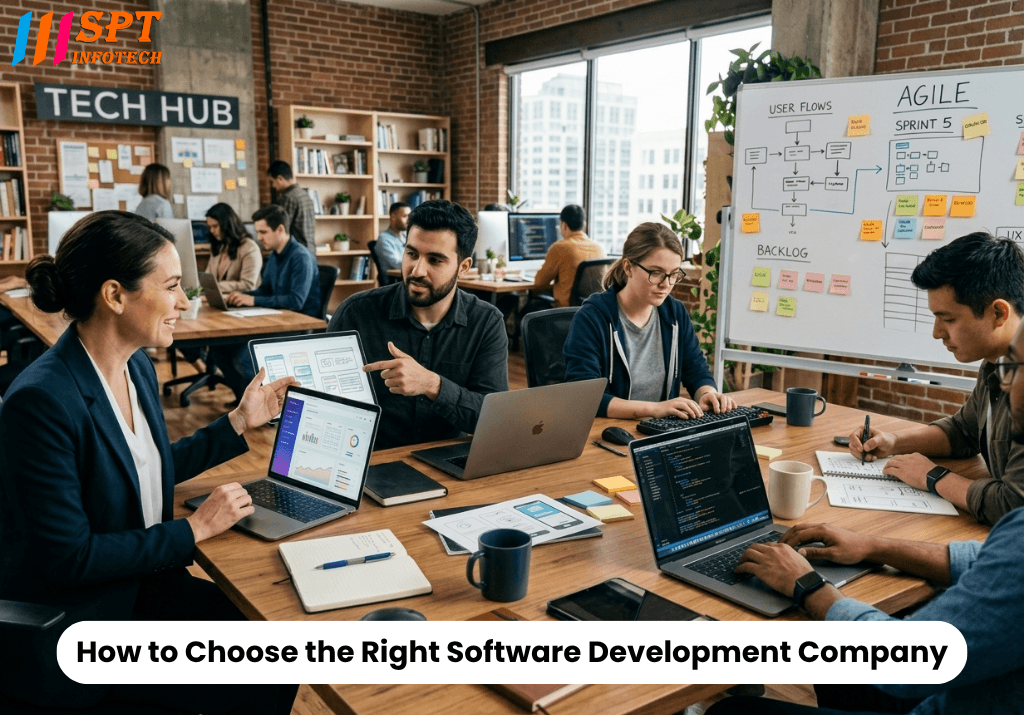
It is important for any business that intends to develop or enhance a digital product to select the right software development company. If you need a business website, a mobile application, custom software or an automated business solution, the development partner you choose can have an effect on the quality, the cost and the long-term success of the project.
Since there are so many IT companies providing the same kind of services, deciding which one to choose can seem overwhelming. The important thing is to go beyond attractive offers and low prices and to select a team that understands your business objectives, communicates clearly and is able to turn your ideas into a practical solution.
1. Understand Your Business Needs
Before you get in touch with a software development company, make sure you know what your objectives are. Are you going to be developing a new application, enhancing an existing system or automating a manual process?
It is not necessary for you to work out all the technical details. On the other hand, if you have a clear understanding of your objectives, your target audience, the essential features and the results you expect, the discussions will be more productive.
For instance, an e-commerce business could require inventory management, payment integration and order tracking, whereas a service company would place greater importance on appointment scheduling and customer management.
Definite requirements enable the development team to propose a suitable solution without introducing unnecessary complexity.
2. Check Technical Skills
As every software project has its own set of requirements, it is important to select a company that has the appropriate technical experience.
Check the technologies that the team uses to see if they are appropriate for your project. It might be necessary, according to your requirements, to involve web development, mobile app development, cloud services, API integration, database management or custom software engineering.
You shouldn’t select a company merely because it provides a long list of technologies; rather, you should inquire into how its team would handle your particular project and the reason why it suggests a specific solution.
A capable development partner who is capable should be able to give technical decisions in simple terms, even if you lack a technical background.
3. Look at Previous Projects and Experience
The capabilities of a company can be readily discovered by looking at the range of projects it has completed. By examining its past work, you can find out the kinds of solutions it has provided, the industries it has dealt with and the problems it has assisted clients in solving.
Find examples that are pertinent to your requirements; for instance, if you need a customer-facing application, look at the way the company deals with usability, performance and functionality.
Client testimonials and case studies can be used to gain more background information; where possible, look for specific results rather than just general remarks about the quality of the service.
What we are looking for is not a company that has developed an identical product, but rather a team that has the experience and problem-solving skills needed for your project.
4. Think about communication and project management
Just as important as technical expertise is good communication; a project that has been well planned can still encounter difficulties if the expectations are not clear or the updates are inconsistent.
Before coming to a decision, find out how the company handles its projects. You should ask who your main point of contact will be, how frequently you will get updates and how feedback or changes will be managed.
A trustworthy team should provide you with information on the timelines, talk over any possible difficulties and keep you up-to-date with progress.
You ought to have an understanding of the various stages of development, such as requirement gathering, design, development, testing and deployment. Taking a structured approach will make it easier to keep track of progress and deal with any problems as early as possible.
5. Compare the pricing and the project scope
Although budget is an important consideration, the lowest-priced proposal is not necessarily the best one.
When you are comparing the quotes, you should check what is included in each one; for example, one company might include UI/UX design, testing, deployment and post-launch support, whereas another could charge separately for these services.
Request a detailed breakdown of the costs, the milestones, the deliverables, the payment terms and any possible extra charges.
It is also worth considering the impact that alterations to the original requirements will have on the budget and the timeline, as this will help to avoid misunderstandings later on.
What we want is to come up with a solution that provides real value and at the same time stays within our financial means.
6. Quality Assurance and Security Check
Software must work reliably, safeguard user information and ensure a consistent experience on all supported devices.
Inquire as to how the company tests its work before it is released. The type of testing involved may vary and can include functional testing, usability checks, performance testing, compatibility testing and security assessments, according to the particular project.
Security must be given due consideration at the start and not be added at a later stage. Issues such as authentication, access controls, secure handling of data, frequent updates and suitable backup procedures could all be relevant.
A company involved in development which takes quality assurance seriously will be in a better position to spot problems before they have an effect on users.
7. Talk about maintenance and future scalability
The launching of your software marks only one stage in its lifecycle; at a later date you might need new features, bug fixes, security updates, performance improvements or integrations with other systems.
Before you sign the agreement, find out what takes place after the launch. Does the company offer continued maintenance? How are support requests managed? Are the response times and the costs of the service clearly stated?
You ought also to think about whether the suggested solution is able to support future growth and a system that is scalable should be based on actual business requirements so as to allow for expansion without introducing unnecessary complexity.
Final Thoughts
The selection of the appropriate software development company involves more than just comparing prices or looking at impressive websites; you have to assess their technical expertise, relevant experience, communication skills, project management abilities, security measures and commitment to long-term support.
Take time to talk about what you need. Ask practical questions. Make sure you write down expectations clearly before development starts.
At SPT Infotech, businesses have the opportunity to look into solutions in the areas of custom software development, web and app development, quality assurance and IT consulting. If you begin with your business objectives and choose an appropriate development method, you will be able to create a digital solution that supports your present operations as well as your future growth.
| For more information check this link : https://www.sptinfotech.com/how-to-choose-the-right-software-development-company/ |
Views: 5 · 30s+ reads: 0