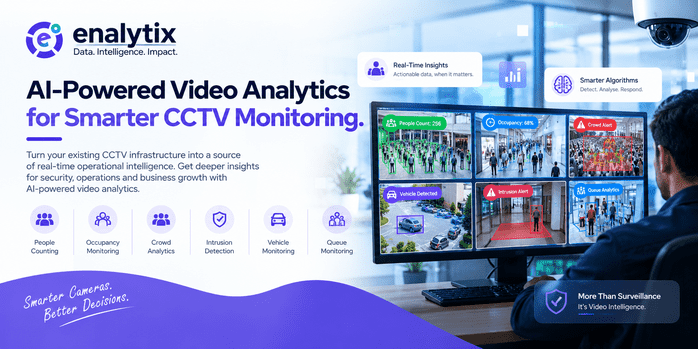
CCTV cameras have become a standard part of security and monitoring infrastructure for businesses. Retail stores, offices, warehouses, factories, schools, hospitals, public venues and commercial facilities often operate dozens or even hundreds of cameras every day. However, having cameras installed is only one part of the equation. The bigger challenge is understanding the enormous amount of visual information those cameras continuously generate.
This is where AI-powered video analytics is changing the way organizations approach video monitoring.
Instead of using CCTV only to record incidents for later investigation, businesses can use intelligent analytics to understand activities, movements, occupancy and events as they happen. The objective is not simply to collect more footage, but to extract useful information from the footage that can support security, operations and business decisions.
What Is AI-Powered Video Analytics?
AI-powered video analytics refers to the use of artificial intelligence and computer vision techniques to analyse video captured by cameras.
Traditional CCTV generally provides a live video feed and stores recordings. Someone has to watch the screens or search through recorded footage when an incident needs to be investigated.
With AI based video analytics, software can analyse camera feeds and identify predefined objects, activities, movements or patterns. Depending on the environment and configuration, this can include people, vehicles, crowds, occupancy levels, queues, restricted-area activity and other events.
The result is a transition from simply watching video to extracting structured information from it.
Why Traditional CCTV Monitoring Has Limitations
Imagine a facility with 100 cameras operating throughout the day.
Even if a security team monitors several screens simultaneously, it is difficult for humans to maintain the same level of attention for every camera at every moment. Important events can also happen very quickly.
When something goes wrong, teams may need to search hours of recordings to determine what happened.
This creates three common challenges:
- Large amounts of footage
- Limited human attention
- Time-consuming incident investigation
Video analytics software can help address these challenges by continuously analysing video and highlighting events or information that match predefined requirements.
Instead of forcing teams to watch every second of footage, analytics can help direct their attention toward specific situations.
From Video Recording to Video Intelligence
The real value of modern video analytics AI lies in converting visual information into something that teams can understand and act upon.
For example, a retail business may want to know how many people entered its premises during a particular period. A warehouse may need to monitor vehicle movement and restricted areas. A stadium may need information about crowd density and occupancy. An office building may want to understand how different areas are being utilized.
These are not necessarily traditional surveillance questions.
They are operational questions that happen to have answers inside video footage.
A video intelligence solution can help extract those answers from existing camera feeds and present them through alerts, dashboards, reports or other monitoring interfaces.
Common Applications of Camera Analytics
One of the major advantages of camera analytics is that it can be applied to different environments based on their individual requirements.
People Counting
Organizations can measure how many people enter or leave a particular area. This can be useful for retail footfall analysis, facility management and public venue monitoring.
Occupancy Monitoring
Businesses can monitor the number of people present within defined areas and understand how spaces are being utilized.
Crowd Monitoring
Crowd density and unusual gathering patterns can be monitored in environments where large numbers of people are present.
Queue Analytics
Businesses can identify queues and monitor their conditions, which can be particularly useful in retail stores, transport facilities and public-facing environments.
Intrusion and Restricted Area Monitoring
Analytics can help identify movement into predefined restricted zones and generate alerts for the relevant teams.
Vehicle Monitoring
Camera feeds can also be analysed for vehicle movement, helping organizations gain better visibility around parking areas, facilities, warehouses and access points.
These examples show why smart video analytics is becoming useful beyond traditional security monitoring.
Can Businesses Use Existing CCTV Infrastructure?
One of the biggest considerations for organizations exploring analytics is infrastructure.
Many businesses have already invested significantly in CCTV cameras, networking equipment and surveillance systems. Replacing an entire camera network simply to introduce analytics may not always be necessary or practical.
Depending on camera compatibility and deployment requirements, modern analytics platforms can work as an additional intelligence layer around existing CCTV infrastructure.
This means businesses can explore new capabilities without necessarily treating their existing surveillance investment as obsolete.
The approach can be particularly useful for organizations with multiple locations where installing an entirely new camera system would involve significant cost and operational disruption.
AI Video Analytics Across Different Industries
The applications of AI-powered video analytics are not limited to one particular industry.
In retail, organizations can use analytics for footfall, occupancy, customer movement and queue monitoring.
In warehouses, analytics can support vehicle monitoring, intrusion detection, restricted-area monitoring and safety-related use cases.
In offices, organizations can gain visibility into occupancy, staff presence and space utilization.
In public venues, crowd density, people counting, occupancy and movement can become important monitoring requirements.
In schools and campuses, analytics can support security monitoring, crowd management and restricted-area detection.
In manufacturing environments, organizations may use camera intelligence for safety monitoring, movement analysis and operational visibility.
The specific implementation depends on the environment, available camera infrastructure and the organization's objectives.
Why Smart Video Analytics Is Becoming More Relevant
The amount of video generated by businesses continues to increase. More cameras mean more visibility, but they also mean more data that needs to be interpreted.
Simply adding additional screens does not necessarily solve the problem.
The smarter approach is to make the existing video infrastructure more useful.
This is where smart video analytics can play an important role. By automatically analysing camera feeds and surfacing relevant information, organizations can reduce the dependency on continuous manual observation.
However, analytics should not be viewed as a complete replacement for human decision-making.
A well-designed system should help teams identify relevant events and provide useful context, while people remain responsible for evaluating situations and taking appropriate action.
Building a Practical Video Intelligence Strategy
Organizations considering video analytics software should begin with the actual business or operational problem rather than selecting technology simply because it uses AI.
For example, a retail business might start with footfall and occupancy. A warehouse might prioritize vehicle movement and intrusion monitoring. A public venue might focus on crowd density and queue management.
Once the problem is clear, organizations can evaluate camera compatibility, processing requirements, alert mechanisms, dashboards and privacy considerations.
This problem-first approach can make an analytics deployment more useful and easier to scale.
The Future of CCTV Is More Than Recording
CCTV remains an important part of security infrastructure, but its role is expanding.
With AI based video analytics, cameras can become sources of operational information rather than passive recording devices. Businesses can use their existing visual infrastructure to understand people movement, occupancy, crowd conditions, vehicles and other activities.
The broader shift is from surveillance toward intelligence.
A modern video intelligence solution connects cameras, analytics and operational workflows so that teams can spend less time searching through footage and more time responding to meaningful information.
For organizations looking to get more value from their existing CCTV infrastructure, AI-powered video analytics provides a practical path toward smarter monitoring, better visibility and more informed decision-making.
The future of video monitoring is therefore not simply about installing more cameras. It is about making the cameras already installed more intelligent and more useful to the people responsible for running the business.
Views: 2 · 30s+ reads: 0