Overview
When it comes to communicating with customers, employees, visitors, and other audiences effectively, businesses can rely on digital signage. Advanced digital signage solutions can deliver promotions, announcements, schedules, alerts, and brand messages through centrally managed screens. It is, however, fair to say that poor planning, irrelevant content, and weak management can turn this initiative into an expensive collection of screens.
The good news is that most digital signage problems are avoidable. Businesses can improve the effectiveness of digital signage boards by treating them as a communication strategy. Whether it is defining objectives or maintaining content, businesses should consider audience experience with any information on screens.
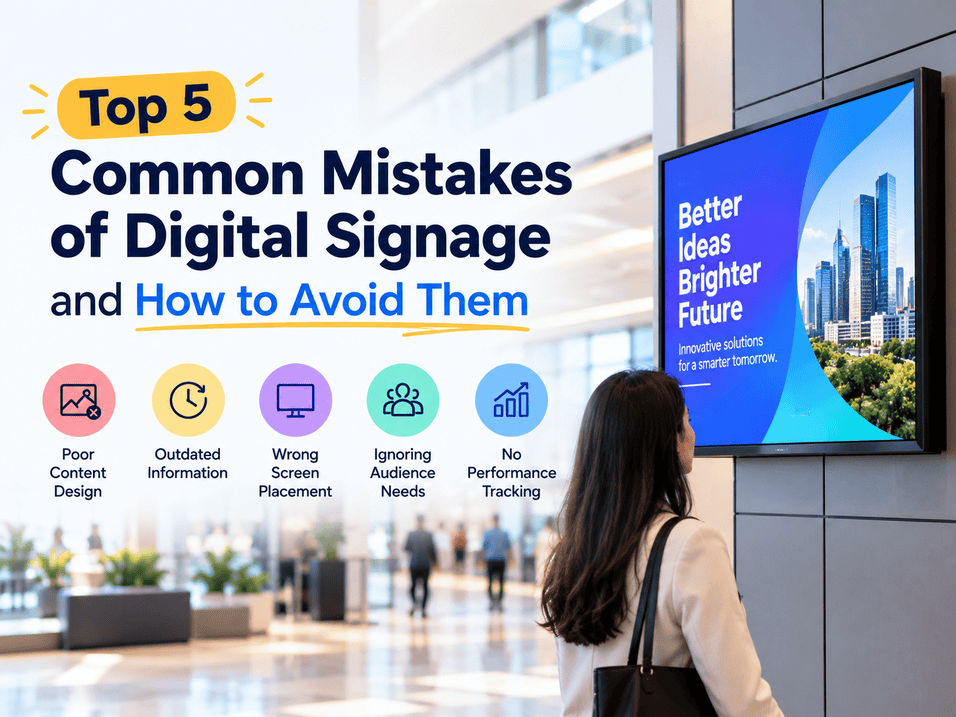
Here are five common digital signage mistakes that businesses should identify and avoid.
Five Common Digital Signage Mistakes to Avoid
Rich virtual experience, flexibility, and real-time display are some of the key benefits of digital signage. But businesses should avoid the following mistakes to leverage the benefits of digital signage solutions.
Installing Screens Without Clear Goal
It is one of the most common mistakes. It starts with the hardware instead of the objective of implementing digital signage solutions. A business may purchase several digital displays or screens to give engaging visual experiences to their customers. Without a clear purpose, however, the content becomes inconsistent, and people may not like the overall concept.
It is, therefore, necessary to determine the end goal that the signage can accomplish before selecting the solution or even creating content. For example, a retail business might use displays to promote products and guide customers through different sections. Corporate digital signage solutions aim to establish internal communication, visitor guidance, and employee recognition. A healthcare facility may need it for queue information and important notices.
Clear objectives are useful to determine the right content for the screen. They also help businesses evaluate the benefits of digital signage over time.
Treating Digital Signage Like Poster
A digital display offers more flexibility than a printed, static poster. A poster can communicate one message for an extended period, whereas digital signage can rotate multiple messages, support different formats, and deliver timely information. It is, therefore, essential to keep the message simple and moving when you use digital signage. Content should have a defined refresh cycle with appropriate motion, video, animation, etc.
People may look at a screen for a few seconds while walking through a lobby or waiting in a queue. A complicated message that requires several minutes to understand cannot work well for this reason. Focused messages with short headlines, concise supporting text, and readable typography are necessary to leverage the digital signage benefits.
Companies that treat digital signage as a static poster cannot get the advantage of stronger engagement and timely communication.
Choosing the Wrong Screen for Environment
Some businesses choose digital signage boards based primarily on price, screen size, or appearance without considering the way of displaying them. For example, a screen positioned near a bright storefront may need different brightness characteristics from one installed inside a conference room. Similarly, a screen mounted in a large reception area requires different viewing considerations from a smaller display placed near an information desk.
It is better to consider factors including viewing distance, screen size, expected operating hours, connectivity, physical security, and mounting requirements before purchasing hardware. Physical security, maintenance accessibility, etc. are also important to take into consideration. Among all these factors, the viewing angle and distance are highly important. Businesses should also consider whether the display needs to support video, interactive elements, etc.
Making the right choice of the screen can improve your business’ reality while preventing unnecessary replacement costs and saving big on maintenance.
Giving Too Much Information on Screens
This is another major mistake modern enterprises commit when implementing digital display solutions. Sometimes, businesses may attempt to use every available area of a display. They add multiple headlines, images, logos, icons, and calls to action at the same time. As a result, the difficulty level increases. Digital signage can work best when the viewer can quickly identify and relate to the main message.
For example, instead of displaying a long paragraph about an upcoming event or promotional offer, a screen could highlight the name, date, location, and a simple call to action. You can provide people with additional details of the event or offer through another communication channel if they are interested. Another important factor is visual hierarchy. The most important element of the content should be noticeable immediately. It is followed by supporting information in consistent typography and spacing.
What, who, and how are three important questions to ask when reviewing content.
Neglecting Content Management & Maintenance
This is another major mistake businesses commit. It is fair to say that installing digital signage is not the end of promotion or communication. It is the beginning of communication with people, and outdated content can ruin their experience. Broken links, incorrect information, or technical issues are some other shortcomings of digital signage. Imagine a visitor arriving at an office and seeing directions for an event that ended a week ago.
Businesses should, therefore, establish ownership of both content and technology to leverage the digital signage advantage. It is better to keep someone responsible for displayed content, approving messages, expiring campaigns, and updating information. A centralized content management approach can make this process easier, especially when an organization shows displays across multiple locations.
Finally, many businesses ignore regular maintenance of digital screens, software, mounting equipment, and media players. Periodic checks of them can help companies identify issues before they affect customers or employees. They can also establish a backup communication plan for situations like network outages or system failures.
Avoiding all such common mistakes can enable modern businesses to gain the maximum business value from digital signage solutions and screens.
How to Get Maximum Digital Signage Benefits for Your Business
Here are several additional steps to get digital signage benefits for any business. They can start by understanding the audience. It is better to keep in mind that visitors in a corporate lobby may need different information from shoppers in brick-and-mortar shops. It is essential to create content around specific communication objectives. Whatever you publish, there must be a reason to be there on the screen.
A content calendar can prevent screens from becoming repetitive and make it easier to plan seasonal campaigns, announcements, promotions, operational information, etc. Finally, businesses should review performance periodically. They can monitor engagement, campaign performance, customer responses, or feedback from employees and visitors.
Concluding Remarks
Digital signage can transform the way companies communicate, but successful implementation requires more than proper installation. Clear objectives, focused content, proper hardware, regular updates, and ongoing maintenance are essential to serve the purpose effectively. The most useful digital signage solutions combine technology with thoughtful communication. When businesses understand their audiences and design displays around real needs, screens become more useful communication channels. Organizations should avoid some common mistakes to leverage the benefits of digital signage boards by following standard practices.
For More Information : CloudyFy-Tv
Views: 3 · 30s+ reads: 0