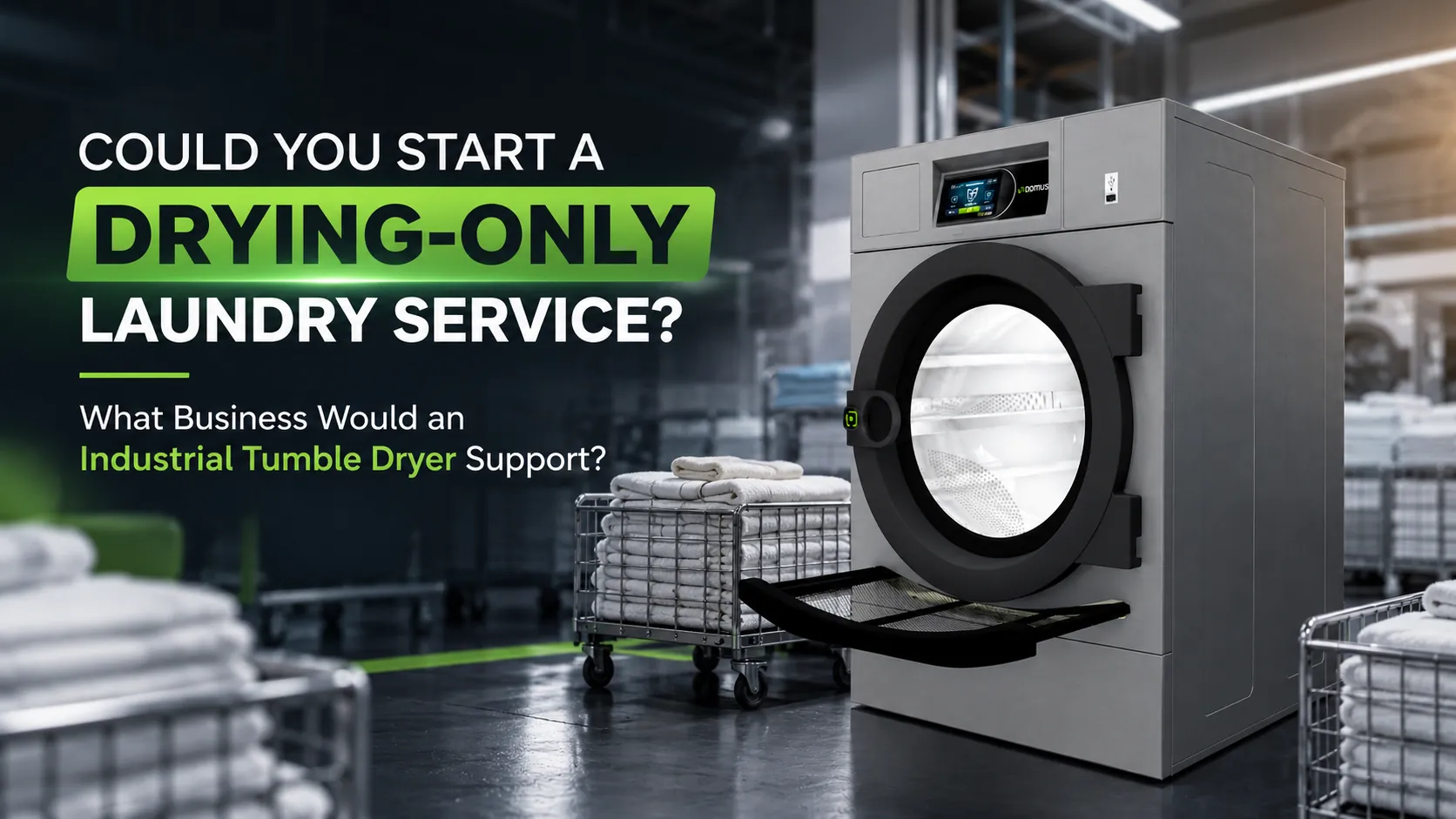
Starting a laundry business does not always mean offering washing, drying, ironing, and garment care from day one. In some markets, there may be an opportunity to focus on one specific processing need: professional drying.
A drying-only service could support laundries or businesses that already wash textiles but struggle with drying space, slow turnaround, or temporary increases in volume. An industrial tumble dryer can become the core equipment in this model, but the opportunity depends on local demand, operating costs, textile types, and how consistently the machine can be utilized.
Before investing, it is important to understand who would pay for drying capacity and whether the numbers make sense for your market.
What Is a Drying-Only Laundry Service?
A drying-only laundry service focuses on receiving textiles that have already been washed and extracted, processing them through a dryer, and returning them ready for the next stage.
A simple workflow could look like:
Receive wet textiles → Sort → Dry → Check → Fold/Pack → Dispatch
Instead of building a complete laundry plant immediately, an entrepreneur could build the service around drying capacity.
Potential customers may include small laundries without sufficient drying equipment, businesses with limited drying space, or commercial operators experiencing temporary capacity shortages.
However, the business depends heavily on logistics. Wet textiles are heavier and need timely handling, so collection distance, transport time and turnaround commitments should be considered before deciding whether the model is practical.
Who Could Need an Industrial Tumble Dryer Service?
The first question should not be, “Which dryer should I buy?” It should be:
“Who around me regularly needs more drying capacity?”
Possible customer groups could include:
Small commercial laundries: A laundry may have enough washing capacity but insufficient dryer capacity, particularly during busy periods.
Hotels and hospitality businesses: Properties processing linen internally may occasionally need additional drying support when volumes increase or existing equipment cannot keep pace.
Gyms, spas and salons: Towels can create recurring laundry volumes, making turnaround important for daily operations.
Restaurants and catering businesses: Depending on their textile requirements, they may process items such as kitchen cloths, napkins and other washable textiles.
Linen and textile service providers: Businesses already handling collection, washing or linen supply could potentially require additional drying capacity.
Before buying an industrial laundry dryer, speak with prospective customers and understand their actual requirements. Potential demand is not the same as confirmed business.
Ask how many kilograms they process, how often they need outside support, which textiles they handle and what turnaround they expect.
Why Would a Business Outsource Drying Instead of Buying Its Own Dryer?
If another business can purchase a commercial tumble dryer, why would it pay someone else to dry its textiles?
That is the central business question.
One reason may be volume. A small laundry could have enough work to require mechanical drying occasionally but not enough consistent demand to justify investing in additional equipment.
Space can also be a constraint. Adding a commercial laundry dryer requires more than finding an empty corner. The selected machine may have specific electrical, ventilation, gas, steam or other installation requirements depending on its design and heating system.
Seasonal and peak-period demand can create another opportunity. A laundry's normal equipment capacity may work well most of the year but become a bottleneck during unusually busy periods.
For a drying-only operator, these problems can represent potential demand—but only if enough customers experience them frequently enough to support the business.
What Industrial Tumble Dryer Capacity Would the Business Need?
Choosing industrial tumble dryer capacity should begin with expected processing volume rather than the largest machine available.
For example, suppose prospective customers indicate that they could collectively send around 200 kg of wet textiles per working day. That does not automatically mean you should purchase a 200 kg machine.
You need to determine how that daily volume will be divided into practical loads and how many cycles can realistically be completed during productive operating hours.
A useful starting calculation is:
Required loads per day = Expected daily drying volume ÷ Practical average load per cycle
Then consider:
- Textile type and bulk
- Moisture remaining after extraction
- Expected drying time
- Required final moisture level
- Productive operating hours
- Peak-day demand
- Loading and unloading time
- Sorting requirements
- Manufacturer-recommended loading conditions
Two businesses processing the same kilograms per day may still require different dryer configurations.
Towels, sheets, uniforms and other textiles do not necessarily behave identically during drying. That is why dryer selection should consider the actual textile mix instead of relying only on the machine's nameplate capacity.
Industrial Tumble Dryer Price: What Should You Calculate Before Investing?
Searching for industrial tumble dryer price is useful, but equipment price is only one part of the investment decision.
A better calculation is:
Total setup investment = Dryer cost + Site preparation + Installation + Required utilities + Supporting infrastructure
Operating expenses matter as well.
Depending on the specific industrial dryer machine, expenses may include electricity, gas or steam, labour, maintenance, transportation and the cost of the space being used.
This becomes particularly important in a drying-only model because the dryer is directly responsible for generating the service revenue.
If the machine remains idle for long periods, the business may struggle to justify the investment even if the equipment itself performs well.
Before investing, estimate three numbers:
Expected daily KG → Average charge per KG/load → Expected machine utilisation
Do not build projections only around maximum capacity. Use realistic customer commitments and practical operating conditions.
Commercial Tumble Dryer vs Industrial Tumble Dryer: What Does Your Business Need?
The terms commercial dryer machine, industrial clothes dryer and industrial tumble dryer are sometimes used broadly when buyers search for professional laundry equipment.
Instead of choosing based only on terminology, evaluate the actual operating requirement.
A smaller operation may need a commercial dryer suitable for its expected daily workload, while a higher-volume processing unit may require equipment designed around longer operating hours and greater throughput.
Compare factors such as:
Capacity: How much can be processed practically per cycle?
Heating system: What heating options are available for the specific model, and which utilities are available at your site?
Cycle requirements: How do your textile types affect drying time?
Daily throughput: How many kilograms must be processed within your operating window?
Installation: What ventilation, electrical supply and other utilities does the selected model require?
Service support: How will maintenance and downtime be handled?
A machine that appears economical initially may not necessarily be the right commercial laundry dryer if it creates a bottleneck as volumes increase.
Could a Drying-Only Service Grow Into a Larger Laundry Business?
Potentially, yes.
Drying could be an entry point rather than the final business model.
Once the business develops a customer base and understands local textile volumes, it may identify demand for additional processing stages.
For example:
Drying only → Washing + drying → Finishing → Complete textile processing
Expansion should follow proven demand rather than assumptions.
If customers repeatedly ask you to take responsibility for washing as well as drying, that is more meaningful than purchasing additional equipment simply because you expect the business to grow.
The same principle applies when adding another industrial tumble dryer. First understand whether existing dryer capacity is consistently becoming a bottleneck.
How Orgaearth Can Help
Planning a drying operation involves more than selecting a dryer from a catalogue.
OrgaEarth Laundry Solutions can help businesses evaluate their laundry requirements based on expected processing volume, textile type, available space, utilities and planned workflow.
Depending on the project requirements, the discussion can cover commercial tumble dryer and industrial dryer selection, capacity planning, laundry equipment configuration, installation considerations and related laundry setup requirements.
For entrepreneurs planning to expand beyond drying, OrgaEarth can also help evaluate washing, drying and finishing equipment as part of a broader commercial laundry setup.
The objective should be to select equipment around the business requirement—not build the business around a machine that has already been purchased.
Conclusion
A drying-only laundry service is an interesting business model, but owning an industrial tumble dryer does not create demand by itself.
Start by identifying businesses that regularly face drying limitations. Estimate their actual daily or weekly volume, understand the textiles being processed and calculate how consistently they could use your service.
Only then should you evaluate industrial tumble dryer capacity, equipment price, utilities and operating costs.
If the demand is consistent and the workflow is practical, professional drying could become a focused service on its own—or the first stage of a larger commercial laundry operation.
Contact Us:
Orgaearth Laundry Solutions
Plot no. 774, Udyog Vihar, Phase 5, Gurugram, Haryana, India-122016
Email: marketing@orgaearth.com
Contact No.- +91 7042912777
Views: 1 · 30s+ reads: 0