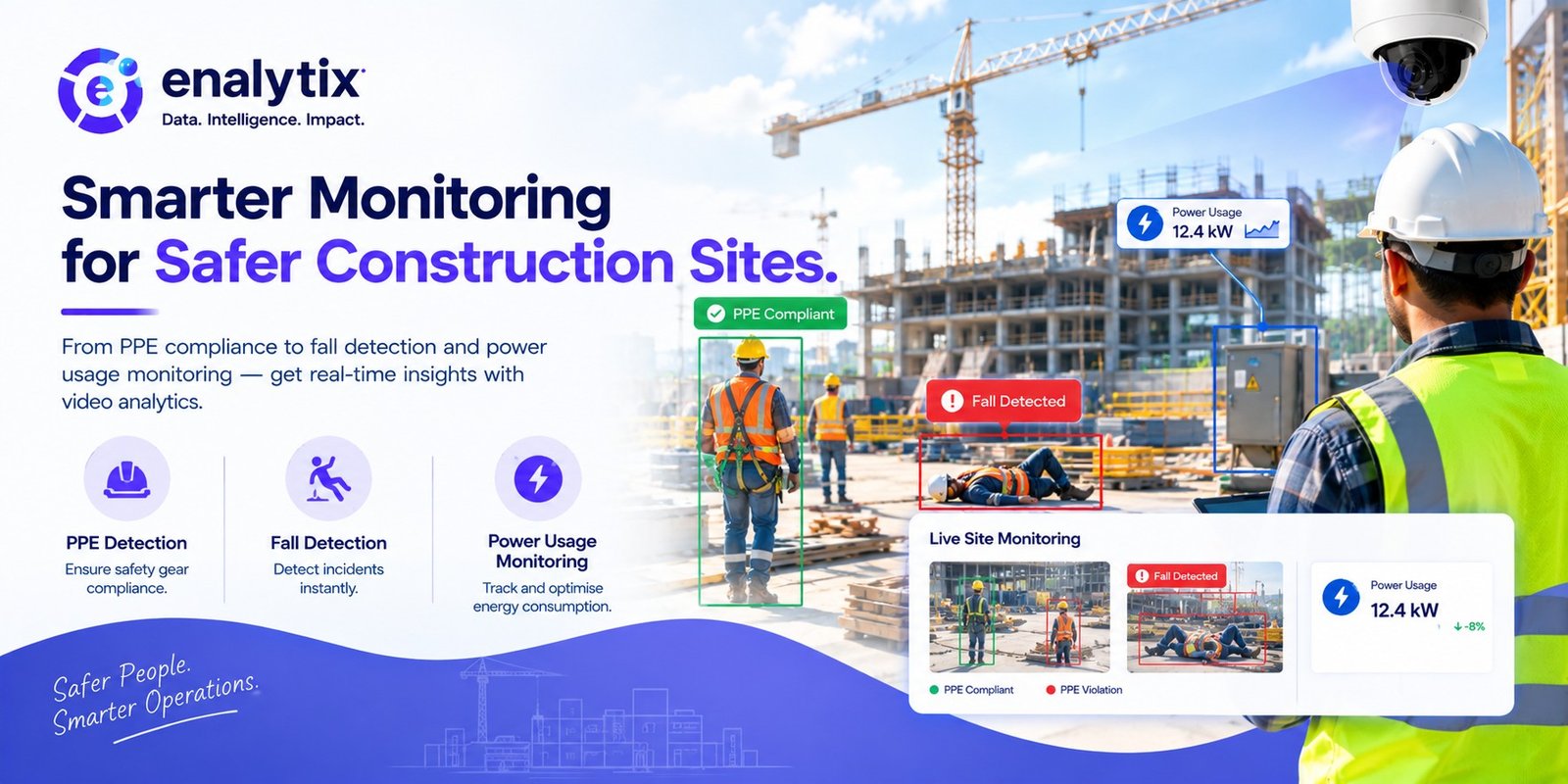
How Video Analytics Is Improving Safety and Efficiency on Construction Sites
Construction sites are among the most dynamic and challenging working environments. Workers, vehicles, heavy machinery, tools and construction materials are constantly moving across different areas, while safety teams need to monitor multiple activities at the same time. Maintaining safety and operational efficiency becomes increasingly difficult as construction projects grow larger and more complex.
Traditional safety inspections and CCTV surveillance provide valuable visibility, but they often depend on someone actively monitoring camera feeds or reviewing recorded footage after an incident has already occurred. This can make it difficult to identify every potential safety issue in real time.
Construction video analytics is changing this approach by turning existing camera footage into useful, actionable information. Instead of using cameras only for recording, organisations can use intelligent video analysis to identify specific events, detect potential risks and provide additional visibility to safety and operations teams.
Making PPE Compliance Easier to Monitor
Personal protective equipment (PPE) is an essential part of construction-site safety. Depending on the type of work and location, workers may be required to wear helmets, safety vests, gloves, safety shoes, protective eyewear or harnesses.
One of the biggest challenges is ensuring that PPE requirements are followed consistently throughout the working day. Manual inspections can identify problems, but safety personnel cannot physically monitor every worker and every area continuously.
With PPE Detection, video analytics can analyse camera feeds and identify situations where required protective equipment may appear to be missing. For example, the system can help identify workers who may not be wearing a helmet or safety vest in areas where such equipment is required.
This technology does not replace safety supervisors or established safety procedures. Instead, it provides an additional source of information that can help safety teams identify areas that may require attention.
By providing automated monitoring across selected camera views, PPE Detection can also help organisations improve visibility across large or busy work zones where continuous manual observation may be difficult.
Faster Awareness of Potential Falls
Falls are another significant safety concern in construction environments. Workers may operate near elevated platforms, scaffolding, temporary structures, stairs, ladders, rooftops and other areas where a fall could result in serious injury.
Fall Detection uses video analysis to identify visual patterns that may be associated with a potential fall. When the system detects a possible event, an alert can help the responsible team investigate the situation more quickly.
The value of this technology becomes particularly apparent on large construction projects. A safety team may be responsible for several floors, work zones or buildings at the same time, making continuous physical observation impossible.
Video-based detection can provide an additional layer of awareness by helping teams identify potential incidents in monitored areas. Once an alert is generated, trained personnel can verify the situation and follow the site's established emergency or response procedures.
It is important to view automated detection as a support mechanism rather than a replacement for human judgement. Human verification, site-specific procedures and professional safety practices remain essential.
Understanding Construction Site Power Consumption
Safety is not the only area where monitoring technology can improve construction-site operations. Energy management is also becoming increasingly important.
Construction sites can consume significant amounts of electricity through heavy machinery, lighting systems, temporary offices, power tools, HVAC equipment and other electrical infrastructure. When consumption is not properly monitored, it can be difficult to determine where energy is being used or why consumption changes from one period to another.
A Power Usage Monitoring Device can provide information about electricity consumption across different equipment, circuits or areas. This information can help project teams understand usage patterns and investigate unusual or unnecessary consumption.
For example, if electricity usage remains high in an area after working hours, the available data may encourage the operations team to investigate whether equipment, lighting or other electrical systems have been left running unnecessarily.
Better visibility into energy consumption can support operational planning, equipment management and efforts to reduce avoidable energy use. It can also help construction companies make decisions based on actual usage data rather than assumptions.
Moving Beyond Traditional CCTV
CCTV has traditionally been used primarily as a security and recording system. Cameras provide a visual record that can be reviewed when an incident occurs or when a specific situation needs to be investigated.
While this remains useful, traditional CCTV has an important limitation: large amounts of footage can be difficult and time-consuming for people to monitor continuously.
Video analytics adds an intelligent analysis layer to this existing infrastructure.
Instead of waiting until an incident has occurred and then searching through hours of footage, teams can use automated analysis to identify predefined events or conditions that deserve attention. PPE compliance, potential falls, restricted-area activity and other site conditions can become measurable events rather than observations hidden inside large volumes of video.
This can be particularly valuable for large construction projects where dozens or even hundreds of cameras may be installed across different areas.
Supporting a More Data-Driven Construction Site
The objective of construction video analytics is not to eliminate existing safety processes. Construction companies still need regular inspections, safety policies, trained supervisors, worker education, risk assessments and established emergency procedures.
Instead, analytics can provide an additional layer of visibility that complements these practices.
When technologies such as PPE Detection, Fall Detection and power usage monitoring are combined with existing surveillance infrastructure, construction companies can make more relevant information available to the people responsible for safety and operations.
This can help teams focus their attention on areas that may require investigation instead of relying exclusively on random inspections or reviewing footage after an incident.
Improving Operational Efficiency
Construction video analytics can also contribute to operational efficiency beyond immediate safety monitoring. Construction projects involve multiple teams, contractors, vehicles and equipment working according to schedules and site requirements.
Automated video analysis can help organisations gain a clearer understanding of what is happening across monitored areas. Depending on the system and its configuration, analytics can be used to identify specific activities, events or conditions that are relevant to the project.
This additional visibility can support better coordination between safety and operations teams. When information is available in a structured form, managers can spend less time searching through large amounts of footage and more time responding to situations that require human attention.
Using Existing Infrastructure More Effectively
One of the advantages of video analytics is that organisations may be able to build on their existing camera infrastructure rather than completely replacing their surveillance systems.
Many construction sites already have CCTV cameras installed for security, monitoring and documentation purposes. Adding an analytics layer can potentially make those cameras more useful for operational and safety-related applications.
Solutions such as those offered by Enalytix are designed to use video intelligence to support construction-site monitoring while working with existing surveillance infrastructure.
The exact capabilities and results depend on camera placement, lighting, environmental conditions, system configuration and the specific analytics being used. For this reason, video analytics should be implemented as part of a broader safety and operational strategy.
The Future of Construction Site Monitoring
As construction projects become larger and more complex, organisations need better ways to understand what is happening across their sites. Manual supervision and traditional CCTV remain important, but automated analytics can provide another layer of information.
From PPE Detection and Fall Detection to energy monitoring through a Power Usage Monitoring Device, technology can help transform everyday site activity into useful operational data.
The goal is not simply to install more cameras. It is to make existing and new surveillance infrastructure more useful by converting visual information into events, alerts and insights that responsible teams can investigate.
By combining technology with trained professionals, established safety procedures and effective site management, construction companies can work toward a more visible, data-driven approach to safety and operations.
As video intelligence continues to develop, construction organisations may increasingly use these technologies to monitor risks, improve awareness, support energy management and make better-informed operational decisions.
Source: Enalytix Construction Solutions – Video intelligence for construction safety and operational monitoring.
Keywords: PPE Detection, Fall Detection, Power Usage Monitoring Device, construction site safety, construction video analytics, construction safety monitoring
Views: 8 · 30s+ reads: 0