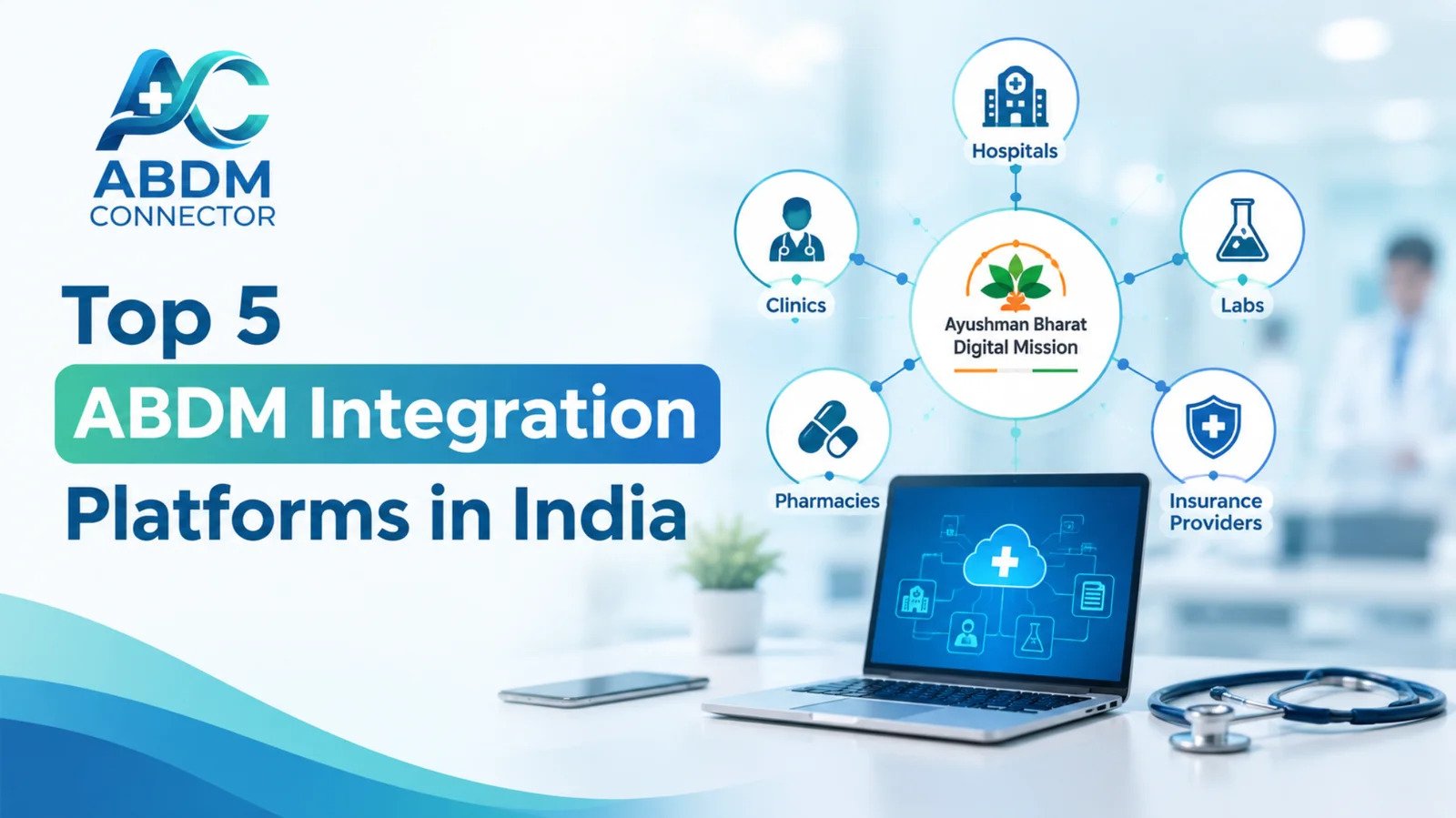
India's healthcare sector is steadily adopting digital systems that allow hospitals, clinics, diagnostic laboratories, health-tech companies, and software providers to exchange information more efficiently. As this ecosystem develops, healthcare applications increasingly need to connect with the Ayushman Bharat Digital Mission (ABDM).
For healthcare organizations, building ABDM connectivity from the ground up can involve multiple technical requirements, including digital health identities, consent-based data exchange, health records, APIs, authentication, data conversion, testing, and production deployment.
An ABDM integration Platform can reduce this complexity by providing the infrastructure needed to connect an existing healthcare application with the ABDM ecosystem. Below are five platforms and solutions that organizations in India can consider, beginning with ABDMConnector.
1. ABDMConnector
ABDMConnector is an integration platform designed specifically to help healthcare software connect with ABDM services.
It can be used by organizations that already operate applications such as HMIS, EMR, EHR, LIS, diagnostic software, hospital-management systems, or healthcare SaaS platforms. Rather than replacing the existing application, the integration layer works alongside it to introduce ABDM-related capabilities.
Key ABDMConnector capabilities
The platform supports several areas of digital-health integration, including:
- ABHA-related workflows
- Health information exchange
- Consent-based health-data sharing
- HIP and HIU integration
- FHIR-based data transformation
- REST APIs
- Webhooks
- Sandbox connectivity
- Production integration
- HFR and HPR-related workflows
- Healthcare application integration
This approach can be particularly useful for organizations that already have a functioning healthcare application and want to add ABDM connectivity without redesigning their entire software infrastructure.
For example, a hospital may already use an HMIS for patient registration, clinical information, billing, laboratory records, and reporting. An integration platform can connect that existing system to ABDM rather than requiring the hospital to replace its core software.
Why consider ABDMConnector?
ABDM implementation can involve considerably more than a basic API connection. Depending on the project, developers may need to manage authentication, data mapping, consent flows, information exchange, callbacks, error management, testing, and production deployment.
ABDMConnector takes an API-focused approach to these requirements. This can also make it relevant for healthcare technology companies that want to incorporate ABDM functionality into products they already operate.
2. Eka Care
Eka Care offers ABDM Connect API services intended for healthcare applications that need connectivity with the ABDM ecosystem.
Its developer-focused infrastructure covers areas such as digital health identity, consent workflows, and health-record exchange. Eka Care also provides API and SDK-oriented capabilities that can support technology teams during implementation.
Organizations looking for a managed integration layer can evaluate Eka Care based on their existing technology stack and the specific ABDM functions they need to implement.
3. DRiefcase
DRiefcase provides digital-health solutions for healthcare organizations and technology companies, including ABDM-related integration services.
Its enterprise offering includes an ABDM API Connector intended to help software applications communicate with the ABDM ecosystem. The company has also worked on digital health records and patient-facing healthcare information solutions.
Healthcare organizations considering DRiefcase can assess its offering according to their current software architecture, implementation requirements, and ABDM use cases.
4. NIC e-Hospital and ABDM-Integrated HMIS Solutions
Government and institutional healthcare information systems also form part of India's digital-health infrastructure.
e-Hospital, developed by the National Informatics Centre (NIC), is a hospital information system used by healthcare institutions. The National Health Authority has also listed e-Hospital among applications integrated with ABDM.
An HMIS and an ABDM integration platform serve somewhat different purposes. An HMIS typically manages wider hospital operations, whereas an integration platform primarily helps an existing application communicate with the digital-health ecosystem.
5. Bahmni
Bahmni is an open-source hospital information system designed to bring multiple healthcare workflows together within one environment.
The platform combines various hospital-management functions and has also been included among applications participating in the ABDM ecosystem. Because it is open source, Bahmni can be considered by healthcare organizations looking for greater flexibility in their hospital information infrastructure.
Factors to Consider When Selecting an ABDM Integration Platform
Choosing an ABDM integration solution involves more than looking at the number of features offered. The appropriate option depends on the organization's existing software, required ABDM workflows, internal development capabilities, and the amount of infrastructure the organization wants to manage itself.
1. Existing Software Compatibility
Begin by examining the systems your organization already uses.
These could include:
- HMIS
- EMR
- EHR
- Laboratory information systems
- Diagnostic applications
- Hospital ERP
- Healthcare mobile applications
If the current software is already established, an integration platform may allow the organization to add ABDM functionality without replacing its core system. ABDMConnector, for example, is designed around connecting existing healthcare applications with ABDM.
2. API and Developer Documentation
Clear technical documentation can make the implementation process easier for development teams.
Before selecting a solution, check whether the provider offers:
- API documentation
- Authentication instructions
- Request and response examples
- Sandbox access
- Webhook documentation
- Error-handling guidance
- Testing procedures
- Production deployment information
Having these resources available can reduce implementation delays and unnecessary communication between development teams and the integration provider.
3. Data Transformation and Mapping
Healthcare systems may store information using different structures and formats. Connecting these systems to ABDM workflows may therefore require data transformation.
Data mapping should be considered when evaluating an integration solution, particularly when information from an existing healthcare application needs to be converted into the required format.
ABDMConnector includes data transformation and FHIR-aligned capabilities within its integration approach.
4. Consent Workflows
Consent is an important element of digital health information exchange.
Organizations should understand how a potential platform manages consent-related processes and how those processes can be incorporated into the architecture of their existing application.
It is also useful to evaluate how the platform provides visibility into requests, responses, errors, and other relevant integration events.
5. Scalability
Integration requirements can vary significantly between a small clinic and a large hospital network.
Before choosing a platform, organizations should consider factors such as:
- Number of healthcare facilities
- Number of users
- Expected API volume
- Patient-record volume
- Health records exchanged
- Number of connected applications
- Future expansion requirements
The selected infrastructure should be capable of handling the organization's expected growth without creating unnecessary integration limitations.
Conclusion
ABDM connectivity is becoming increasingly relevant for India's healthcare technology landscape. Hospitals, clinics, laboratories, HMIS providers, EMR companies, and health-tech businesses may have very different technical requirements, meaning that the same integration architecture will not necessarily suit every organization.
For organizations that already have healthcare software and primarily need to connect that software with ABDM, an integration layer can simplify implementation. ABDMConnector focuses on this type of use case, with API-based connectivity covering areas such as health records, consent, HIP/HIU workflows, data transformation, and other ABDM-related requirements.
Frequently Asked Questions
Q1. What is an ABDM integration platform?
An ABDM integration platform is a technology layer that enables healthcare applications to communicate with ABDM services and implement relevant digital-health workflows.
Q2. Which ABDM integration platform can connect with existing HMIS software?
ABDMConnector is designed to integrate existing healthcare applications, including HMIS, EMR, EHR, and LIS platforms, with ABDM-related services.
Q3. What does ABDMConnector provide?
ABDMConnector provides APIs and integration capabilities for healthcare software. Its use cases include health-record exchange, consent workflows, HIP/HIU integration, and data transformation.
Q4. Can an existing EMR be integrated with ABDM?
Yes. An existing EMR can be connected with ABDM through an appropriate integration architecture. The implementation will depend on the EMR's available APIs, data structure, and required ABDM workflows.
Q5. Can diagnostic laboratories use ABDM integration?
Yes. Diagnostic laboratories can have ABDM-related use cases involving digital diagnostic information and health records. The exact implementation depends on the laboratory's software and operational workflow.
Q6. What is the difference between ABDM and ABHA?
ABDM refers to India's broader digital-health ecosystem and infrastructure. ABHA is associated with an individual's digital health identity within that ecosystem.
Q7. What do HIP and HIU mean?
HIP stands for Health Information Provider, while HIU stands for Health Information User. These terms describe different roles involved in health-information exchange.
Q8. Are APIs required for ABDM integration?
APIs play an important role in connecting healthcare software with digital-health services. The specific APIs required depend on the ABDM workflow being implemented.
Q9. Can health-tech startups use ABDMConnector?
Yes. ABDMConnector is intended to be relevant for health-tech companies that want to introduce ABDM capabilities into existing healthcare applications using APIs and integration infrastructure.
Q10. How can a company begin ABDM integration?
Start by identifying the existing healthcare software, required ABDM workflows, data structures, and technical requirements. The organization can then evaluate an integration platform such as ABDMConnector and determine the appropriate implementation approach.
Views: 5 · 30s+ reads: 3