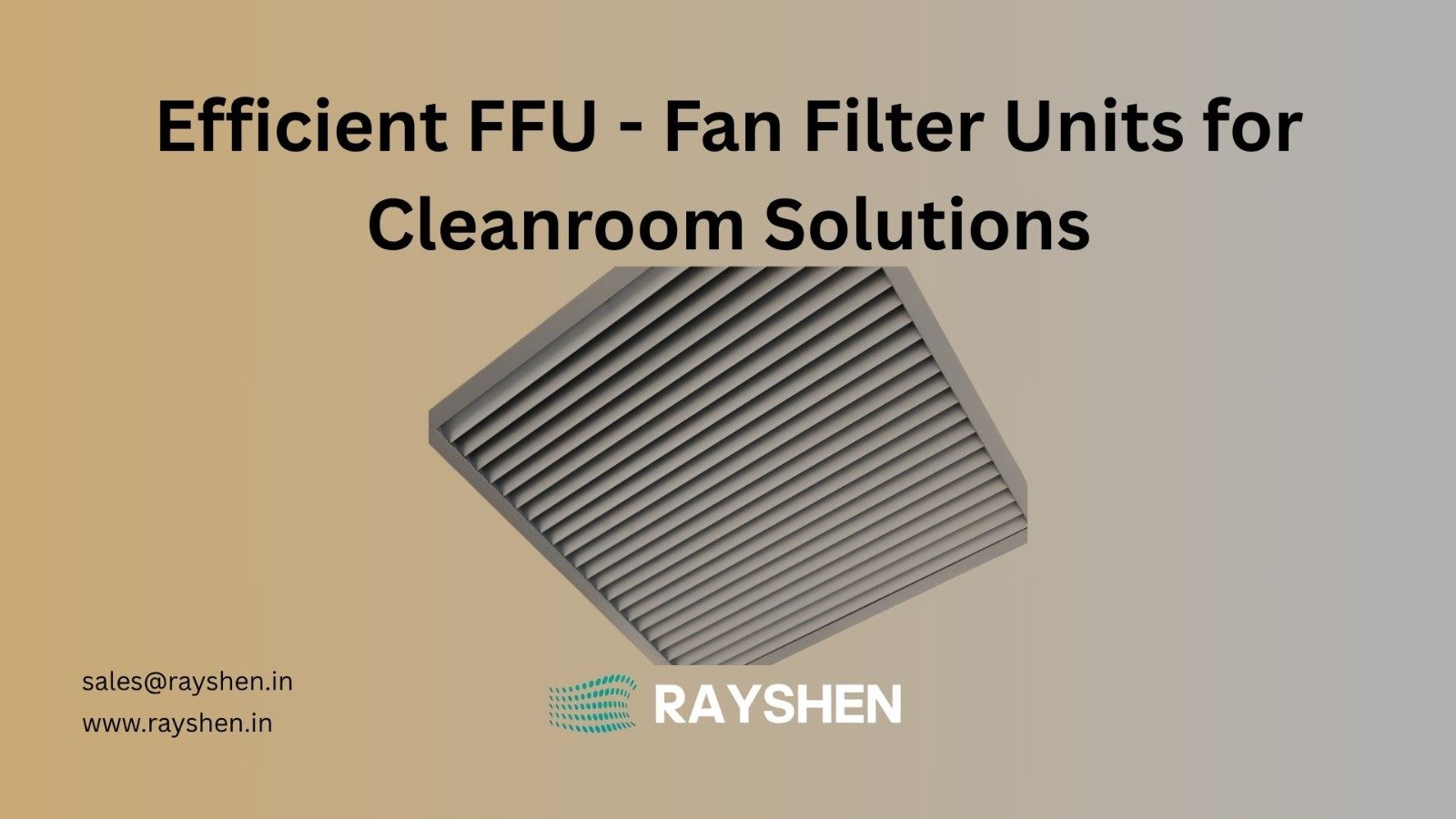
Clean rooms are the backbone of industries where even the tiniest particle can cause massive damage — from semiconductor manufacturing to pharmaceutical production. Maintaining a controlled, particle-free environment requires a precise balance of airflow, filtration, and pressure control. At the center of this system lies one critical component — the FFU, or Fan Filter Unit.
At Rayshen, we design advanced FFUs that ensure clean rooms maintain the highest standards of air purity, efficiency, and reliability. Let’s explore why FFUs truly are the heart of every clean room’s air filtration system — and how they work to keep your controlled environment performing flawlessly.
What Is an FFU (Fan Filter Unit)?
An FFU is an integrated air filtration system that combines a fan and a HEPA (High-Efficiency Particulate Air) or ULPA (Ultra-Low Penetration Air) filter within a single housing. Installed in the ceiling grid of a clean room, each FFU draws in contaminated air from the plenum, filters it, and delivers clean, laminar airflow directly into the workspace.
Unlike centralized HVAC systems, FFUs operate independently and can be easily configured to meet specific clean room requirements. This modular design makes them ideal for scalable clean room installations — from small laboratories to large manufacturing facilities.
How FFUs Work: The Science of Clean Air
The operation of an FFU may seem simple, but it involves sophisticated engineering to ensure consistent performance. Here’s how the process works step by step:
- Air Intake:
The fan inside the unit draws in air from the space above the ceiling (return plenum) or through ducted connections.
- Filtration Process:
The air passes through a HEPA or ULPA filter, which removes 99.97% (or more) of particles as small as 0.3 microns — including dust, bacteria, and aerosols.
- Laminar Airflow Delivery:
The cleaned air is then discharged evenly at a constant velocity, usually between 0.45 and 0.55 m/s, creating a laminar (unidirectional) flow across the clean room workspace.
- Contaminant Control:
This continuous flow pushes airborne contaminants downward and away from critical areas, maintaining cleanliness levels as per ISO or GMP standards.
By using multiple FFUs across the clean room ceiling, the system ensures uniform air quality and pressure throughout the environment — minimizing the risk of contamination.
Key Components of an FFU
Every FFU is a compact powerhouse of air purification technology. Its core components include:
- Fan Motor Assembly:
Provides the suction and pressure needed to move air through the filter. Rayshen FFUs feature energy-efficient, low-noise motors.
- HEPA / ULPA Filter:
Captures microscopic particles, ensuring clean and particle-free air delivery.
- Diffuser Plate:
Ensures laminar airflow distribution across the clean room area.
- Casing or Housing:
Built with durable, corrosion-resistant materials like aluminum or powder-coated steel for longevity and hygiene.
- Speed Controller or ECM Control:
Allows users to adjust fan speed and airflow volume for precise control.
- Optional Pre-Filters:
Extend the life of the main filter by capturing larger particles before HEPA filtration.
Each Rayshen FFU integrates these components with precision, ensuring dependable performance, quiet operation, and long-term energy savings.
Why FFUs Are the Heart of Every Clean Room
FFUs play a central role in maintaining clean room performance. Here’s why they are considered the core component of modern clean room air filtration systems:
1. Independent Air Filtration and Control
Each FFU operates autonomously, allowing precise airflow management in different zones. This modular flexibility makes it easier to expand or reconfigure clean rooms without overhauling the entire ventilation system.
2. Uniform Laminar Airflow
Consistent laminar airflow is essential for pushing contaminants away from sensitive areas. FFUs deliver uniform air velocity across the clean room, ensuring stable pressure and cleanliness.
3. Energy Efficiency
Modern FFUs, like those from Rayshen, are engineered for energy optimization. By using high-efficiency motors and variable speed controls, they minimize power consumption while maintaining ISO-class air purity.
4. Reduced Contamination Risk
Because FFUs continuously supply filtered air directly to the working environment, they create positive pressure that prevents unfiltered air from entering. This is crucial for sectors like pharmaceuticals, semiconductors, and biotechnology.
5. Scalability and Ease of Maintenance
Need to expand your clean room? Simply add more FFUs. Maintenance is equally simple — individual units can be serviced or replaced without disrupting overall operations.
Applications of FFUs in Clean Rooms
The versatility of FFUs makes them essential across numerous industries:
- Pharmaceuticals & Biotechnology:
Ensuring sterile environments for drug production and laboratory research.
- Semiconductors & Electronics:
Maintaining dust-free conditions for wafer fabrication and electronic assembly.
- Healthcare & Hospitals:
Protecting patients and medical equipment from airborne contaminants.
- Food & Beverage Industry:
Maintaining hygiene during production and packaging.
- Aerospace & Optics Manufacturing:
Providing ultra-clean environments for precision engineering.
Each Rayshen FFU is designed to meet specific industry requirements, offering customizable air volumes, filtration grades, and housing materials.
Rayshen FFUs: Precision, Performance, and Reliability
At Rayshen, we understand that clean room performance depends on consistent air purity. Our FFUs are designed with advanced engineering and high-quality components to deliver exceptional filtration, quiet operation, and long-term reliability.
Features of Rayshen FFUs:
- HEPA / ULPA filters with 99.97%+ efficiency
- Low-noise, high-performance EC motors
- Modular and scalable design
- Energy-efficient operation
- Easy installation and maintenance
- Durable, corrosion-resistant construction
Every Rayshen FFU undergoes rigorous testing to ensure compliance with international clean room standards and client specifications.
Maintenance and Best Practices for FFUs
To keep your FFUs performing efficiently, regular maintenance is key:
- Inspect and replace filters periodically based on pressure drop readings.
- Clean fan blades and housings to maintain airflow efficiency.
- Monitor air velocity to ensure laminar flow consistency.
- Check electrical connections and controls for safe operation.
- Schedule preventive maintenance with certified service providers.
Rayshen also offers professional maintenance support to help clients sustain optimal clean room performance year after year.
Conclusion
The FFU is more than just a piece of equipment — it’s the heartbeat of a clean room. By providing constant, filtered, and uniform airflow, FFUs ensure that your workspace remains pure, compliant, and efficient.
With Rayshen’s FFU solutions, you get the perfect balance of engineering precision, energy efficiency, and reliability — keeping your clean room running at peak performance while safeguarding your products and processes from contamination.
Views: 25 · 30s+ reads: 2