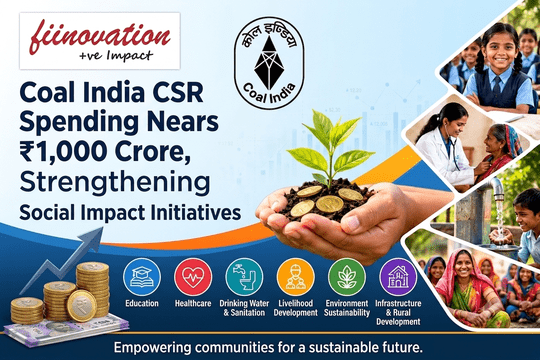
Corporate Social Responsibility (CSR) continues to play an important role in supporting community development across India, particularly in regions associated with large-scale industrial and mining activities. Fiinovation News highlights the latest developments in the CSR sector , including the growing CSR spending of Coal India Limited and its efforts to strengthen social impact initiatives across communities.
Coal India Limited, one of India’s major public sector enterprises, has continued to expand its contribution towards CSR projects , community development and social welfare programs. Its annual CSR expenditure is approaching the significant ₹1,000 crore mark, reflecting the scale of social investment associated with the country’s coal sector. The development has renewed attention on how large public sector companies can use CSR funding to address community needs and create measurable social outcomes.
Coal India’s Growing CSR Contribution
Coal India’s CSR activities cover a wide range of development areas, including education, healthcare, sanitation, drinking water, livelihood development, rural infrastructure, skill development and environmental sustainability. These initiatives are particularly relevant in communities located around mining and operational areas where corporate social investment can contribute to local development.
The company’s increasing CSR expenditure demonstrates the importance of structured CSR planning and responsible utilization of funds. Rather than viewing CSR only as a regulatory requirement, companies are increasingly focusing on programs that can generate long-term benefits for communities.
For organizations operating in resource-intensive sectors, CSR can provide an important framework for addressing social and environmental priorities while building stronger relationships with local stakeholders.
CSR and Community Development
CSR spending has become an important component of India's broader development ecosystem. Companies across sectors are supporting programs designed to improve access to essential services and create opportunities for underserved communities.
Coal India’s CSR initiatives are significant because of the geographical footprint of its operations. Mining communities often have diverse development requirements, including access to healthcare facilities, quality education, sanitation infrastructure, clean drinking water and employment-oriented skills.
Well-planned CSR programs in India can help bridge some of these development gaps by bringing together corporate resources, implementing agencies, government institutions and local communities.
Effective implementation, however, requires more than financial expenditure. CSR projects need appropriate planning, baseline assessment, stakeholder consultation, monitoring and impact evaluation to understand whether interventions are delivering meaningful outcomes.
Focus Areas of Coal India CSR Initiatives
Coal India’s CSR activities have supported several key development sectors. Education and skill development remain important areas because improving access to learning and vocational opportunities can contribute to long-term economic and social development.
Healthcare is another major component of corporate social investment. CSR supported healthcare programs can help improve access to medical services, awareness initiatives and preventive healthcare, particularly in underserved areas.
Sanitation and drinking water initiatives also have a direct connection with community well-being. Investments in toilets, water infrastructure and hygiene awareness can contribute to healthier living conditions and improved quality of life.
Livelihood development and skill-building programs can further support economic participation by helping individuals acquire employable skills and income-generating capabilities.
Environmental sustainability is another important area for companies operating in sectors that have a significant interaction with natural resources. CSR and sustainability programs can support activities such as environmental awareness, water conservation, plantation drives and community-based environmental initiatives.
From CSR Spending to Measurable Impact
The growth in CSR expenditure also raises an important question: how effectively are funds being converted into measurable social impact?
For CSR stakeholders, the focus is increasingly shifting from CSR spending to CSR outcomes. Financial allocation is an important starting point, but the effectiveness of a program depends on how well it responds to community needs and whether its results can be monitored over time.
A structured CSR impact assessment can help organizations evaluate program performance, beneficiary reach, outcome indicators and sustainability. Baseline, midline and end line assessments can provide useful information about changes generated through an intervention.
Monitoring and evaluation also help CSR teams identify implementation challenges and make evidence-based improvements. This approach can strengthen transparency and support better decision-making for future CSR investments.
Role of CSR Consulting and Implementation Partners
Large-scale CSR programs often involve multiple stakeholders. Companies may work with NGOs, social organizations, government bodies, academic institutions and specialized implementation partners to deliver projects on the ground.
This is where CSR consulting firms in India can contribute by supporting organizations with CSR strategy, project identification, implementation planning, monitoring and evaluation, impact assessment and reporting.
Professional CSR consultants can also help companies align social investments with community priorities and applicable CSR requirements. A data-driven approach can improve program design and make it easier to track progress against clearly defined objectives.
For NGOs, strong CSR project management and reporting systems can also improve their readiness to partner with corporate organizations and demonstrate the outcomes of their interventions.
Strengthening the Future of CSR in India
The increasing scale of CSR spending by major public sector enterprises highlights the expanding role of corporate participation in India's social development landscape. As CSR budgets grow, there is an opportunity to develop more integrated programs that address education, healthcare, livelihoods, sanitation, environmental sustainability and community infrastructure.
The next phase of CSR is likely to place greater emphasis on impact measurement, transparency, accountability and long-term sustainability. Companies can strengthen their CSR strategies by combining financial resources with community consultation, technology, data and robust monitoring systems.
Coal India’s approach provides an important example of how large-scale corporate resources can be directed towards multiple development priorities. The scale of its CSR expenditure also highlights the importance of ensuring that investments are strategically planned and effectively implemented.
Conclusion
The news that Coal India’s CSR spending is nearing ₹1,000 crore reflects the growing scale of corporate social investment in India. Its focus on areas such as healthcare, education, sanitation, drinking water, livelihood development, skill development and environmental initiatives demonstrates the broad role CSR can play in supporting communities.
As companies increase their CSR allocations , the emphasis should increasingly extend beyond expenditure towards measurable social impact, responsible implementation and sustainable outcomes. Strong partnerships between corporations, NGOs, CSR consultants and communities can help ensure that CSR investments create meaningful and lasting value.
Through Fiinovation News , readers can stay informed about important developments in CSR, sustainability, corporate philanthropy, social impact and community development across India. The evolving CSR landscape reinforces the importance of strategic planning, effective implementation and impact assessment in transforming corporate resources into meaningful social change.
Views: 2 · 30s+ reads: 1