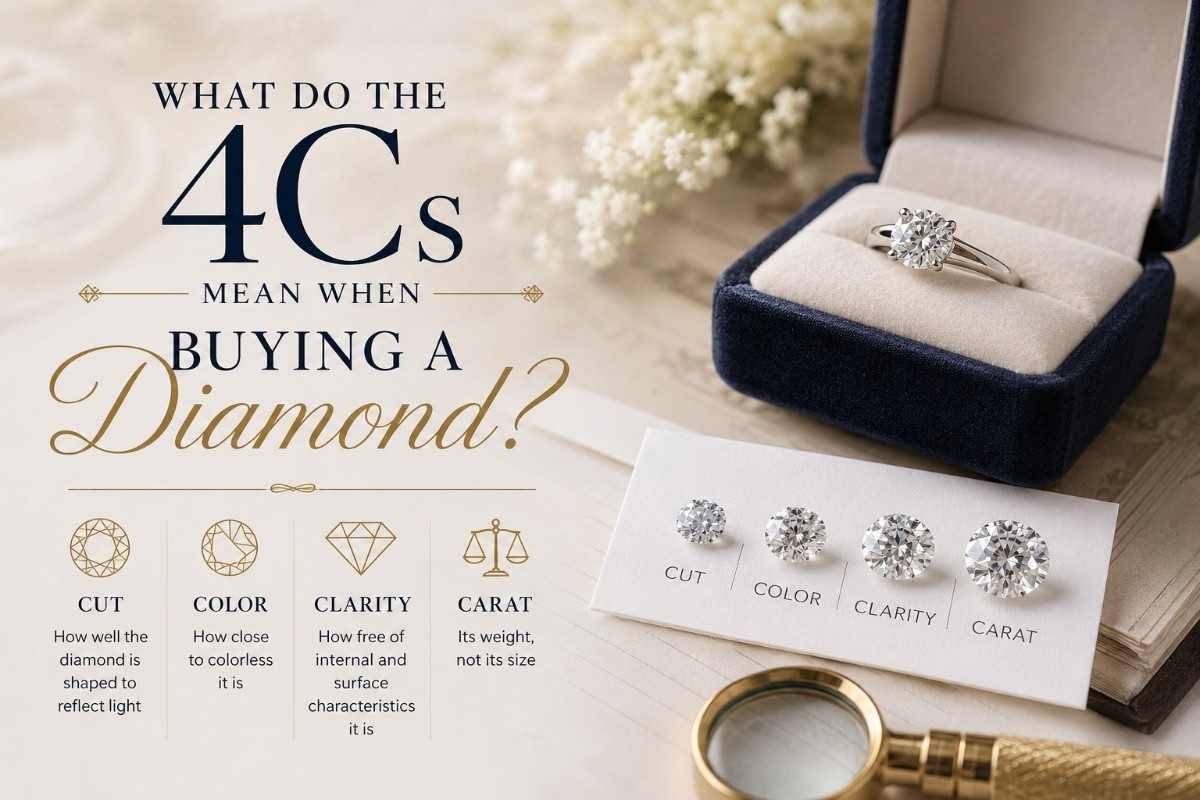
Every diamond guide mentions the 4Cs eventually, usually in passing, assuming you already roughly know what they mean. If you don't, or if the explanation you got somewhere else left out the details that matter, this is the deeper version. Not a quick mention. A genuine, complete breakdown of what cut, color, clarity, and carat measure, how each scale works, and which ones deserve your attention first.
The Short Answer
The 4Cs are the four standardized characteristics used to grade and compare diamonds: cut (how well the stone is shaped to reflect light), color (how close to colorless it is), clarity (how free of internal and surface characteristics it is), and carat (its weight). Cut has the biggest effect on visible brilliance, while carat only measures size, not quality, which is why understanding all four together matters more than focusing on any single one.
Cut: The Most Important C, and the Most Misunderstood
Cut is frequently confused with shape, but they're entirely different things. The shape describes the outline, round, oval, cushion, and so on. Cut describes how precisely that shape was executed, specifically how well the diamond facets are angled and proportioned to reflect light back to the eye.
A diamond cut with excellent proportions returns nearly all the light entering it, creating strong brilliance and fire. A poorly cut diamond, even with excellent color and clarity, leaks light out the sides or bottom and looks noticeably duller as a result.
| Cut Grade | What It Means |
| Excellent / Ideal | Maximizes light return, strongest brilliance and fire |
| Very Good | Slightly less optimal light return, still visually strong |
| Good | Noticeable light leakage begins, reduced sparkle |
| Fair | Significant light leakage, visibly duller appearance |
| Poor | Minimal brilliance regardless of other grades |
If you remember one thing from this entire guide, make it this: cut affects appearance more than any other single factor, including carat weight.
Color: A Quieter Factor with a Real Visual Effect
Color grading measures how close a white diamond is to being completely colorless, using a scale that runs from D to Z. This can be confusing at first, since D doesn't stand for "diamond," it simply starts the scale at the top.
| Color Range | General Appearance |
| D–F | Colorless, no visible tint |
| G–J | Near-colorless, tint typically invisible without comparison |
| K–M | Faint tint, sometimes visible, especially in larger stones |
| N–Z | Noticeable tint, increasingly visible yellow or brown |
Most buyers find diamonds in the G–J range offer strong value, since the tint is essentially invisible to the naked eye in normal settings, while the price is noticeably lower than diamonds graded D–F.
Clarity: What's Actually Being Measured
Clarity describes internal characteristics, called inclusions, and surface characteristics, called blemishes, formed naturally during a diamond's growth. The clarity scale measures how visible these characteristics are under 10x magnification, not necessarily to the naked eye.
| Clarity Grade | What It Means |
| FL / IF | Flawless or internally flawless, no visible inclusions under magnification |
| VVS1 / VVS2 | Very, very slightly included, extremely difficult to detect |
| VS1 / VS2 | Very slightly included, minor inclusions, typically not visible unaided |
| SI1 / SI2 | Slightly included, may be visible under close inspection |
| I1–I3 | Included, often visible to the naked eye, can affect brilliance |
Here's the detail most guides skip: inclusion position matters as much as clarity grade. An inclusion near the edge of a stone is far less noticeable than one sitting directly under the table facet, the flat-top surface, even at the identical clarity grade.
Carat: Weight, Not Size, and Definitely Not Quality
Carat measures a diamond's weight, with one carat equal to 0.2 grams. It's the most commonly discussed of the 4Cs, and also the most misunderstood, since many buyers assume it directly reflects visual size or overall quality.
Neither is entirely true. Two diamonds of identical carat weight can look meaningfully different in size depending on their cut proportions, and a smaller, excellently cut diamond frequently looks larger and more brilliant than a bigger, poorly cut one.
Carat price also doesn't increase in a straight line. Diamonds jump disproportionately in price at popular round-number thresholds, like exactly 1.00 or 2.00 carats, since demand spikes specifically at those sizes. A diamond at 0.90 or 1.90 carats often costs noticeably less while looking nearly identical.
How the 4Cs Work Together, Not in Isolation
None of the 4Cs should be evaluated alone. A diamond with excellent colour and clarity, but poor cut will still look disappointing. A diamond with a large carat weight but weak colour and clarity can look worse than a smaller, better-balanced stone.
The most effective approach prioritises cut first, since it has the largest visible impact, then balances colour, clarity, and carat according to personal priorities and budget. Some buyers prioritise size and accept a slightly more visible tint. Others prioritize a completely clean, colourless look and accept a smaller stone. Neither approach is wrong, but understanding the trade-off matters.
How Setting Choice Interacts With the 4Cs
The right setting can influence how much any single C actually matters to the finished look. A design like halo rings for women surrounds the centre stone with smaller accent diamonds, which adds brightness and visual size on top of the centre stone's own specifications, sometimes making a slightly smaller or lower-colour centre diamond appear more impressive than it would in a plain solitaire setting.
This is worth factoring into your priorities before you shop. If you're planning to browse the broader engagement ring for women category, understanding how setting and stone specifications interact helps you get more visual impact for your specific budget, rather than treating the diamond's grade in complete isolation from the ring it's going into.
A Simple Framework for Prioritising the 4Cs on a Budget
- Set cut as non-negotiable. Never compromise significantly on cut grade to gain carat weight or a marginally better colour grade.
- Choose a colour grade in the G–J range for strong value, unless a fully colourless look is a specific priority.
- Choose a clarity grade of SI1 or higher, checking inclusion position specifically rather than relying on the grade alone.
- Let carat weight be the flexible variable, adjusting size based on what's left in the budget after prioritising the other three.
Frequently Asked Questions
1. Which of the 4Cs matters most?
Ans. Cut generally matters most, since it has the largest effect on a diamond's visible brilliance and overall appearance, more than colour, clarity, or carat weight individually.
2. Does a higher carat weight always mean a better diamond?
Ans. No. Carat only measures weight, not quality or visual size. A smaller, well-cut diamond can look larger and more brilliant than a bigger diamond with poor cut quality.
3. What's the difference between diamond shape and diamond cut?
Ans. Shape refers to the outline of the stone, like a round or oval. Cut refers to how precisely that shape was executed and how well it reflects light, which is a separate, independently graded characteristic.
4. What colour and clarity grades offer the best value?
Ans. Colour grades in the G–J range and clarity grades of SI1 or higher typically offer strong visual quality at a noticeably better price than diamonds graded closer to flawless or fully colourless.
Can two diamonds with the same 4Cs still look different? Yes, since factors like inclusion position, exact cut proportions within the same grade, and fluorescence can all affect appearance even between diamonds with matching certificate grades.
The Bottom Line
The 4Cs exist to give buyers a shared, standardised language for comparing diamonds, but understanding what each one measures matters more than simply recognising the terms. Cut drives visible brilliance more than anything else. Colour and clarity shape the overall impression more subtly. Carat measures weight, not quality. Understood together, rather than in isolation, the 4Cs turn diamond shopping from a guessing game into a genuinely informed decision.
Views: 27 · 30s+ reads: 0