Introduction
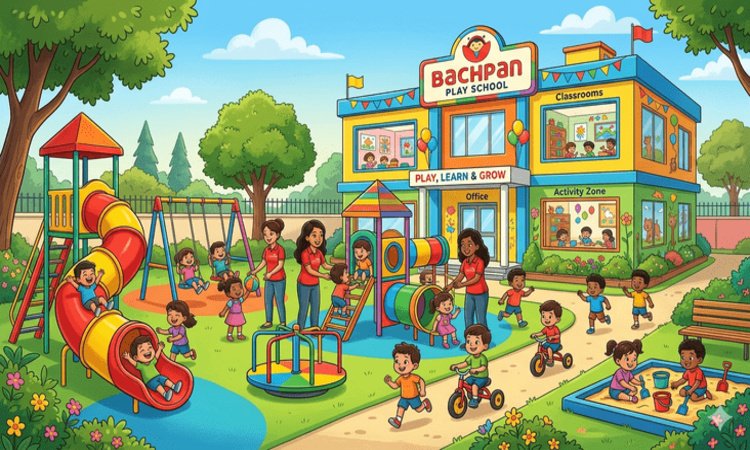
Play School for kids in Chitradurga Karnataka is often the first major decision the parent takes regarding the child's education and is usually followed by a constant worry: should my child already be learning alphabets and numbers and is this "playing around" really aiding? It's a fair inquiry. Parents often go to the preschool classroom expecting to be greeted by rows of worksheets, but feel uncertain when they see kids building blocks or playing in a play kitchen instead. The reality, as proven by decades of research into early childhood it is clear it is that the play can be the main focus of education for children at this stage and there is no interruption from it. This article explains what play-based learning really looks like, the reasons it is important over early academic drill and what you can observe at a preschool in Chitradurga to determine if it's actually doing it well.
The Play against. Academics Myth
It's a popular belief that an "serious" school must look as a miniature version primary school - desks arranged in rows and rhymes that are memorized in a timely manner. Actually, children between two and six years old learn best by engaging in hands-on activities, not through passive instruction. The brains of children are equipped to learn language, logic, and social skills through interactions with their peers, objects and the environment around them and not by repetition alone.
A great Playschool Chitradurga Karnataka option won't ignore the importance of early literacy and numeracy. It simply teaches the concepts through games of sorting games that gently develop numbers as well as storytelling circles that develop vocabulary, and play that builds sequence and causal and effect thinking. The academics are in place and are just incorporated into play, not tucked away on the worksheet.
What Activity-Based Learning Actually Builds
Activity-Based Learning isn't simply "fun time" -- it's performing specific developmental work that academic drill can't duplicate:
- Skills for fine motor development Threading beads, cutting them with scissors as well as building using blocks build the hand muscles children eventually need to write with.
- The development of languages Activities for groups and storytelling can naturally increase vocabulary more quickly than the repetition of flashcards.
- Problem-solving Puzzles simple games and free-play encourage children to play with their own ideas, make mistakes, and attempt to try again.
- Skills for social-emotional development -sharing toys, taking turns, and resolving minor disagreements in play help develop the self-regulation skills children require before the class 1.
- Literacy and numeracy in the early years -counting while playing or identifying shapes during a walk in the nature plant numerals and letters without any pressure.
This is the basis Montessori Education and other child-centered philosophy are built upon providing children with a stimulating environment, and liberty to explore it and then "academic" learning naturally follows.
What to Actually Observe on a Campus Visit
If you're looking at the options for preschool admission in Chitradurga Do not just inquire about the curriculum you've read on paper take a look at the way a typical day is run. There are a few aspects worth paying focus on:
- Do children seem to be engaged, or simply occupied? There's a difference between a child who is absorbed in building a tower, and an uninterested child watching a teacher do something.
- Does it have an equal amount of free and structured playing? Both matter -certain activities should be guided by a teacher while others should be led by children.
- What are teachers' responses to errors? A good early teacher will treat a mistake or a tower falling down as a learning opportunity rather than failing to rectify the issue immediately.
- Are outdoor or gross-motor time integrated into the daily schedule? Physical movement is equally important as cognitive and fine motor activities in this stage of life.
- Do the children appear to be comfortable and not stressed? A relaxed, playful classroom environment is usually an indicator of better high-quality than a peaceful one.
Matching Learning Style to Your Child's Age
Child Development Activities must change with the development of children and mature, which is something an area that is worth discussing with your child in detail:
- Playgroup (around 2 years old): Sensory play basic cause-and-effect games, and the ability to settle into a routine are the most important aspects here.
- Nursery (around 3 years old): Sorting, matching early group activities, and sorting establish the foundation for organized learning.
- LKG as well as UKG (ages between 4-5): Activities gradually introduce more organized pre-writing, reading and concepts of numbersbut still using activities and games instead of rote memorization.
A well-planned Preschool Curriculum will not follow a universal approach to these levels -it must be adaptable to as well as the expectations of children as they grow.
Why This Matters for Long-Term Readiness
Early Childhood Education research consistently yields the same result that kids who are exposed to their first years in a rich, playful environments develop stronger self-regulation, problem solving ability and social skills than children who are forced into early academic rigor. The real test of school readiness isn't being able to read the alphabet prior to Class 1; it's being capable of sitting through an entire class, work with other students, and tackle any new challenge with a sense of curiosity, not fear. Play-based learning helps build precisely that, in a quiet and consistently over the years of preschool.
Frequently Asked Questions
1. Play-based learning is less challenging than a preschool that is academically focused?
No -- it usually includes the same basic concepts (numbers shapes, letters,) however, it is based on hands-on activities which help to build a deeper understanding and retention, rather than repetition on its own.
2. What is the age at which formal academics be started?
Most early-childhood experts suggest a gradual shift beginning around the time of LKG/UKG (ages 4 to 5) and formal academics only starting at the beginning of Class 1 and onwards.
3. What can I do to determine how a preschool juggles playing and learning well?
Visit during active hours and check if the children are actually involved in activities, whether the teachers are guiding rather than dictating or dictate, and if the schedule is a mix of structured and unstructured play.
4. Do my child get left behind if they do not complete homework early?
Not typically -children who develop solid foundational skills through play generally adapt to formal schooling in the same way or better after formal schooling has begun.
5. What do I need to bring or inquire regarding during a visit to a preschool?
Ask to observe an active class or ask about what the curriculum changes from Playgroup through UKG and how the teachers deal with a child's disappointment or errors in the course of activities.
Conclusion
Selecting a play school in Chitradurga Karnataka doesn't have to be a choice between learning and playingThe best programs acknowledge that, in this age playing can be an effective way of learning. Instead of looking at a school's performance based on the way it appears "academic" it appears on the outside It's worth looking at how active in a positive, engaging, and safe environment the kids are in the course of a typical day. For parents living in Chitradurga considering their options, going to an actual campus and watching a class the classroom is an invaluable option prior to making a choice.
Views: 21 · 30s+ reads: 0