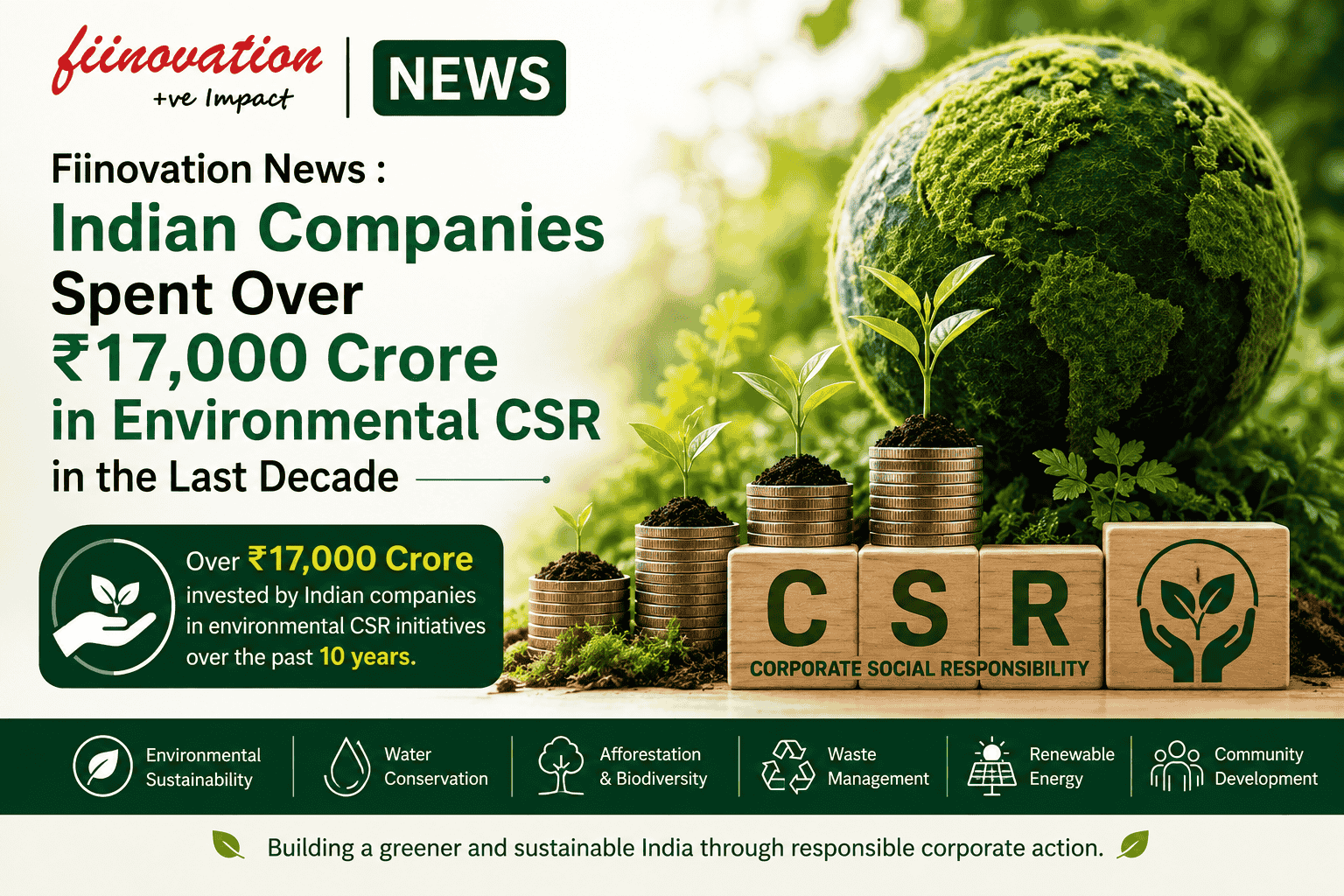
Corporate Social Responsibility (CSR) in India has evolved significantly over the past decade, with companies increasingly focusing on environmental sustainability, climate resilience, natural resource conservation, and community development. According to recent trends, Indian companies have spent more than ₹17,000 crore on environmental CSR initiatives over the last decade, highlighting the growing importance of sustainable development within the corporate sector.
Fiinovation News brings attention to this significant development, which reflects how businesses are moving beyond traditional philanthropy and integrating environmental responsibility into their CSR strategies. From afforestation and water conservation to renewable energy, waste management, biodiversity protection, and sustainable agriculture, corporate investments are supporting a wide range of environmental initiatives across India.
Growing Importance of Environmental CSR in India
India is facing several environmental challenges, including water scarcity, air pollution, climate change, deforestation, waste generation, and ecosystem degradation. These challenges have increased the need for collaboration between government agencies, corporations, NGOs, and local communities.
The introduction of mandatory CSR provisions under the Companies Act, 2013, created a structured framework for eligible companies to contribute toward social and environmental development. Over the years, environmental sustainability has become an important area of CSR investment.
Companies are increasingly recognizing that environmental initiatives can create long-term benefits not only for communities and ecosystems but also for businesses. Responsible environmental practices can strengthen stakeholder relationships, improve corporate reputation, and contribute to sustainable economic growth.
Where Environmental CSR Funds are Being Utilized
The more than ₹17,000 crore spent on environmental CSR over the last decade represents investments across multiple areas. Afforestation and tree plantation programs are among the most visible forms of environmental CSR. Companies and implementing organizations have supported plantation drives, restoration of degraded land, and community-based forestry programs.
Water conservation is another major focus area. CSR-funded projects have included watershed development, rainwater harvesting, groundwater recharge, restoration of ponds, and improving access to sustainable water resources. Such initiatives are particularly important in rural and water-stressed regions.
Companies are also supporting renewable energy and clean energy solutions. Solar-powered infrastructure, energy-efficient systems, clean cooking solutions, and decentralized renewable energy projects can help communities transition toward more sustainable energy sources.
Similarly, waste management and sanitation have become increasingly relevant to corporate environmental strategies. CSR programs may support waste segregation, recycling, plastic waste reduction, composting, and awareness campaigns designed to encourage responsible consumption and disposal.
CSR and Climate Action
Climate change has further strengthened the role of environmental CSR. Extreme weather events, changing rainfall patterns, rising temperatures, and environmental degradation can disproportionately affect vulnerable communities.
Corporate CSR initiatives can contribute to climate resilience by supporting sustainable agriculture, ecosystem restoration, water security, renewable energy, and disaster preparedness. These projects can help communities adapt to environmental changes while creating measurable social and ecological benefits.
For businesses, environmental CSR is increasingly becoming part of a broader sustainability strategy. Companies are looking for ways to connect CSR investments with long-term environmental outcomes rather than focusing solely on one-time activities.
Role of NGOs and CSR Consultants
Effective implementation is essential for ensuring that CSR investments create meaningful and measurable impact. NGOs, social organizations, research institutions, and CSR consultants can help companies identify community needs, design suitable projects, manage implementation, and evaluate outcomes.
Organizations such as Fiinovation work in the CSR and social development ecosystem, supporting companies and organizations in areas such as CSR project planning, NGO project management, need assessment, monitoring and evaluation, impact assessment, and sustainability-focused initiatives.
A structured CSR approach can help companies identify the right geographical locations and beneficiaries while ensuring that projects are aligned with community requirements. Baseline studies, regular monitoring, and impact assessments can further help organizations understand whether CSR investments are producing the intended environmental and social outcomes.
Moving From Spending to Impact
While the ₹17,000 crore-plus figure demonstrates the scale of corporate environmental investment, the effectiveness of CSR should not be measured only by the amount of money spent. The quality, sustainability, transparency, and measurable impact of projects are equally important.
For example, a tree plantation project should consider survival rates and long-term ecosystem benefits rather than simply counting the number of saplings planted. Similarly, water conservation projects should assess improvements in water availability, agricultural productivity, groundwater levels, and community participation.
This shift from CSR spending to CSR impact is becoming increasingly important. Companies are now looking for data-driven approaches that demonstrate how their investments are improving environmental conditions and benefiting communities.
Future of Environmental CSR in India
The next phase of CSR in India is likely to see greater emphasis on climate action, biodiversity conservation, circular economy initiatives, renewable energy, sustainable livelihoods, and resource efficiency.
Technology and data can also play an important role. Geographic information systems, digital monitoring platforms, impact measurement tools, and data analytics can help companies track project progress and measure outcomes more effectively.
As businesses increasingly recognize the connection between environmental sustainability and long-term economic resilience, environmental CSR is expected to remain a key component of India's corporate responsibility landscape.
The reported ₹17,000 crore-plus environmental CSR investment over the last decade demonstrates the growing contribution of Indian businesses toward environmental protection and sustainable development. Going forward, stronger partnerships among corporations, NGOs, government institutions, communities, and CSR consultants can help transform these investments into scalable and measurable environmental impact.
Fiinovation News continues to highlight important developments in India's CSR ecosystem, helping businesses, NGOs, and development professionals understand emerging trends in corporate social responsibility, sustainability, environmental initiatives, and community development.
Views: 43 · 30s+ reads: 4