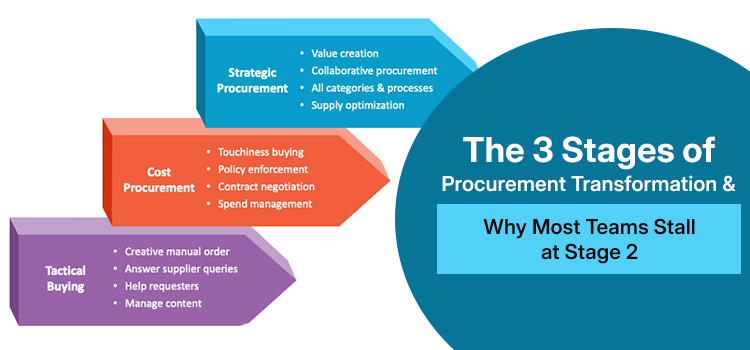
Procurement transformation is the operational restructuring of an organization's purchasing processes, spend visibility, and department alignment—shifting procurement from a reactive administrative unit into a strategic partner in corporate decision-making. Buying software is merely a purchase order decision; true transformation fundamentally alters how procurement operates, measures success, and delivers enterprise value.
Here is a practical, fluff-free roadmap for procurement leaders building a modern purchasing operation.
What Procurement Transformation Actually Means
Buying a new software platform and labelling it a "transformation" is one of the most common operational missteps. For an initiative to qualify as a transformation rather than a basic tool swap, three structural pillars must evolve together:
- Process: Moving from reactive order-taking and manual request fulfilment to proactive ownership over sourcing strategies, preferred supplier lists, and spend policy enforcement.
- Data: Eliminating fragmented spreadsheets, isolated ERP records, and inbox approval trails by consolidating spend data, contract expiration dates, and itemized spend into a centralized single source of truth.
- Role: Transforming procurement from a back-office administrative gatekeeper to a strategic advisory unit that finance, operations and executive leadership consult before committing capital.
Automating a broken process just means you’re running inefficient workflows faster – it’s not a transformation.
3 Stages of Procurement Maturity
Stage 1 Manual: Requests are made by email, messaging channels or ad-hoc spreadsheets. There is no consolidated view of upcoming expenditure, vendor master data is in individual personal inboxes and budget approvals are ad-hoc. At this stage teams suffer from maverick spend, duplicate vendor accounts, and delays from manual three-way invoice matching.
Stage 2 Digital: An automated procurement or procure to pay (P2P) platform monitors requisitions, purchase orders and approval workflows in a centralized system. Most organizations stall at this point, confusing the implementation of transactional software with full operational transformation. While software brings order to workflow tracking, the business continues to buy from the same vendors on the same (un)negotiated terms.
Stage 3 Strategic: Procurement is actively leveraging the system data to drive financial and operational outcomes – consolidating fragmented suppliers, running structured RFPs, renegotiating contracts based on actual volume patterns and forecasting future cash flow requirements.
Most initiatives fail because leadership treats Stage 2 deployment as the finish line. The measurable financial return on investment—and the justification for funding these projects—resides entirely in Stage 3.

Common Pitfalls & Operational Solutions
- Tool First Thinking: Buying software before establishing quantitative operational goals. Remedy: Set target metrics (e.g. cut tail spend 15%) before going to market with an RFP to software vendors.
- No Executive Sponsor: Procurement involves finance, legal, operations and department heads. If you don’t have buy-in from senior executives, software adoption stalls within the one department that paid for the tool. Remedy: Get co-sponsorship from the CFO or COO before the procurement system is rolled out.
- Ignoring Change Management: All departmental requisitioners are responsible for adhering to the new submission requirements. A platform no one touches generates friction without capturing spend data. Remedy: Automated purchase requisition tracking; make automated approval routing and mandatory role based training.
- Omitting Baseline Metrics: You can’t prove ROI if you deploy new software without metrics from before the implementation.
- Remedy: Get pre-transformation baseline metrics on requisition to PO cycle times, percentage of rogue spend, and audit compliance rates before go-live.
KPIs That Show the Impact of Transformation: To determine the actual operational progress, the organizations need to monitor quantitative key performance indicators (KPIs).
- Cycle Time: Total elapsed hours or days from initial requisition submission to approved purchase order and supplier fulfilment.
- Spend Under Management (SUM): The proportion of company spend that is channelled through controlled, pre-approved purchasing channels versus rogue spending.
- Compliance Rate: Percentage of purchases that meet official corporate approval hierarchies, policy thresholds and contracted vendor lists.
- Supplier Rationalization Rate: Systematic elimination of unnecessary, unqualified suppliers to preferred strategic vendors by purchasing category.
- Realized Savings: Actual cost savings generated after negotiation or contract renewal, determined by using past pricing baselines as opposed to initial vendor offers.
How to Start with an Actionable Execution Framework
Conduct a 90 Day Spend Audit (If You Are at Stage 1): Don't dive straight into software demos. Instead, conduct a formal 90-day spend audit to establish your data baseline
- Days 1-30 (Data Extraction) Pull 12 months of credit card statements, accounts payable ledgers, ERP invoice records and organize into a single database.
- Days 31-60 (Taxonomy Mapping): Map expenses by vendor, department and expense type to identify redundant software subscriptions and supplier bloat.
- Days 61-90 (Leakage Identification): Isolate maverick spend, rogue purchases and non-contracted volume to identify your true software requirements before you evaluate tools.
Build operational ownership (If you’re stuck at stage 2): If the software is there but spend behavior is the same, the issue is execution and category ownership. Assign specific owners to each category (e.g. IT, Marketing, Facilities) to review spending patterns on a quarterly basis.
- Create a Strategic Sourcing Pipeline: Use platform data to flag contract end dates 90 days out to trigger mandatory RFQs/RFPs before auto-renewals.
- Policy Enforcement: Prevent non-compliant purchases at the requisition stage before a PO or invoice payment is created.
Conclusion
Stage 3 isn't a feature you turn on. It's a decision leadership makes after Stage 2 stops feeling like enough. Most teams never make that decision because nobody forces the question. The dashboard works, approvals move faster, and that alone gets treated as the win while the vendor list stays exactly what it was three years ago.
Here's where to start, depending on where you are.
Stuck at Stage 1: Run the 90-day spend audit before a single demo call. Pull 12 months of AP records in the first 30 days, map them by vendor in the next 30, isolate the maverick spend in the last 30.
Stuck at Stage 2: Name a category owner for IT, Marketing, and Facilities this week. Give each a quarterly review date and a mandate: flag redundant vendors and contracts expiring in 90 days.
Have baseline metrics: Pick one — cycle time, spend under management, compliance rate — and set a 90-day target.
The platform already has the data. Stage 3 means someone opens the report and acts on it.
Views: 33 · 30s+ reads: 5