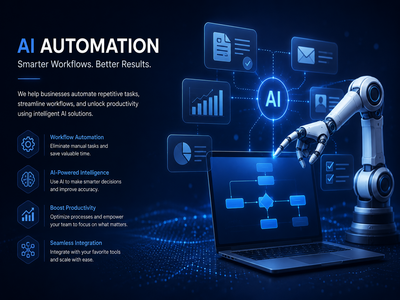
Artificial intelligence is rapidly changing the way businesses operate, market their products, serve customers, and manage everyday processes. As companies look for smarter ways to improve productivity and reduce repetitive work, the demand for AI automation companies and specialized technology partners continues to grow.
AI automation combines artificial intelligence with software, APIs, cloud platforms, and workflow tools to automate tasks that traditionally require significant manual effort. From marketing and customer support to retail operations and business management, AI can help organizations create faster, more connected, and scalable workflows.
Companies such as CSG Technosol help businesses explore modern technology solutions by combining software engineering, automation, and digital transformation expertise. With the right strategy, businesses can use AI to improve processes without completely replacing their existing technology infrastructure.
What Are AI Automation Services?
AI automation services use artificial intelligence and workflow automation to streamline repetitive business activities. These services can include automated customer communication, lead qualification, data processing, document analysis, reporting, workflow management, and intelligent decision support.
For example, when a customer submits an inquiry, an automated system can analyze the request, identify its intent, update the CRM, assign the lead to the relevant team, and initiate a personalized response.
An experienced AI automation agency first evaluates the company's processes and identifies areas where automation can deliver measurable value. This approach ensures that businesses invest in solutions that solve real operational challenges instead of implementing AI simply because it is a growing technology trend.
Why Businesses Are Adopting AI Automation
One of the biggest benefits of AI automation is improved productivity. Employees frequently spend hours on repetitive activities such as data entry, email management, reporting, lead sorting, and information processing.
AI-powered workflows can handle many routine activities automatically, allowing employees to focus on higher-value responsibilities such as strategy, creativity, customer relationships, and business development.
Scalability is another major advantage. As organizations grow, the volume of customers, transactions, and information also increases. AI automation software can help businesses manage larger workloads without requiring the same increase in manual resources.
AI can also analyze large datasets and identify patterns that can support better decision-making. When implemented correctly, automation can improve consistency, reduce human error, and provide greater visibility into business operations.
AI Marketing Automation for Smarter Campaigns
Marketing is one of the most practical applications of artificial intelligence. AI marketing automation enables businesses to analyze customer behavior, personalize communication, segment audiences, qualify leads, and optimize marketing workflows.
For instance, AI can evaluate customer interactions and determine which content or communication may be most relevant to different audience segments. Automated workflows can then deliver emails, notifications, recommendations, or follow-ups based on predefined conditions.
AI can also assist with lead scoring. Instead of manually reviewing every prospect, businesses can use intelligent systems to prioritize leads based on behavioral data and business criteria.
However, automation should complement human expertise. Marketing strategy, creativity, brand positioning, and customer understanding remain essential for successful campaigns.
The Growing Role of Retail Automation AI
Retail is another sector experiencing significant transformation through artificial intelligence. Retail automation AI can support inventory management, demand forecasting, customer recommendations, sales analysis, and customer service.
Retail businesses can analyze historical purchasing data to identify demand patterns and make more informed inventory decisions. This can help reduce overstocking while minimizing the risk of products becoming unavailable.
AI-powered recommendation systems can also personalize shopping experiences by suggesting products based on browsing behavior, previous purchases, and customer preferences.
For retailers with multiple locations or large product catalogs, automation can provide a scalable way to process information and support employees with faster access to relevant insights.
How to Choose the Right AI Automation Agency
With the increasing number of AI automation companies, selecting the right technology partner requires careful evaluation.
A capable AI automation agency services provider should begin by understanding the organization's business objectives, existing systems, operational challenges, and customer journey. Instead of offering generic automation packages, the agency should recommend solutions aligned with specific business requirements.
Technical expertise is equally important. Modern automation projects may require CRM integration, APIs, databases, cloud infrastructure, analytics platforms, AI models, and custom software development.
Businesses should also evaluate security, scalability, maintenance, integration capabilities, and post-launch support before choosing an automation partner.
CSG Technosol and AI-Driven Digital Solutions
CSG Technosol focuses on delivering modern technology solutions designed around business requirements. Its engineering-oriented approach can support organizations looking to develop and integrate scalable digital products and automation workflows.
From software development and SaaS solutions to AI-driven automation, businesses increasingly need technology systems that can communicate with one another rather than operate as isolated tools.
A well-designed automation ecosystem can connect marketing platforms, CRM systems, customer support tools, databases, and internal applications. For example, a lead generated through a marketing campaign can automatically enter a CRM, receive an AI-based qualification score, trigger a personalized follow-up, and be assigned to an appropriate sales representative.
This type of connected workflow can reduce manual intervention while creating a more consistent customer experience.
The Importance of AI Workflow Automation
A successful AI workflow automation agency should focus on business outcomes rather than simply implementing new technology.
The process generally begins with identifying repetitive tasks and inefficient workflows. Businesses can then prioritize processes based on frequency, complexity, cost, and potential impact.
After selecting the right processes, the automation team can design the workflow, integrate the required systems, test the solution, and monitor its performance.
Continuous optimization is also important. As business requirements, customer expectations, and technologies change, automation workflows should be reviewed and improved.
The Future of AI Automation
AI automation is becoming an important part of modern digital transformation. As AI technologies become more accessible, organizations of different sizes can use automation to improve productivity, customer engagement, and operational efficiency.
The future is likely to involve greater collaboration between employees and intelligent systems. Rather than completely replacing human roles, AI can handle repetitive activities while employees concentrate on decision-making, creativity, innovation, and relationship building.
For businesses exploring this transformation, working with an automation agency AI specialist can provide the technical expertise needed to identify opportunities, implement appropriate technologies, and create scalable workflows.
CSG Technosol represents the type of technology partner businesses can consider when developing modern digital solutions. Whether the requirement involves AI automation software, SaaS development, workflow integration, or broader digital transformation, the focus should remain on creating practical technology that delivers measurable business value.
Ultimately, successful automation is not about automating everything. It is about identifying the right processes, applying the right technology, and continuously improving how people and systems work together.
Views: 30 · 30s+ reads: 2