India's solar energy sector has grown at a remarkable pace over the past decade, driven by falling technology costs, supportive government policy, and a growing awareness of climate change. As rooftop solar becomes common in residential neighborhoods and utility-scale solar parks continue to expand across states like Rajasthan, Gujarat, and Tamil Nadu, more people are asking a practical question: how do you actually choose the right solar panels and equipment for your needs?
This guide walks through the key technologies, components, and cost factors that matter when evaluating solar panel manufacturers in India, whether you're a homeowner exploring rooftop solar or a business planning a larger installation.
Understanding Modern Solar Panel Technology
Not all solar panels are built the same way, and the technology behind a panel has a real impact on how much electricity it produces over its lifetime.
N-Type TOPCon technology has emerged as one of the more advanced options available today. A TOPCon solar panel typically uses features like multi-busbar cell design, non-destructive cell cutting, and round ribbon interconnects to reduce resistance losses and improve overall efficiency. These panels are also engineered with a lower thermal coefficient, which matters a great deal in a country like India where rooftop and ground-mounted panels regularly operate in high-temperature conditions. A lower thermal coefficient means the panel loses less power output as temperatures climb — a meaningful advantage during peak summer months.
Bifacial technology takes this a step further. A TOPCon bifacial solar panel generates electricity from both its front and rear surfaces, capturing direct sunlight on the front while the rear face picks up light reflected from the ground, rooftop, or surrounding surfaces. Depending on installation height, ground reflectivity, and mounting design, bifacial panels can produce meaningfully more energy than standard monofacial panels over the same footprint — making them popular for solar farms, carports, and elevated ground-mount systems.
Mono PERC panels remain a widely used and cost-effective option, particularly for standard rooftop installations where budget and proven reliability are top priorities. Many manufacturers now offer both Mono PERC and bifacial Mono PERC variants, giving buyers flexibility based on their site conditions and budget.
Beyond Panels: Inverters and Battery Storage
A solar panel is only one part of a functioning solar power system. Two other components deserve equal attention.
Solar inverters convert the direct current (DC) electricity generated by panels into the alternating current (AC) electricity used by homes and businesses. When comparing solar inverter price across brands, it's worth resisting the temptation to simply pick the cheapest option. Inverter capacity needs to match your panel array size, and features like monitoring, efficiency rating, and warranty length can significantly affect long-term value — even if they add a bit to the upfront cost.
Hybrid solar inverters are increasingly popular for buyers who want both solar generation and battery backup in one integrated system. A hybrid solar inverter allows a household or business to store excess solar energy for use during outages or evening hours, rather than exporting it back to the grid. When evaluating a hybrid solar inverter, key considerations include battery compatibility, load-handling capacity, and safety certifications.
Solar batteries complete the picture for anyone serious about energy independence or backup power. Solar battery price varies widely based on battery chemistry, usable capacity, cycle life, and warranty terms. A higher upfront solar battery price often reflects a longer lifespan and better depth-of-discharge performance, which can translate into lower cost-per-cycle over the system's lifetime. Pairing a well-matched solar inverter battery setup with a compatible hybrid inverter is one of the more effective ways to maximize the value of a home or commercial solar investment.
Where ADM Solar Power Fits In
With so many solar power companies now operating in India, due diligence matters when choosing a manufacturer. A few practical checks can help separate reliable players from the rest: certifications like BIS and ALMM enlistment, established manufacturing capacity, clear warranty terms, and a product range broad enough to cover panels, inverters, and batteries under one roof.
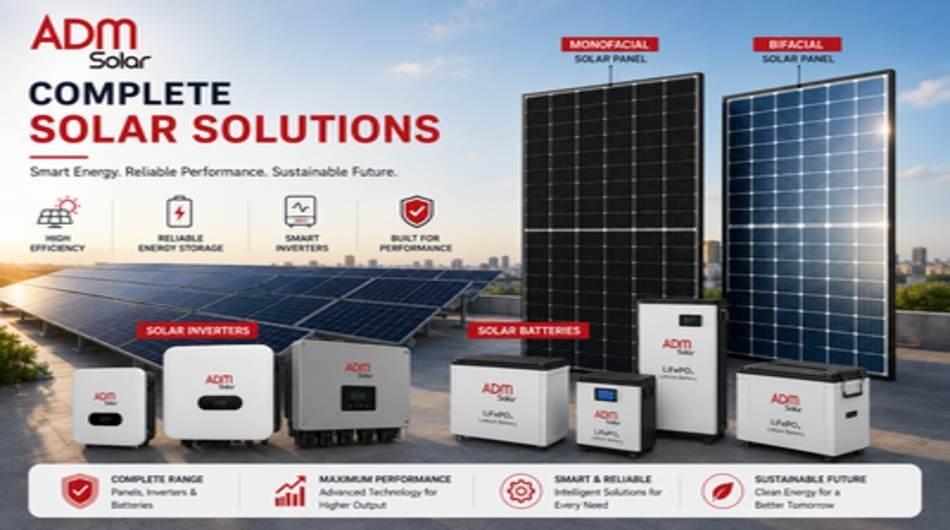
ADM Solar Power, based in Faridabad, Haryana, is a good example of this full-system approach among solar panel manufacturers in India. The company operates with a 2.2 GW PV module manufacturing capacity and has supplied over 1.5 GW of solar PV modules to projects across residential, commercial, industrial, agricultural, and utility-scale segments. Its product lineup includes N-Type TOPCon panels, TOPCon bifacial modules with an 80 ± 10% bifaciality factor, Mono PERC panels in both monofacial and bifacial formats, along with solar inverters, hybrid inverters, and solar batteries.
ADM Solar Power's TOPCon modules incorporate features such as 16BB M10 cut cells, non-destructive cell cutting, round ribbon technology, and a positive power tolerance of up to +5 Wp — details that matter for buyers comparing module specifications rather than price alone. The company's operations are backed by BIS certification, ALMM enlistment, and D-U-N-S registration, and it reports having served over 20,000 customers while contributing to an estimated 10.5 million metric tons of CO₂ reduction.
For customers weighing a TOPCon bifacial solar panel against a standard Mono PERC option, or trying to figure out how solar inverter price and solar battery price fit into an overall budget, having a manufacturer that offers the full system — panels, inverters, and storage — can simplify both the buying decision and long-term after-sales support.
Making the Right Choice for Your Project
Ultimately, the best solar panel company for any given project depends on the specifics: available roof or land space, local climate, budget, and whether backup power is a priority. A homeowner installing a small rooftop system will have different priorities than a business planning a large industrial installation or a developer building a utility-scale solar farm.
What matters most is looking at the full picture — panel technology, inverter compatibility, battery options, certifications, and manufacturer track record — rather than focusing on any single number like solar inverter price or solar battery price in isolation. As India's solar manufacturing base continues to mature, and as manufacturers like ADM Solar Power expand their capacity and product range, buyers have more high-quality options than ever to build a system that performs reliably for decades to come.
Views: 50 · 30s+ reads: 5