Today, almost every business needs a website, mobile app, online store, or digital platform. But simply having a digital product is not enough. It should also be easy to use, attractive, clear, and comfortable for users. This is where UI/UX designers come in.
UI/UX design has become an exciting career option for students, freshers, creative people, and professionals who want to work in the technology and digital industry.
But before choosing this career, one important question often comes to mind:
What jobs can you get after completing a UI UX Design Course?
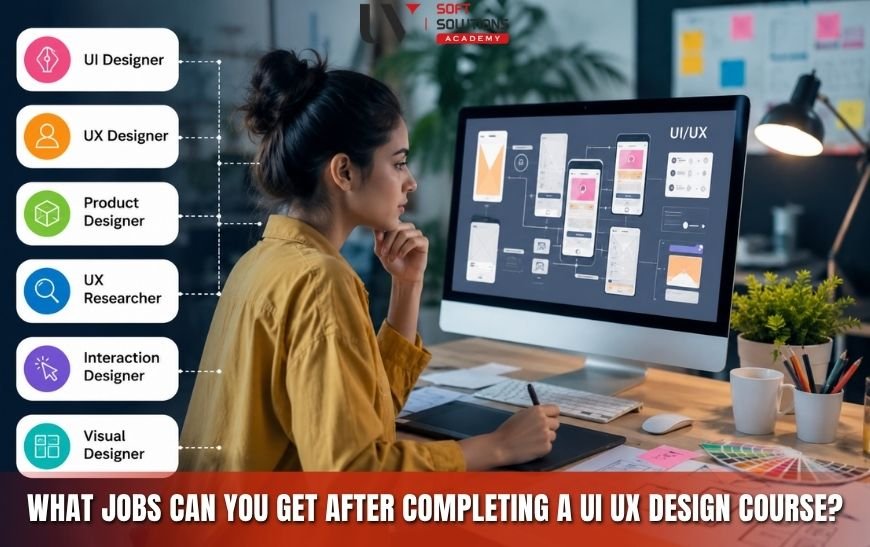
The good news is that UI/UX design can lead to several different job roles. You can work as a UI Designer, UX Designer, Product Designer, Interaction Designer, Visual Designer, UX Researcher, or even start working as a freelancer.
In this blog, we will explain these career options in very simple language, along with the skills you need and how you can prepare for a successful UI/UX career.
What Is UI/UX Design?
Before discussing jobs, let's understand UI and UX in simple words.
UI means User Interface. It is about how a website, app, or digital product looks. Colors, fonts, buttons, images, menus, spacing, icons, and screen layouts are all part of UI design.
UX means User Experience. It is about how easily and comfortably a person can use a website or app.
For example, imagine you open a shopping app. If you can easily search for a product, check its details, add it to your cart, and complete payment without confusion, that is a good user experience.
A UI/UX designer helps make this complete experience better.
Why Are UI/UX Designers in Demand?
People have many choices online. If a website is confusing or an app is difficult to use, users may quickly leave and choose another option.
Businesses therefore want digital products that are:
- Easy to understand
- Simple to navigate
- Attractive to look at
- Fast and convenient to use
- Designed for different screen sizes
- Helpful for customers
This is why companies need skilled UI/UX professionals.
Technology companies, startups, digital agencies, e-commerce businesses, banks, education companies, healthcare platforms, and many other industries can need UI/UX designers.
1. UI Designer
One of the most common career options after UI/UX training is becoming a UI Designer.
A UI Designer mainly works on the visual part of a website or application.
Their work may include:
- Choosing suitable colors
- Selecting fonts
- Designing buttons
- Creating page layouts
- Designing icons
- Creating app screens
- Maintaining a consistent design
For example, if a company wants to create a new food delivery app, the UI Designer may design the home screen, restaurant page, menu page, cart page, and payment screen.
If you enjoy creativity, colors, layouts, and visual design, this can be a good career choice.
2. UX Designer
A UX Designer focuses more on the user's experience.
Their main goal is to make a digital product simple and easy to use.
A UX Designer may ask questions such as:
- What does the user need?
- Where is the user facing difficulty?
- Which information should appear first?
- How should users move from one page to another?
- How can we make the process easier?
They may create user flows, wireframes, prototypes, and test designs with users.
This job is suitable for people who enjoy problem-solving and understanding people's needs.
3. UX/UI Designer
Many companies use the job title UX/UI Designer for professionals who can handle both areas.
This means you may work on both:
UX: How the product works and how users interact with it.
UI: How the product looks and feels.
For beginners, learning both UI and UX can be useful because it gives you more flexibility when looking for jobs.
You can work on websites, mobile apps, dashboards, software products, landing pages, and other digital platforms.
4. Product Designer
A Product Designer works on the design of a complete digital product.
For example, if a company is creating a new fitness application, the Product Designer may help understand the problem, plan the user journey, create wireframes, design screens, create prototypes, and improve the product based on feedback.
Product Designers often work with developers, business teams, marketers, and product managers.
This makes communication and teamwork important skills for this career.
5. UX Researcher
Not every UI/UX career is about creating screens.
If you enjoy understanding people and asking questions, you can consider becoming a UX Researcher.
UX Researchers try to understand what users want and what problems they face.
They may use:
- User interviews
- Surveys
- User testing
- Feedback
- Observation
- Research studies
The information collected by researchers helps designers create better products.
This career can be a good choice for people who are curious, patient, and interested in understanding user behavior.
6. Interaction Designer
An Interaction Designer focuses on how users interact with a website or application.
For example, what happens when a user clicks a button? How should a menu open? How should a form respond? How should users move between different screens?
Interaction designers think about these small but important details.
Their work helps make digital products feel natural and easy to use.
If you like animations, buttons, navigation, screen transitions, and interactive features, this can be an interesting career option.
7. Visual Designer
A Visual Designer mainly works on the visual quality of a digital product.
They focus on elements such as:
- Colors
- Fonts
- Images
- Icons
- Layouts
- Visual style
- Brand elements
Their job is to make a digital product look professional and attractive while keeping it easy to understand.
This role can be especially suitable for people who already enjoy graphic design and want to move toward digital product design.
8. UX Writer
Another interesting career option is UX Writing.
UX Writers create the small pieces of text users see inside websites and apps.
For example:
- Button text
- Error messages
- Form instructions
- Notifications
- Pop-up messages
- App instructions
Good UX writing helps users understand what to do next without confusion.
If you enjoy writing and technology, this can be a unique career path to explore.
What Skills Should You Learn?
Getting a job in UI/UX is not only about completing a course. You also need practical skills.
Some important skills include:
Design Basics
You should understand colors, fonts, spacing, alignment, balance, and visual hierarchy.
Wireframing
Wireframes are simple designs that show the basic structure of a webpage or app screen.
Prototyping
A prototype shows how different screens connect and how users can interact with the design.
User Research
You should know how to understand user needs and identify common problems.
Responsive Design
Your designs should work properly on desktops, tablets, and mobile phones.
Design Tools
Learning popular design tools such as Figma can help you create professional interfaces and prototypes.
Communication
You should be able to explain your design ideas clearly to clients, developers, managers, and other team members.
Why Is a Portfolio So Important?
Imagine two candidates apply for the same UI/UX job.
One candidate only shows a certificate.
The other candidate shows a certificate plus five practical projects with a clear explanation of the design process.
The second candidate can often make a stronger impression.
This is why a portfolio is extremely important for new designers.
Your portfolio can include:
- Website designs
- Mobile app designs
- Landing pages
- E-commerce designs
- Wireframes
- Prototypes
- UX case studies
- Redesign projects
Don't simply show the final image. Explain what problem you solved, how you planned the design, and why you selected your solution.
Can Freshers Get UI/UX Jobs?
Yes, freshers can start a UI/UX career.
You don't necessarily need years of experience to begin. However, you should have the right skills and a good portfolio.
Freshers can look for positions such as:
- UI Design Intern
- UX Design Intern
- Junior UI Designer
- Junior UX Designer
- Junior UX/UI Designer
- Product Design Intern
- Visual Design Intern
Practical projects can help you show employers what you can actually do.
How Can Industrial Training Help Students?
Learning design concepts is important, but applying those concepts to real projects can make learning much stronger.
Industrial Training in Mohali can give students an opportunity to understand how design work is handled in a professional environment.
Students can learn about practical project requirements, teamwork, deadlines, client expectations, design revisions, and portfolio preparation.
Practical training can also help students become more confident when attending interviews because they have experience working on projects instead of only studying theory.
Can UI/UX Designers Work as Freelancers?
Yes. UI/UX design can also be a good option for freelancing.
Many small businesses, startups, agencies, and online brands need design services but may not hire a full-time designer.
A freelancer can provide services such as:
- Website UI design
- Mobile app design
- Landing page design
- Wireframing
- Prototyping
- UX improvement
- Website redesign
You can work with local businesses as well as clients from different cities or countries.
However, freelancing requires more than design skills. You also need good communication, time management, client handling, and a strong portfolio.
How Can You Grow in a UI/UX Career?
Your first job is only the beginning.
As you gain experience, you can move from junior positions to more advanced roles.
A possible career path can look like:
Junior Designer → UI/UX Designer → Senior Designer → Product Designer → Lead Designer → Design Manager
Your growth depends on your practical knowledge, portfolio, creativity, problem-solving ability, communication, and experience.
Keep learning new design trends and improving your projects. The digital world changes quickly, so continuous learning can give your career an extra advantage.
Final Thoughts
UI/UX design offers many career opportunities for people who enjoy creativity, technology, and problem-solving. After completing proper training, you can explore roles such as UI Designer, UX Designer, UX/UI Designer, Product Designer, UX Researcher, Interaction Designer, Visual Designer, or UX Writer.
The most important thing is to focus on practical learning and portfolio building, not just completing a certificate.
If you are planning to build practical skills and start your design career, a UI UX Design Course in Mohali can be a useful step toward learning industry-focused design skills.
UVSoft Solutions Academy helps students build practical digital skills and prepare for career opportunities. For course details, call 7087578797.
This blog, "What Jobs Can You Get After Completing a UI UX Design Course?" was originally posted on "UVSoft Solutions Academy".
Views: 29 · 30s+ reads: 0