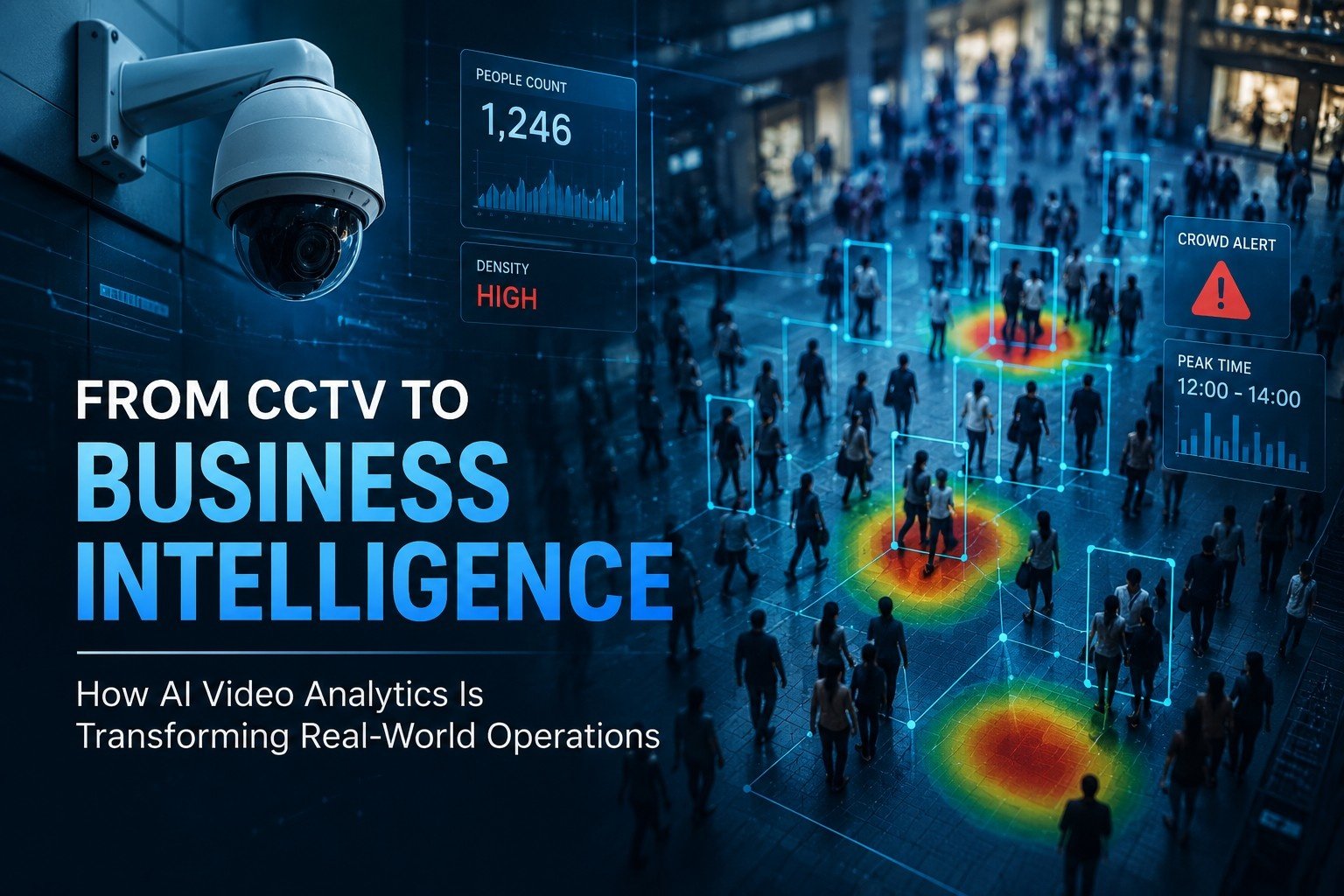
For years, CCTV cameras have been used primarily as a security and surveillance tool. Businesses installed cameras to monitor premises, investigate incidents, and maintain a visual record of what happened.
But cameras have evolved.
With advances in Artificial Intelligence (AI), computer vision, and edge computing, existing video infrastructure can now become a source of operational intelligence. Instead of simply recording what happened, AI-powered video analytics can help organizations understand patterns, identify anomalies, generate alerts, and make faster decisions.
This shift is turning CCTV from a passive recording system into an active intelligence layer for businesses.
The Problem With Traditional Video Surveillance
A modern organization may have hundreds or thousands of cameras operating across stores, warehouses, manufacturing facilities, offices, public spaces, or other locations.
The challenge is not the availability of video data. The challenge is extracting useful information from it.
Security teams cannot continuously watch every camera. Managers cannot manually review every hour of recorded footage. Operational teams often discover problems only after an incident has already occurred.
This creates a gap between what cameras capture and what businesses actually know.
AI video analytics attempts to close that gap by automatically analyzing video streams and identifying events or patterns that matter to a particular business.
What Makes AI Video Analytics Different?
Traditional CCTV answers a relatively simple question:
“Can we see what happened?”
AI-powered video intelligence can help answer much more useful questions:
- How many people entered a location?
- Which areas are experiencing high traffic?
- When does crowding occur?
- Are unauthorized people entering restricted areas?
- Are safety rules being followed?
- Are customers waiting too long?
- Are employees present where they are expected to be?
- Are vehicles entering or leaving a facility?
- Is a particular operational process being followed?
- Is there an unusual pattern that requires attention?
This changes the role of video from evidence after an event to intelligence that can support action during operations.
Existing Cameras Can Become an AI Data Source
One of the biggest advantages of AI video analytics is that organizations may not need to replace their entire camera infrastructure.
Modern platforms can be designed to work with existing CCTV systems and support different deployment environments, including cloud and on-premise architectures.
For businesses, this can reduce the friction associated with adopting AI.
Instead of treating AI as an entirely new hardware investment, organizations can explore how their existing visual infrastructure can generate additional operational value.
Enalytix, for example, positions its platform around adding AI capabilities to existing cameras and delivering video intelligence across multiple business environments. Its platform supports applications ranging from surveillance and safety to retail analytics, productivity, warehouses, manufacturing, and e-commerce.
From Security Alerts to Operational Intelligence
Security remains an important application of video analytics.
AI can help detect events such as intrusion, crowding, fire and smoke, or other predefined conditions and generate alerts for the relevant teams.
But the larger opportunity is operational.
Consider a retail store.
A camera can record customers entering and leaving. An AI system can turn that footage into footfall data, occupancy information, dwell-time insights, queue monitoring, and other operational metrics.
Similarly, in a warehouse, video intelligence can help identify crowded areas, monitor activity in work zones, and highlight patterns that may require operational or safety attention.
The same underlying concept can be applied across industries:
Capture → Analyze → Understand → Alert → Act
AI Video Analytics in Retail
Retail is a strong example of how video data can move beyond security.
Store managers need to understand customer movement, peak traffic periods, queue lengths, staff presence, and areas where customers spend more or less time.
AI-powered analytics can transform these observations into measurable data.
For example, heatmaps can help visualize high-engagement zones and low-traffic areas. Footfall analytics can provide better visibility into customer visits, while occupancy and queue monitoring can help teams respond to changing store conditions.
This creates a more data-driven approach to store management.
Instead of relying entirely on manual observation, retailers can use visual intelligence to understand what is happening on the floor in near real time.
AI Video Intelligence in Warehouses
Warehouses present another environment where visual intelligence can have a significant role.
Large facilities can contain complex movement patterns involving employees, forklifts, inventory, loading areas, and storage zones.
Some operational problems are immediately visible. Others are hidden in repeated patterns.
For example, a particular aisle may consistently experience higher traffic. A loading area may become congested during specific periods. Certain zones may experience frequent interaction between people and vehicles.
Analyzing video over longer periods can help organizations identify these patterns.
The objective is not simply to generate more alerts. It is to give warehouse and safety teams better visibility into where attention may be required.
Manufacturing: Connecting Safety With Productivity
Manufacturing environments also generate large amounts of visual data.
AI-powered video analytics can be used to monitor production areas, identify specific activities, and provide real-time alerts around predefined operational or safety conditions.
For example, computer vision can support use cases involving material movement, vehicle movement, employee activity, and crowding.
This creates an additional layer of visibility without requiring supervisors to manually monitor every production area continuously.
Turning Video Into Evidence
Another important development is the ability to connect video intelligence with business transactions and workflows.
In e-commerce and logistics, for example, video can become part of the audit trail for an order.
Instead of searching through hours of CCTV footage when a shipment dispute occurs, systems can automatically capture and associate relevant video with an order or airway bill.
This can make evidence retrieval faster and create greater transparency across the order lifecycle.
Enalytix's Video Evidence Management solution follows this approach by automatically capturing and tagging video around e-commerce order handovers and integrating with warehouse or order management workflows.
The Importance of Evidence-Backed AI
AI adoption is often limited by one fundamental question:
Can people trust the output?
An alert without context may not be enough for an operational team to take action.
This is why evidence-backed intelligence is important.
When an AI system identifies an event, providing the associated image or video evidence can help a human operator quickly understand what happened and decide what action is appropriate.
This creates a human-in-the-loop model:
AI detects.
AI provides evidence.
Humans decide.
Organizations act.
The goal is not necessarily to replace people. It is to help people focus their attention where it matters most.
Privacy and Responsible AI
As cameras become intelligent, privacy and responsible AI become increasingly important.
Organizations deploying video analytics need to consider data protection, access controls, retention policies, anonymization, and appropriate use of biometric or personally identifiable information.
AI adoption should therefore be built around both technical capability and responsible deployment.
The most useful video intelligence systems will be those that balance business value with privacy, security, transparency, and compliance.
What the Future Looks Like
The future of video analytics is unlikely to be about simply installing more cameras.
It will be about making existing visual infrastructure more intelligent.
As AI models become more capable, organizations will be able to extract increasingly sophisticated insights from environments that were previously monitored only through human observation.
Retail stores can become more measurable.
Warehouses can become more observable.
Manufacturing facilities can become more proactive.
E-commerce operations can become more transparent.
Public spaces can become more responsive.
And businesses can move from asking:
“What happened?”
to:
“What is happening, why is it happening, and what should we do next?”
That is the fundamental shift enabled by AI-powered video intelligence.
The camera is no longer just a device that records the world.
With the right AI layer, it can become a source of business intelligence.
About Enalytix
Enalytix is an AI-powered video analytics and productivity solutions company focused on turning camera data into actionable intelligence. Its solutions span surveillance and safety, retail analytics, AI productivity, warehouses, manufacturing, smart operations, and video evidence for e-commerce.
The company's approach is centered on using AI to help organizations improve safety, efficiency, productivity, and operational visibility through intelligent analysis of video and real-world activity.
Author Bio
Rohit is Marketing Executive at Enalytix, working at the intersection of Artificial Intelligence, computer vision, and business intelligence. He writes about practical applications of AI and how emerging technologies can help organizations improve safety, efficiency, and operational decision-making.
Views: 47 · 30s+ reads: 2