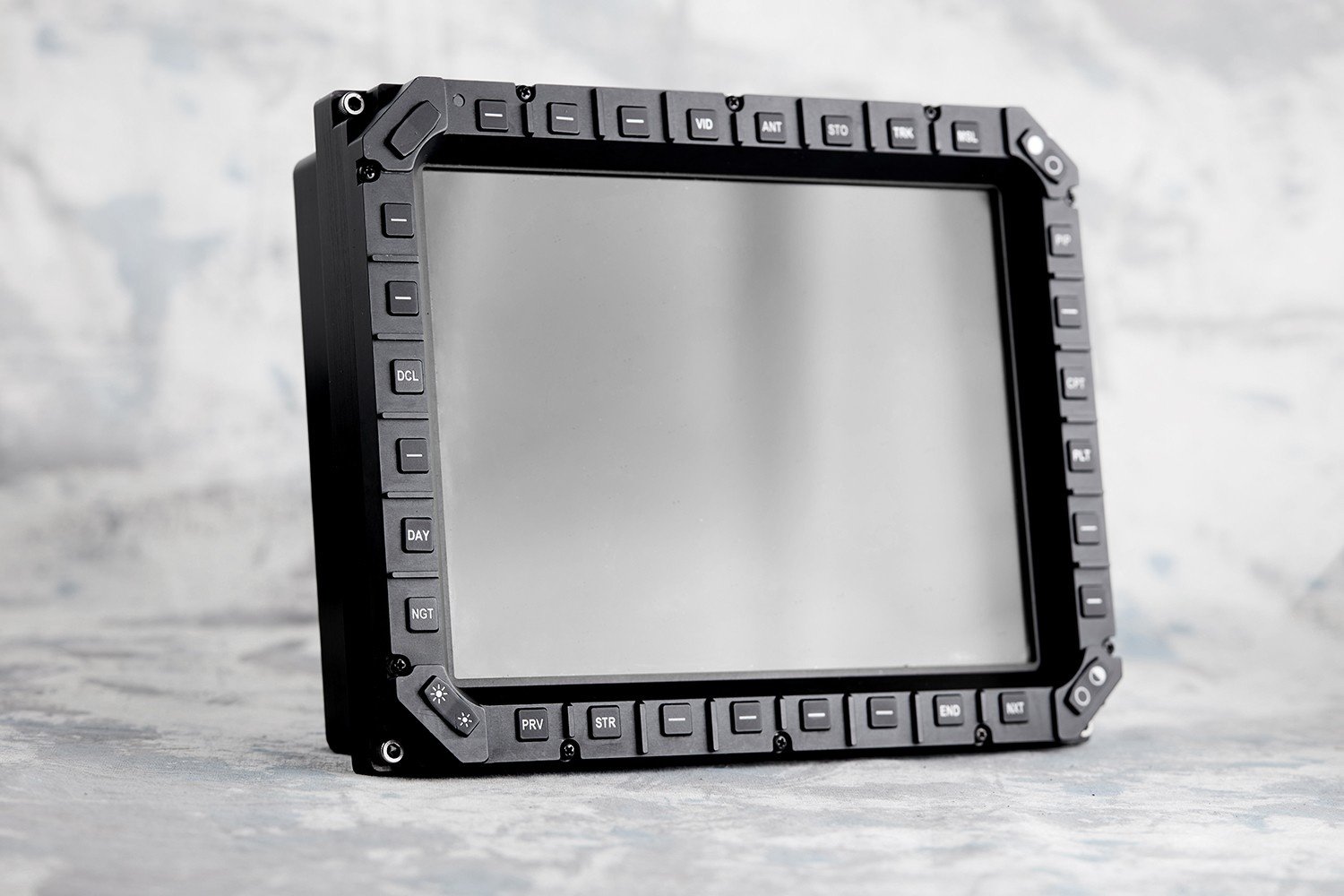
The front surface of a cockpit display lives a hard life. It faces bird strike debris, dropped tools, boots during ingress, gloved fists in turbulence, and decades of cleaning with whatever cloth is at hand. Choosing the right protective material for a rugged touch screen display is therefore not a cosmetic decision but a structural one, and the choice usually comes down to two families: polycarbonate and chemically strengthened glass. Each wins on different axes, and understanding the trade space is essential for design engineers specifying next-generation crew stations.
Polycarbonate: The Impact Champion
Polycarbonate is a thermoplastic with extraordinary toughness. It absorbs impact energy by deforming rather than fracturing, which is why it is the material of choice for canopies and face shields. On a display, a polycarbonate window shrugs off blunt impacts that would shatter glass, and if it does fail, it tends to crack without producing loose sharp fragments. It is also roughly half the density of glass, a meaningful saving on weight-critical airframes. Its weaknesses are surface hardness and chemistry: bare polycarbonate scratches easily, hazes under UV exposure, and is attacked by common solvents, so it depends heavily on hardcoat layers. It also has a high coefficient of thermal expansion, which complicates optical bonding across wide temperature ranges.
Chemically Strengthened Glass: Optical and Surface Excellence
Chemically strengthened glass, produced by an ion exchange process that places the surface under compression, offers a different profile. Its surface hardness resists scratching from grit and daily wiping, its optical transmission and clarity are superior, and it is essentially immune to solvents and UV. The compressive layer lets thin sheets survive flexure and moderate impacts far better than ordinary soda-lime glass. Its limitation is failure mode: exceed its strength and it breaks suddenly, so designs typically retain fragments with lamination or interlayers. It is also heavier than polycarbonate at equal thickness.
Hybrid Stacks: Getting Both
In practice, many high-end avionics displays do not choose one material at all. Laminated constructions place a thin chemically strengthened glass outer surface, for scratch resistance and optical quality, over a polycarbonate structural layer that provides fragment retention and impact absorption, joined by optically clear interlayers and index-matched bonding. Anti-reflective and anti-glare coatings, EMI shielding layers, and heater films can be integrated in the same stack. The engineering art lies in managing thermal expansion mismatch so the laminate stays flat and bubble-free from arctic ramps to desert flight lines.
Qualification: Proving Impact Resistance
Whatever the material, the assembly must be proven. Relevant evidence includes MIL-STD-810 Method 516 shock testing, abrasion and adhesion testing of hardcoats and optical coatings, humidity and thermal cycling of the full laminate, and program-specific impact tests using defined impactors and energies. Equally important is inspection after the test: micro-cracking at bond lines or delamination at the edges may not be visible from the pilot's seat but will propagate over years of pressurization cycles. Reviewing this data, rather than material datasheets alone, is how procurement teams separate marketing claims from flight-worthy engineering.
Experience Across Thousands of Panels
Aeromaoz is a world-known supplier of rugged, mission-critical HMI solutions with more than 45 years of experience in engineering and manufacturing displays, bezels, and illuminated panels for military and commercial aviation, armored vehicles, UAVs, flight simulators, and naval platforms. Its optical stacks are designed and qualified for the specific environmental envelope of each program, serving Tier 1 integrators worldwide.
There is no universally superior window material, only the right laminate for a given threat, weight, and optical budget. Teams that define impact requirements early, and partner with a manufacturer fluent in both polymers and strengthened glass, get displays that stay clear and intact for the life of the platform.
Views: 52 · 30s+ reads: 3