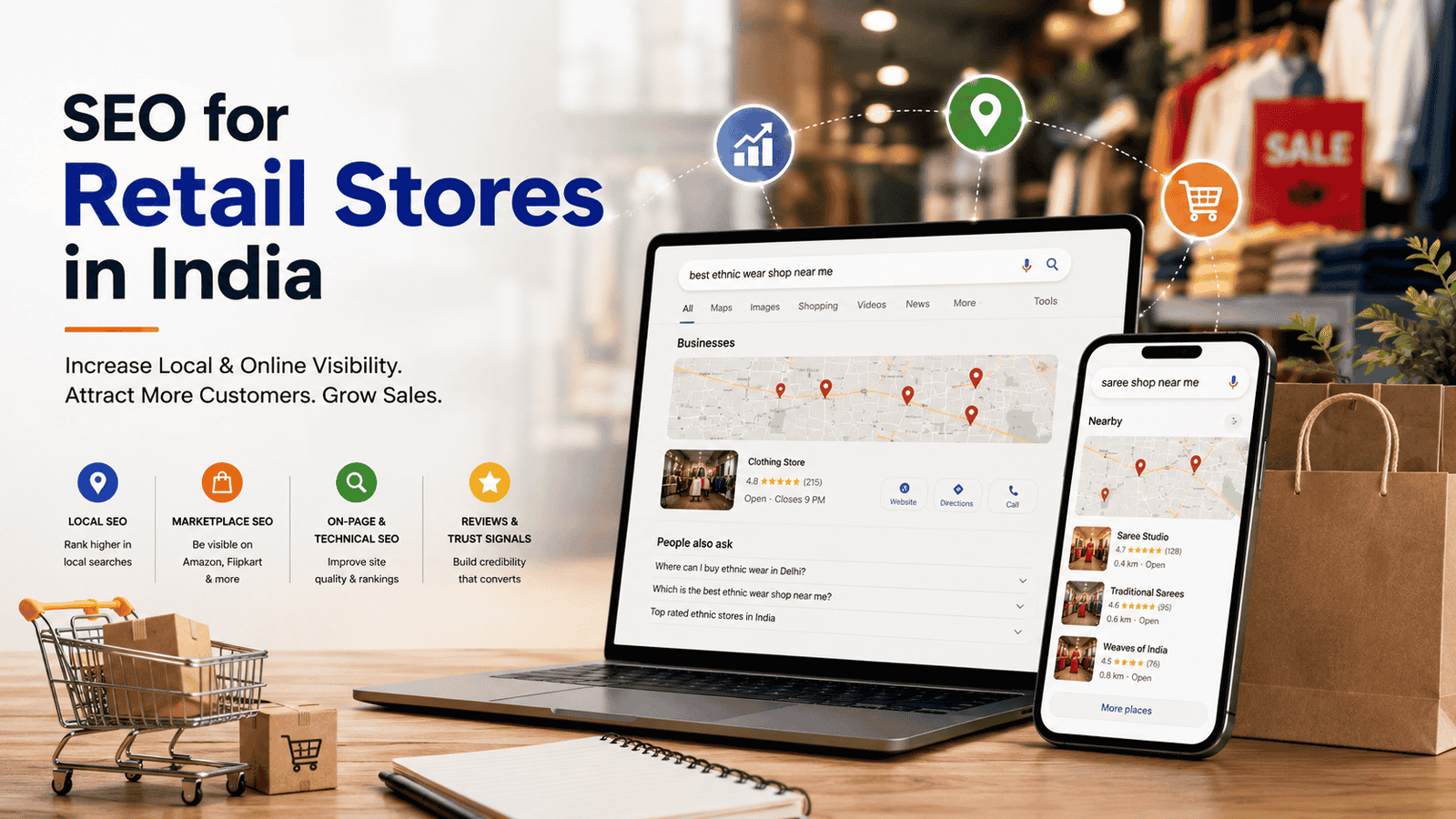
Indian retail has become inseparable from search. With 1.03 billion internet users, 70% national internet penetration, and Google handling the vast majority of India's product discovery journeys, whether a retail store gets found today depends almost entirely on how it ranks on Google Search, Google Maps, and the marketplaces where Indian shoppers now browse. India's D2C e-commerce market alone is valued at USD 108.76 billion in 2026 and projected to reach USD 322.1 billion by 2031 at 24.30% CAGR (Mordor Intelligence).
For any Indian retailer, from a single-location boutique to a national multi-brand chain, SEO for retail stores in India is the discipline that decides whether a customer walks in, calls, orders from your D2C website, or ends up buying from a competitor two blocks away or a marketplace three taps away. Local and online visibility are no longer separate concerns; they are the same battle for search real estate.
This guide breaks down how SEO helps Indian retail stores increase both local and online visibility, covering the five types of SEO retailers must master, an India-specific playbook for GBP and marketplace optimization, budget frameworks, KPIs, and the mistakes that quietly cost sales for retailers who treat SEO as optional.
KEY TAKEAWAYS
- India has 1.03 billion internet users and 500 million social media users. D2C e-commerce is projected to grow from USD 108.76 billion in 2026 to USD 322.1 billion by 2031 at 24.30% CAGR (Mordor Intelligence).
- 46% of Google searches globally have local intent, and "near me" searches in India continue to grow every year. For retail stores with a physical location, Google Business Profile is the single highest-ROI SEO investment.
- Retail SEO in India spans six surfaces: on-page SEO, off-page SEO, technical SEO, local SEO, marketplace SEO (Amazon, Flipkart, Myntra, Meesho), and AI Search Optimization (AEO + GEO for AI Overviews and ChatGPT).
- Regional language voice search, WhatsApp Business Profile appearances in Google Search, and festival keyword spikes (Diwali, Raksha Bandhan, EOSS) are the three highest-leverage India-specific retail SEO tactics most stores underuse.
- SEO for a single-store retailer typically pays back within 6-9 months. For growing D2C and multi-location chains, SEO becomes the primary compounding customer acquisition asset within 12-18 months.
What Is SEO for Retail Stores?
Quick answer: SEO for retail stores is the discipline of making a retail business discoverable on Google Search, Google Maps, marketplaces like Amazon and Flipkart, and increasingly AI search engines like ChatGPT, Perplexity, and Google AI Overviews. It combines on-page optimization (website content, product pages), off-page work (backlinks, citations, reviews), technical SEO (site speed, schema, mobile-first), local SEO (Google Business Profile, local pack), marketplace SEO, and AI Search Optimization into one system that pulls both walk-in customers and online orders.
For an Indian retailer, SEO is what connects a customer typing "best kurta shop near me" or "sports shoes under 3000 in Pune" or asking Google Assistant "where can I buy Ayurvedic skincare in Bengaluru" with the store's website, Google Business Profile, Instagram, WhatsApp Business Profile, or product listing. Unlike paid ads, which stop delivering the day the budget stops, SEO builds an owned discoverability asset that compounds over years.
A modern retail SEO stack for Indian businesses includes keyword research, on-page optimization of category and product pages, technical SEO fundamentals, Google Business Profile optimization, local citations and reviews, marketplace optimization on Amazon and Flipkart, product schema markup, WhatsApp Business Profile setup, Instagram Shopping integration, and ongoing content and AI Search Optimization for AI Overviews and generative engines.
Why SEO Matters More Than Ever for Indian Retail Businesses
Quick answer: SEO matters more than ever for Indian retail because 1.03 billion internet users now start nearly every buying journey with a search, marketplaces and OTAs of retail (Amazon, Flipkart, Myntra) dominate high-intent product discovery, Google Business Profile decides which store wins the local pack for "near me" searches, and AI Overviews and ChatGPT are changing how younger Indian buyers evaluate options before spending. For 30 million+ Indian retail businesses, SEO is now the primary competitive lever for discoverability.
The Indian Retail SEO Opportunity in Numbers
- 1.03 billion internet users in India with 70% national penetration.
- 500 million active social media users; average daily social media time ~2 hours 44 minutes.
- D2C e-commerce market: USD 108.76 billion in 2026, projected USD 322.1 billion by 2031 at 24.30% CAGR (Mordor Intelligence).
- Apparel and footwear lead D2C categories at 25.18% market share.
- 46% of Google searches globally have local intent; "near me" retail searches in India are among the fastest-growing categories.
- WhatsApp has approximately 535 million Indian users; WhatsApp Business Profile now appears directly in Google Search results.
- AI-sourced retail visitors from ChatGPT, Perplexity, and Google AI Overviews convert at approximately 27% vs 2.1% for traditional organic (industry benchmarks, 2026).
These numbers make the argument for retail SEO simple. Without visibility on Google Search, Google Maps, marketplaces, and increasingly AI search, an Indian retail store is invisible to the majority of its potential customers. SEO is what closes that visibility gap, and it does so with returns that compound long after the initial investment.
How SEO Helps Retail Stores Increase Local and Online Visibility
Quick answer: SEO helps Indian retail stores increase visibility through five distinct mechanisms: local pack rankings for "near me" searches, product and category page rankings for online orders, brand-name search protection so competitors and marketplaces do not intercept branded queries, marketplace SEO on Amazon and Flipkart for high-intent product searches, and AI search citations that increasingly influence Gen Z and millennial buying decisions.
Local Pack Visibility for Near-Me Searches
When a customer searches "kurta shop near me" or "electronics store in Andheri West," Google shows a local pack: three map results with photos, ratings, addresses, and directions. Retailers who dominate the local pack in their pincode capture the majority of walk-in intent. Google Business Profile optimization is the primary lever here, and it is nearly always the highest-ROI SEO action for a physical retail store.
Product and Category Page Rankings
For retailers with a D2C website or an online catalogue, ranking product and category pages on queries like "linen shirts under 2000" or "organic skincare brands India" drives direct e-commerce orders. On-page SEO, product schema markup, and internal linking are the mechanics. This is where D2C brands compete with marketplaces on high-intent SERP real estate.
Brand-Name Search Protection
When customers Google the retailer's own brand name, the top result should be the retailer's own website, not an Amazon listing, a Flipkart page, or a competitor bid. Losing branded search results to marketplaces means paying a commission on every branded-search buyer. SEO on the brand keyword, combined with defensive Google Ads bidding, protects margin on the highest-intent traffic the business will see.
Marketplace SEO on Amazon, Flipkart, and Myntra
A large share of Indian retail purchase intent now starts on marketplace search bars rather than on Google. Amazon India, Flipkart, Myntra, Meesho, Nykaa, and Ajio each have their own search algorithms. Optimizing product titles, bullet points, images, keywords, ratings, and reviews on these platforms is a distinct SEO discipline, and one most retailers under-invest in relative to Google SEO.
AI Search Citations from AI Overviews and ChatGPT
Younger Indian buyers increasingly ask ChatGPT, Perplexity, and Google AI Overviews for shopping recommendations. Retail brands cited by AI engines capture a fast-growing segment of discovery. Structured content with clear category framing, comparison tables, and named source citations wins these placements. AI-sourced retail visitors convert at multiples of traditional organic search.
The Three Pillars of Modern Retail SEO: SEO, AEO, and GEO
Quick answer: Modern retail SEO in India now covers three surfaces: traditional SEO ranks pages on Google's blue links and Google Maps; AEO (Answer Engine Optimization) formats content to win featured snippets, People Also Ask boxes, and voice-assistant answers; GEO (Generative Engine Optimization) structures content to be cited by Google AI Overviews, ChatGPT, Perplexity, and Gemini. Indian retail brands winning all three are the ones building the fastest compounding organic traffic engines.
Traditional SEO
Traditional SEO covers Google's blue-link results and Google Maps local pack. Keyword research, on-page optimization, backlinks, and technical fundamentals still drive 60-70% of retail search opportunity for most Indian retailers in 2026. This remains the foundation everything else builds on.
Answer Engine Optimization (AEO)
AEO wins featured snippets, People Also Ask boxes, and voice-assistant answers. For retail, this matters most for informational and evaluation queries like "what is the best cotton for summer," "how to choose running shoes," or "which mattress size for double bed India." Retailers that answer these questions concisely with a 40-60 word quick answer become the go-to reference and pull traffic that competitors miss.
Generative Engine Optimization (GEO)
GEO makes content easier for AI Overviews, ChatGPT, Perplexity, and Gemini to cite. The tactics are direct-answer paragraphs, comparison tables, named source citations, and entity clarity. Indian retail brands winning GEO in 2026 are building lasting AI-search visibility while competitors are still focused on legacy SEO alone.
Types of SEO Every Indian Retail Store Should Know
Quick answer: Indian retail stores should master six types of SEO: on-page (content, meta, product pages), off-page (backlinks, citations, reviews), technical (site speed, schema, mobile), local (Google Business Profile, local pack, reviews), marketplace (Amazon, Flipkart, Myntra product SEO), and AI search (AEO plus GEO). Ignoring any one of these caps overall performance. Retailers who master all six own the discovery surface in their category.
| Type of SEO | What It Covers | Why It Matters for Indian Retail |
|---|---|---|
| On-Page SEO | Product pages, category pages, meta tags, headings, internal links | Foundation of ranking. Product and category pages drive e-commerce orders. |
| Off-Page SEO | Backlinks, brand mentions, citations, reviews | Authority signal Google uses to decide who ranks in competitive retail categories. |
| Technical SEO | Site speed, mobile, HTTPS, schema (Product, LocalBusiness, Organization), sitemap | Non-negotiable. 90%+ of Indian retail search happens on mobile. |
| Local SEO | Google Business Profile, local citations, reviews, geo-content | Highest-ROI action for physical retail stores. Wins the local pack. |
| Marketplace SEO | Amazon, Flipkart, Myntra, Meesho, Nykaa, Ajio product optimization | Where a large share of Indian retail purchase intent now starts. |
| AI Search (AEO + GEO) | Featured snippets, AI Overviews, ChatGPT and Perplexity citations | 27% conversion vs 2.1% traditional organic. Fastest-growing surface. |
Proven SEO Strategies for Indian Retail Stores
Quick answer: The most effective retail SEO strategies for Indian businesses combine claiming and fully optimizing Google Business Profile, publishing authority content on decision-stage retail keywords, optimizing product and category pages with strong schema, running disciplined marketplace SEO on Amazon and Flipkart, building local citations and reviews, structuring content for AI Overviews, and integrating WhatsApp Business Profile and Instagram Shopping with the SEO stack.
1. Claim and Fully Optimize Google Business Profile
For any Indian retail store with a physical location, Google Business Profile is the single highest-ROI SEO investment. Complete every field, add high-quality photos of the storefront and inside displays, keep hours accurate, respond to every review within 24-48 hours, post weekly Google Posts on new arrivals or offers, and enable messaging. Retailers who post updates weekly consistently outrank inactive competitors in the local pack.
2. Rank Number One for Your Own Brand Name
When a customer searches for your retail brand name, the top result should be your website, not an Amazon listing or Flipkart page that pays you less per sale. Coordinated SEO services for retail stores in India that combine on-page brand-page optimization, defensive Google Ads bidding, and schema markup protect margin on the highest-intent traffic your business receives.
3. Optimize Product and Category Pages with Product Schema
Every product page should have a unique title tag, meta description, structured product schema (name, price, availability, reviews), high-quality images with alt text, and internal links to related categories. Category pages should target specific keyword clusters like "cotton kurta for women" or "sports shoes for men under 3000." This is what pulls organic e-commerce traffic against marketplaces.
4. Run Marketplace SEO on Amazon, Flipkart, and Myntra
Marketplace search is a distinct algorithm. Product titles must include primary keywords in the first 80 characters, bullet points should cover use cases and benefits, images must be high-resolution and multi-angle, and reviews must be systematically requested from every buyer. Rating and review volume are among the strongest ranking signals on Indian marketplaces, arguably more so than on Google.
5. Build Local Citations and NAP Consistency
Local citations are mentions of your business Name, Address, and Phone (NAP) on directories and platforms. In India, prioritize Google Business Profile, Justdial, Sulekha, IndiaMART, Yellow Pages, Zomato and Swiggy (for F&B retail), Practo (for pharmacy/wellness), and industry-specific directories. Consistent NAP data across every mention strengthens local ranking signals.
6. Structure Every Page for AI Overviews and Featured Snippets
Include Quick Answer paragraphs of 40-60 words under every H2, comparison tables where relevant, named source citations, and clear FAQ sections. This structure wins featured snippets, AI Overviews, and citations in ChatGPT and Perplexity. AI-sourced retail traffic converts at 27% vs 2.1% for traditional organic, making this one of the highest-leverage upgrades available.
7. Integrate WhatsApp Business Profile and Instagram Shopping
WhatsApp Business Profile now appears directly in Google Search results for many branded and category retail queries. Set up a full Business Profile with catalogue, opening hours, and click-to-chat. Similarly, Instagram Shopping tags connect to Google's product feed and can appear in Google Shopping results for retailers with proper Meta commerce integration. Both are underused visibility levers in Indian retail SEO.
The India-Specific Retail SEO Playbook
Quick answer: Retail SEO in India works best when the strategy accounts for India-specific realities: Google Business Profile plus "near me" optimization for local visibility, WhatsApp Business Profile in Google Search, regional language keywords and Hindi voice search, festival SEO for Diwali, Raksha Bandhan and EOSS windows, marketplace SEO on Amazon and Flipkart, and mobile-first Core Web Vitals for the 90%+ of Indian retail searches that happen on smartphones.
Google Business Profile and "Near Me" Optimization
For any Indian retail store with a physical location, GBP dominance for "near me" searches is the single largest source of walk-in and call traffic. Full profile completion, weekly Google Posts, photo uploads, review response, and Q&A management are the fundamentals. Retailers in Tier 2 and Tier 3 cities with less local competition see the fastest local pack wins.
WhatsApp Business Profile in Google Search
With approximately 535 million WhatsApp users in India, WhatsApp Business Profile appearing directly in Google Search is a distinct visibility surface. Complete the WhatsApp Business Profile with a full business description, catalogue, opening hours, and one-tap chat link. Then link it to the Google Business Profile so both surfaces reinforce each other.
Regional Language Keywords and Hindi Voice Search
Voice search in Hindi, Tamil, Telugu, Marathi, Bengali, Kannada, and Malayalam is one of the fastest-growing search categories in India. Retailers who publish content and optimize product listings in the languages their customers actually speak capture Tier 2 and Tier 3 market share that English-only competitors miss. Regional language content is one of the cheapest ways to expand addressable retail audience.
Festival SEO for Diwali, Raksha Bandhan, and EOSS
Search volume for retail keywords spikes 3-5x during Diwali, Dhanteras, Raksha Bandhan, Karwa Chauth, and End of Season Sale windows. Publish festival-specific landing pages 6-8 weeks ahead of each window, target festival-specific keywords ("Diwali gifts under 1000," "Raksha Bandhan hampers for sister"), and update product schema with sale pricing. Retailers who plan festival SEO ahead capture significantly higher share of the demand spike.
Marketplace SEO on Amazon India, Flipkart, and Myntra
Marketplace search is where a large share of Indian retail purchase intent now starts. Amazon India, Flipkart, Myntra, Meesho, Nykaa, and Ajio each have their own search algorithms. Product title optimization (primary keyword in first 80 characters), bullet-point clarity, keyword-rich bullet points, high-resolution images, systematic review requests, and A+ content or Enhanced Brand Content where available drive marketplace visibility. This is a distinct discipline that most retailers under-invest in relative to Google SEO.
Mobile-First Design and Core Web Vitals
Over 90% of Indian retail search happens on mobile, and Google indexes mobile-first. Retail websites and marketplace listings must load in under three seconds, present product information above the fold, use thumb-friendly buttons, and pass Core Web Vitals (loading, interactivity, visual stability). Slow mobile experiences silently cap SEO regardless of content quality.
SEO Investment Framework for Indian Retail
Quick answer: SEO investment for Indian retail typically follows this framework: single-store retailers can start with INR 15,000-40,000 per month covering GBP, on-page, and reviews; growing D2C brands invest INR 40,000-1,50,000 per month for content, technical, and marketplace SEO; multi-location and mid-size chains invest INR 1,50,000-4,00,000 per month; large retail brands and D2C category leaders invest INR 4,00,000+ per month across full-stack SEO. Payback typically lands 6-12 months for most Indian retailers.
| Retailer Type | Monthly SEO Investment | Focus | Payback Range |
|---|---|---|---|
| Single-Store Retailer | INR 15,000-40,000 | GBP + on-page + reviews + local citations | 6-9 months |
| Small D2C Brand | INR 30,000-80,000 | GBP + on-page + content + basic marketplace | 6-9 months |
| Growing D2C Brand | INR 80,000-2 lakh | Content authority + technical + marketplace + AEO/GEO | 5-9 months |
| Multi-Location Chain | INR 1.5-4 lakh | Local SEO at scale + brand + content + marketplace | 6-12 months |
| Large Retail Brand | INR 4 lakh+ | Full stack + PR + AI Search + marketplace at scale | 9-18 months |
SEO investment covers ongoing monthly effort (content, technical, reviews, link earning, marketplace optimization). Initial audits, website technical fixes, or full website rebuilds typically add a one-time INR 50,000-5,00,000 setup depending on retailer scale.
Measuring Retail SEO ROI: KPIs Every Indian Retail Store Should Track
Quick answer: The most important retail SEO KPIs for Indian businesses are organic revenue attribution, local pack visibility, Google Business Profile actions (calls, direction requests, website visits), keyword rankings on decision-stage retail terms, marketplace search visibility, branded search volume, review score and sentiment, and conversion rate from organic traffic. Vanity metrics like impressions without walk-ins or orders should not drive decisions.
| KPI | What It Measures | When to Prioritize |
|---|---|---|
| Organic Revenue Attribution | Revenue from organic search traffic | The core commercial KPI |
| Local Pack Visibility | Appearance in Google's local 3-pack | Priority for physical retail stores |
| GBP Actions | Calls, direction requests, website visits | Local intent conversion signal |
| Keyword Rankings | Position for decision-stage retail terms | Progress and competitive tracking |
| Marketplace Search Visibility | Rank on Amazon / Flipkart / Myntra | Marketplace-driven revenue |
| Branded Search Volume | Searches for your retail brand name | Brand awareness and demand |
| Review Score & Sentiment | Google, Justdial, marketplace review scores | Local ranking + click-through signal |
| Organic Conversion Rate | % of organic visitors who buy | Landing page and funnel quality |
| AI Overview Citations | Times cited by AI Overviews / ChatGPT | GEO performance |
Track these in a single monthly dashboard connected to Google Search Console, GA4, Google Business Profile Insights, marketplace seller dashboards, and CRM data. Attribute revenue back to originating source for accurate ROI measurement across the six SEO surfaces.
Common Retail SEO Mistakes Indian Businesses Should Avoid
Quick answer: The most common retail SEO mistakes Indian businesses make are ignoring or under-optimizing Google Business Profile, losing branded search to marketplaces, publishing thin category pages, ignoring marketplace SEO entirely, skipping product schema, using desktop-first website design, buying cheap backlinks, and quitting SEO before it works (results take 4-9 months for most Indian retailers).
1. Ignoring or Under-Optimizing Google Business Profile
Many Indian retailers claim GBP once, complete 60% of fields, and never touch it again. This is the largest silent SEO leak in Indian retail. Weekly Google Posts, new photos, review responses, and Q&A management compound into local pack dominance over 90 days.
2. Losing Branded Search to Marketplaces
When customers Google your brand name and Amazon or Flipkart ranks above your own website, you pay marketplace commission on your own brand equity. On-page brand SEO and defensive Google Ads bidding protect this margin.
3. Publishing Thin Category Pages
A category page with three sentences and a grid of products does not rank. Category pages should have 300-800 words of useful content covering buyer questions, sizing guides, care instructions, and internal links to related categories. This is one of the fastest content upgrades available for retail SEO.
4. Ignoring Marketplace SEO Entirely
A large share of Indian retail purchase intent starts on Amazon or Flipkart search bars. Retailers who invest only in Google SEO leave this discovery surface uncontested for competitors. Marketplace SEO is a distinct discipline, and it deserves dedicated budget.
5. Skipping Product Schema Markup
Product schema (name, price, availability, reviews) enables rich results in Google Search, price comparisons, and inclusion in Google Shopping. Retailers without product schema forfeit these visibility surfaces to competitors who implement it correctly.
6. Desktop-First Website Design
Over 90% of Indian retail search happens on mobile. A website that looks great on desktop but loads slowly or crops badly on mid-tier Android phones silently kills SEO. Mobile-first is baseline, not optimization.
7. Buying Cheap Backlinks
Link packages sold for INR 500-5,000 on freelance marketplaces are almost always harmful. Google identifies and penalizes link schemes, and the short-term ranking bump is not worth the risk of a manual action that can take months to recover from.
8. Quitting SEO Before It Works
Indian retail SEO typically shows meaningful results between months 4-9 and compounds after month 12. Retailers who give SEO 90 days and quit are not testing SEO; they are testing impatience. Commit to at least 12 months of consistent effort before evaluating.
Why Choose Morphiaas for Retail SEO
Indian retail SEO demands a retail SEO agency in India that runs local SEO, on-page, technical, marketplace, and AI Search Optimization as one connected system, not as separate specialists working in silos.
Morphiaas has delivered 300+ digital projects with 8+ years of industry experience across SEO, performance marketing, social media marketing, branding, e-commerce, website design, and UI/UX. This breadth matters for retail because SEO alone does not drive walk-ins or orders. A first-page ranking that sends traffic to a slow website, without WhatsApp integration, without review systems, without Instagram Shopping tags, produces impressions instead of customers.
For Indian retail businesses, this integrated approach means SEO is engineered to move measurable outcomes: walk-in traffic, phone enquiries, direct online orders, marketplace sales, and long-term brand equity, not just keyword rankings on a report.
Conclusion
SEO for retail stores in India is no longer optional. In a market of 1.03 billion internet users, USD 108.76 billion in D2C e-commerce projected to reach USD 322.1 billion by 2031, and 90%+ mobile-first product discovery, ranking on Google Search, Google Maps, marketplaces, and AI search is the primary infrastructure of modern retail growth.
The winning approach is not more keywords or more content. It is disciplined mastery of the six SEO surfaces (on-page, off-page, technical, local, marketplace, AI search), consistent Google Business Profile activity, festival-timed campaigns, WhatsApp and Instagram integration, and steady execution over 12-24 months so returns compound. The retailers who invest early own their category before competitors realize what happened.
For Indian retail businesses ready to build a real SEO engine that connects search rankings to walk-ins, phone enquiries, orders, and marketplace revenue, a partner like Morphiaas can integrate local, on-page, technical, marketplace, and AI Search Optimization into one measurable system built for growth.
Frequently Asked Questions
1. How does SEO help retail stores in India?
SEO helps Indian retail stores by making them visible in Google Search, Google Maps, marketplaces like Amazon and Flipkart, and AI search engines when customers search for what they sell. It drives walk-in traffic through local pack rankings, phone enquiries through Google Business Profile, direct online orders through category and product page rankings, marketplace sales through Amazon and Flipkart optimization, and long-term brand equity through consistent search visibility.
2. Why is SEO important for retail businesses in India?
SEO is important for Indian retail because 1.03 billion internet users now start nearly every buying journey with a search, 46% of searches have local intent, over 90% of retail discovery happens on mobile, and marketplaces dominate high-intent product searches. Without SEO, a retail store is functionally invisible to the majority of its addressable market and forced to compete on paid advertising alone, which is more expensive and less durable.
3. What is local SEO for retail stores in India?
Local SEO is the discipline of ranking a retail store in Google's local pack (top three map results), Google Maps, and location-specific searches like "kurta shop near me" or "grocery store in Koramangala." It centers on Google Business Profile optimization, consistent NAP data across directories (Justdial, Sulekha, IndiaMART), reviews, geo-targeted content, and local citations. Local SEO is the single highest-ROI SEO investment for any Indian retail store with a physical location.
4. How to increase online visibility for a retail store in India?
Increase online visibility for an Indian retail store by claiming and fully optimizing Google Business Profile, ranking number one on Google for your brand name, optimizing product and category pages with strong schema, running disciplined marketplace SEO on Amazon and Flipkart, building local citations and reviews on Justdial and Sulekha, structuring content for AI Overviews with Quick Answer paragraphs, and integrating WhatsApp Business Profile and Instagram Shopping with your website.
5. How much does SEO cost for a retail store in India?
Single-store retailers can start with INR 15,000-40,000 per month covering Google Business Profile, on-page, and reviews. Growing D2C brands typically invest INR 40,000-1,50,000 per month for content, technical, and marketplace SEO. Multi-location chains and mid-size D2C brands spend INR 1,50,000-4,00,000 per month. Large retail brands and category leaders invest INR 4,00,000+ per month. One-time setup and technical fixes typically add INR 50,000-5,00,000.
6. How to optimize a retail store for local search in India?
Optimize for local search by claiming Google Business Profile and completing every field, uploading high-quality photos of storefront and products, posting weekly Google Posts on new arrivals or offers, responding to every review within 24-48 hours, enabling GBP messaging, ensuring NAP consistency across Justdial, Sulekha, IndiaMART, and industry directories, using LocalBusiness schema markup on the website, and targeting "[category] near me" and "[category] in [locality]" keywords.
7. What is marketplace SEO for retail businesses?
Marketplace SEO is the discipline of ranking product listings on Amazon India, Flipkart, Myntra, Meesho, Nykaa, and Ajio search results. Each platform has its own search algorithm. Key levers: primary keyword in the first 80 characters of the product title, keyword-rich bullet points and product descriptions, high-resolution multi-angle images, systematic review requests from every buyer, competitive pricing, and A+ or Enhanced Brand Content where available. Rating and review volume are among the strongest ranking signals.
8. How to appear in Google Maps for a retail store in India?
To appear in Google Maps, claim and verify Google Business Profile, complete every field including business category, hours, address, phone, and website, add high-quality photos, respond to reviews, post regular Google Posts, ensure NAP consistency across the web, get listed on Justdial and other major Indian directories, and encourage customers to leave reviews. Consistent activity plus positive review volume drives Google Maps and local pack rankings over 30-90 days.
9. How long does retail SEO take to show results in India?
For single-store retailers focused on local SEO and GBP, meaningful results typically appear within 60-120 days. For D2C and multi-location retail focused on on-page, technical, and content SEO, results usually appear between months 4-9 and compound significantly after month 12. Marketplace SEO on Amazon and Flipkart can show results within 30-60 days for optimized listings. Highly competitive retail categories like fashion, electronics, and beauty can take 9-12 months for measurable share gains.
10. When should a retail store hire an SEO agency in India?
An Indian retail store should hire an SEO agency when SEO becomes a growth channel requiring integrated execution across local SEO, on-page, technical, marketplace, content, and AI Search Optimization, most retailers find it more efficient to work with a specialist agency than to build every capability in-house. Signals to hire: walk-in traffic is stagnant, phone enquiries are dropping, marketplace sales are underperforming, the website is more than 2-3 years old, or the business is expanding to new locations or new categories.
About Morphiaas
Morphiaas is a digital marketing agency specializing in SEO, performance marketing, social media marketing, branding, e-commerce, and website design for Indian retail businesses. With 300+ delivered projects and 8+ years of industry experience, we help single-store retailers, D2C brands, multi-location chains, and large retail groups build integrated SEO programs that connect local search, on-page, technical, marketplace, and AI Search Optimization into measurable revenue outcomes.
Views: 26 · 30s+ reads: 0