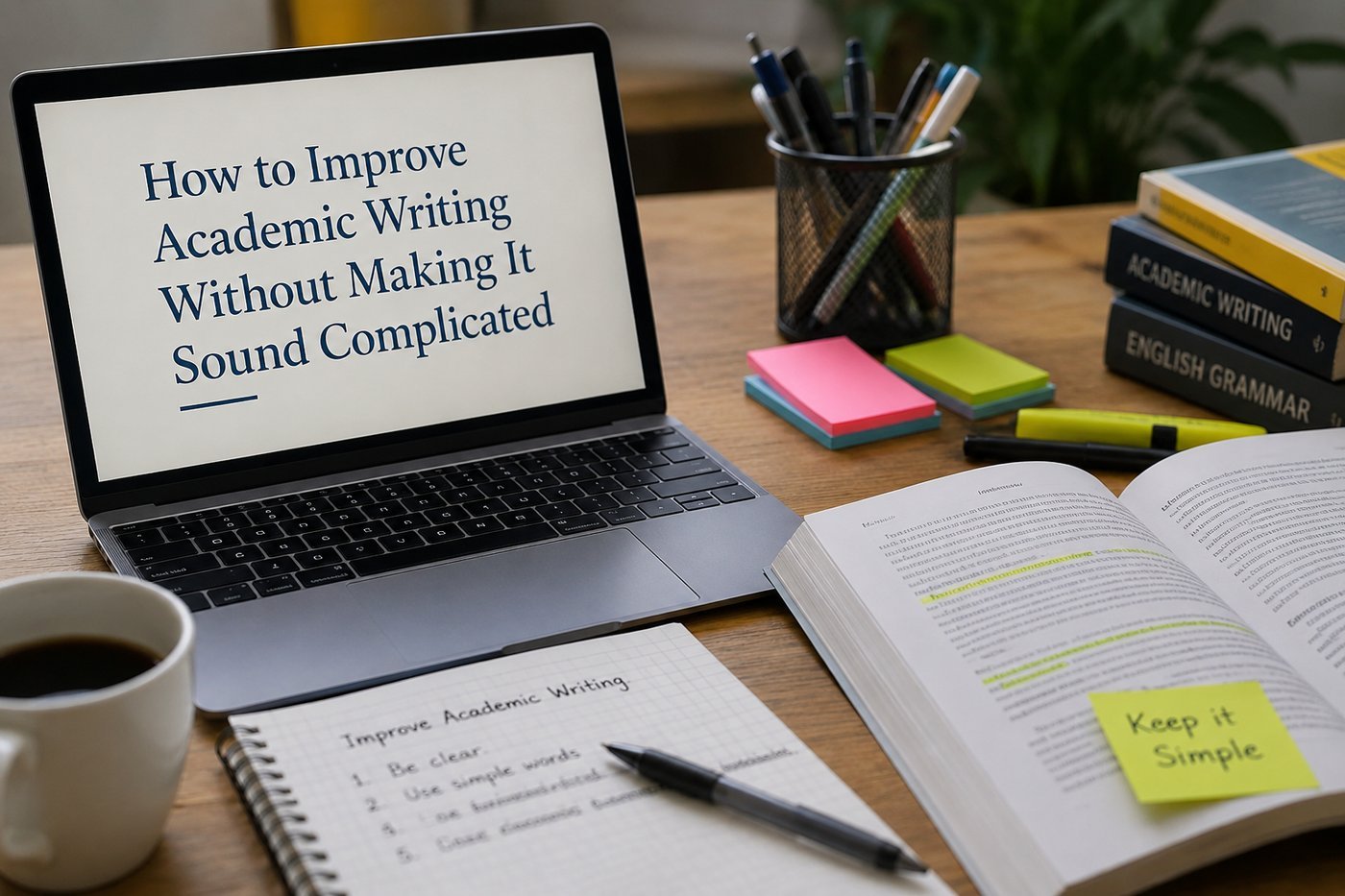
It usually happens in the middle of the night, somewhere around the third cup of coffee. A student stares at a half-finished paragraph, deletes it, rewrites it with longer words, deletes it again, and wonders why the sentence still doesn't sound "academic enough." This scene repeats itself across dorm rooms, libraries, and shared apartments every single semester. Many students struggle with academic writing not because they lack ideas, but because they believe good writing has to sound complicated to be taken seriously.
That belief is one of the most common — and most damaging — myths in higher education. Academic writing is not about impressing a reader with dense vocabulary or tangled sentences. It is about communicating an argument clearly, supporting it with credible evidence, and guiding the reader through your reasoning without friction. Once that shift in mindset happens, everything else — structure, tone, citations, even confidence — starts to fall into place.
This guide walks through how to build clear, credible, well-supported academic writing, step by step, without falling into the trap of overcomplicating your language.
What You'll Learn
- Why "sounding smart" and "writing well" are not the same thing
- How to structure essays and research papers so ideas flow logically
- How to find and evaluate credible academic sources
- The basics of citation styles and why consistency matters
- Common mistakes that quietly damage grades
- Practical editing habits that separate strong papers from average ones
Why Students Confuse Complexity With Quality
There's a persistent assumption that longer sentences and rarer vocabulary signal intelligence. In reality, university instructors generally expect the opposite: clarity, precision, and logical flow. A complicated sentence that hides a weak argument is far less impressive than a simple sentence that states a strong one.
This confusion often comes from three sources:
- Reading academic journals without reading the writing craft behind them. Published research can sound dense because it's written for specialists, not because complexity equals quality.
- Trying to hit a word count by padding sentences instead of developing ideas further.
- Fear of sounding "too simple" even when the argument itself is genuinely strong.
Academic best practices recommend writing so that a reasonably informed reader — not just your professor — could follow your argument without re-reading a sentence three times. If a reader has to decode your writing before they can evaluate your thinking, the writing is working against you.
Actionable Takeaway
Before submitting any paragraph, read it aloud. If you stumble over your own sentence, your reader will too. Rewrite it in the simplest version that still communicates the full idea.
Building a Structure That Does the Thinking For You
Weak academic writing is rarely a vocabulary problem. It's almost always a structure problem. When paragraphs don't follow a clear logic, even well-researched ideas feel scattered.
A dependable structure for most academic essays and research papers looks like this:
- Introduction — presents the topic, the argument (thesis statement), and a preview of your reasoning.
- Body paragraphs — each one develops a single idea, supports it with evidence, and connects back to the thesis.
- Counterargument (where relevant) — acknowledges opposing views and explains why your position still holds.
- Conclusion — synthesizes the argument without simply repeating the introduction word for word.
For longer academic writing such as a dissertation or thesis, the structure expands to include a literature review, research methodology, findings, and discussion sections — but the underlying principle stays the same: each section should answer a specific question the reader is likely asking at that point.
A well-structured research paper improves readability so much that even a moderately written argument can outperform a brilliantly worded but disorganized one. Structure carries weight that vocabulary simply cannot replace.
Actionable Takeaway
Before writing your first full draft, write a one-sentence summary for every paragraph you plan to include. If two summaries say almost the same thing, you likely need to merge or cut one.
Finding and Evaluating Credible Sources
Academic writing lives or dies on the quality of its evidence. International and ESL students especially benefit from learning this early, since source evaluation standards can differ significantly between education systems.
Reliable sources typically include:
- Peer-reviewed journal articles
- University press publications
- Government and institutional reports
- Established academic databases such as Google Scholar, JSTOR, or your university's library portal
Sources that generally weaken academic credibility include unmoderated blogs, opinion-based websites, and content with no clear author or publication date.
Academic Sources vs Non-Academic Sources
| Feature | Academic Sources | Non-Academic Sources |
| Review Process | Peer-reviewed by experts | Rarely reviewed |
| Author Credentials | Identifiable, qualified authors | Often anonymous or unclear |
| Evidence Base | Data, citations, methodology | Opinion or unverified claims |
| Update Frequency | Stable, versioned publications | Frequently edited without notice |
| Best Used For | Research papers, theses, dissertations | General background reading only |
Actionable Takeaway
For every source you plan to cite, ask three questions: Who wrote this? What evidence supports their claim? Would my instructor accept this as credible? If any answer is unclear, keep looking.
Understanding Citation Styles Without the Confusion
Citation anxiety is one of the most common reasons students lose marks — not because they plagiarized, but because they applied a citation style inconsistently. APA, MLA, Chicago, and Harvard referencing all serve the same purpose: giving credit and allowing readers to trace your evidence back to its source. The differences lie mainly in formatting details.
- APA Style — common in psychology, education, and social sciences; uses author-date in-text citations.
- MLA Style — common in humanities and literature; uses author-page in-text citations.
- Chicago Style — used across history and some social sciences; offers both footnote and author-date variations.
- Harvard Referencing — widely used in the UK and Australia; similar to APA in structure.
Actionable Takeaway
Pick your required citation style at the start of your research process, not at the end. Formatting citations retroactively across dozens of sources wastes hours that should go toward revising your argument.
Academic Integrity and the Role of AI Tools
AI writing tools have become part of many students' research and drafting process, and used responsibly, they can support brainstorming, outlining, and editing. However, academic integrity policies at most universities require that submitted work reflect a student's own understanding and analysis.
Responsible AI usage generally means:
- Using AI to clarify confusing concepts, not to generate final submitted text
- Using AI-assisted paraphrasing tools carefully, always verifying meaning is preserved accurately
- Always running your own critical thinking over any AI-generated suggestion
- Checking your institution's specific policy, since rules vary between universities and even between courses
Overdependence on AI without understanding the underlying material is a genuine warning sign — not just for academic integrity reasons, but because it prevents the kind of skill development that coursework is designed to build.
Warning Signs That Signal Weak Academic Writing
Recognizing these patterns early can save significant revision time later:
- A vague thesis statement that could apply to almost any topic
- Sparse or outdated research, especially sources older than a decade in fast-moving fields
- Missing or inconsistent citations, which can trigger plagiarism flags even when unintentional
- Arguments without counterpoints, making the paper feel one-sided and underdeveloped
- Skipped proofreading, which allows grammar and clarity issues to undermine strong ideas
- Reliance on a single source type, limiting the depth of your evidence
Left unaddressed, these issues often lead to lower grades, revision requests, or in more serious cases, academic integrity reviews — not because the research was dishonest, but because the writing process wasn't rigorous enough.
A Realistic Student Example
Consider a second-year student working on a research paper about climate policy. Early drafts relied heavily on unreliable websites and inconsistent notes, which made the argument feel thin and difficult to support. After learning to evaluate scholarly sources through the university library database, organize citations using a reference manager, and revise the paper across multiple drafts, the overall clarity and strength of the argument improved noticeably. The core ideas didn't change — the process behind developing them did.
This kind of improvement is common and realistic. It comes from better research habits and revision discipline, not from memorizing complex vocabulary.
Expert Tips for Stronger Academic Writing
- Plan before you write. A rough outline saves far more time than it costs.
- Take structured notes with the source and page number attached immediately, not after the fact.
- Write your introduction last. It's easier to introduce an argument once you know exactly what you argued.
- Edit in passes. Review once for structure, once for clarity, once for grammar — trying to fix everything at once leads to missed errors.
- Read your work as if you were the grader, not the writer.
- Build in time for proofreading. Rushed final checks are where avoidable mistakes slip through.
Good Research Habits vs Poor Research Habits
| Behavior | Good Research Habit | Poor Research Habit |
| Note-Taking | Records source details immediately | Notes ideas without tracking sources |
| Source Selection | Uses peer-reviewed, credible material | Relies on random web searches |
| Drafting | Writes multiple revised drafts | Submits the first draft |
| Citation Management | Tracks references throughout | Adds citations at the last minute |
| Time Management | Starts research early | Begins days before the deadline |
Frequently Asked Questions
1. How can I make my academic writing sound less complicated without losing credibility? Focus on clear sentence structure and strong evidence rather than complex vocabulary. Academic credibility comes from logical argumentation and reliable sources, not difficult phrasing.
2. What's the difference between paraphrasing and plagiarism? Paraphrasing restates an idea in your own words while properly citing the original source. Plagiarism occurs when someone else's words or ideas are presented as your own, whether intentionally or not.
3. Which citation style should I use for my paper? It depends on your discipline and your institution's requirements. Social sciences often use APA, humanities often use MLA, and some UK and Australian universities prefer Harvard referencing. Always check your course guidelines first.
4. Is it acceptable to use AI tools while writing academic papers? Many universities allow AI tools for brainstorming, clarifying concepts, or editing support, but expect final submitted work to reflect the student's own analysis. Policies vary, so checking your institution's specific guidelines is essential.
5. How many sources should a research paper typically include? This varies by assignment length, academic level, and discipline, and there's no universal number. Instructors generally look for enough credible sources to thoroughly support the paper's argument rather than a specific count.
Final Thoughts
Strong academic writing isn't built on impressive vocabulary — it's built on clear thinking, reliable evidence, and a structure that makes your argument easy to follow. When students shift their focus from "sounding smart" to communicating clearly, their writing almost always improves, and so does their confidence in the process. Good academic writing is a skill developed through practice, feedback, and revision — not a talent some students simply have and others don't.
Views: 36 · 30s+ reads: 4