What Is Six Sigma? A Clear Explanation from Instructor Don Lynch
Description
Learn what Six Sigma is, how DMAIC works, what the belts mean, and how it applies to CRM tools like Salesforce. A complete plain-English guide for beginners.
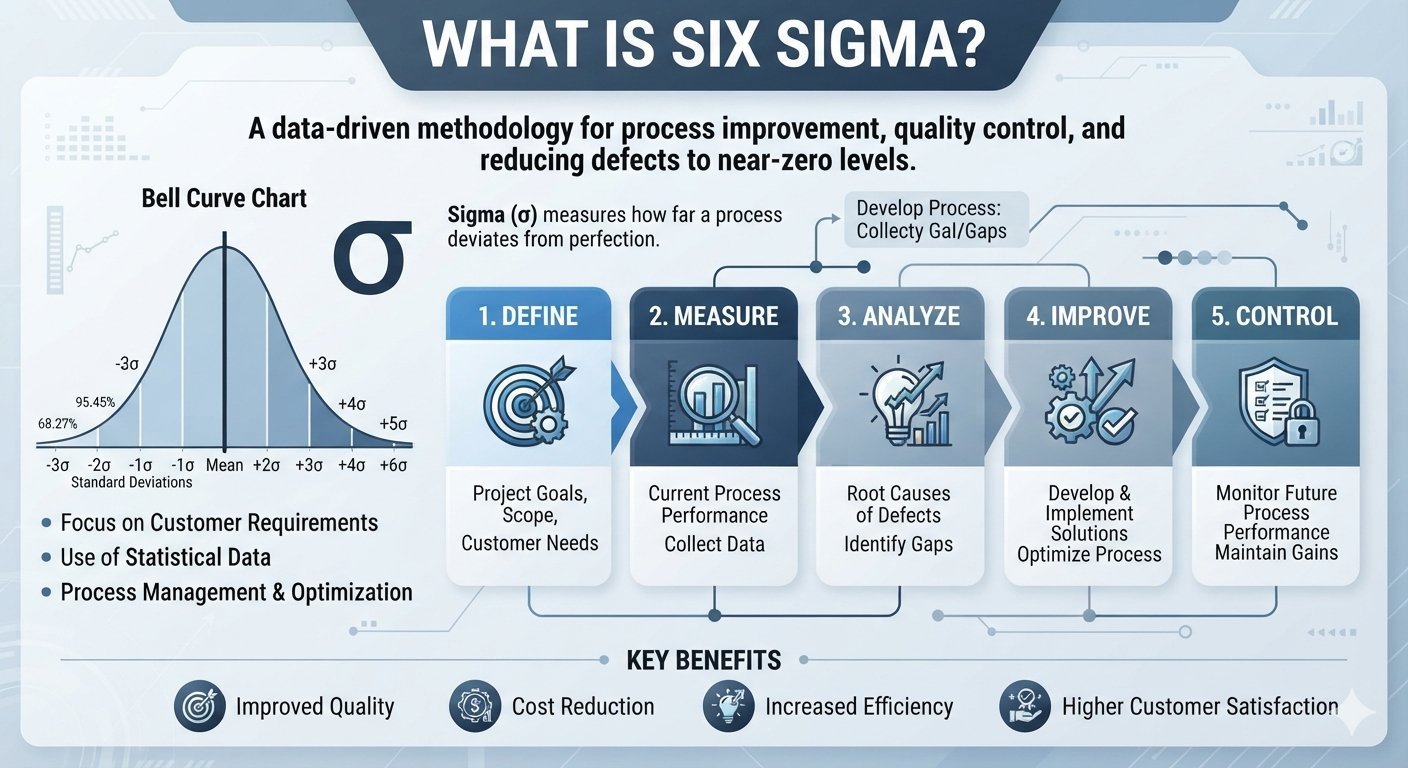
Six Sigma is a data-driven method for improving processes by finding and removing the causes of defects and variation. Developed at Motorola in the 1980s, it follows a structured cycle called DMAIC (Define, Measure, Analyze, Improve, Control) and aims for no more than 3.4 defects per million opportunities.
What Is Six Sigma in Plain English?
Learn What is Six Sigma is a way of making work more consistent and less error-prone. Instead of relying on gut feeling, you measure how a process actually performs, find out why it goes wrong, fix the cause, and then keep it fixed.
The word “sigma” comes from statistics. It is the symbol for standard deviation, which describes how much results vary. The less a process varies, the fewer defects it produces, and the more predictable the outcome is for your customer.
A “defect” is anything that fails to meet a customer requirement. That could be a faulty part, a late delivery, a wrong invoice, or a support ticket that gets reopened three times.
If you are looking to learn what Six Sigma is, start with this idea: it is a problem-solving discipline, not a piece of software or a slogan.
Where Did Six Sigma Come From?
Six Sigma began at Motorola in 1986. Engineer Bill Smith is widely credited as its originator, and Mikel Harry helped develop and promote the approach. General Electric adopted it in the 1990s under CEO Jack Welch, which helped spread it across industries.
Today it is used well beyond factories, including in healthcare, banking, logistics, IT, and government services. The methodology is also described in the international standard ISO 13053.
What Does “Six Sigma” Actually Mean?
A process performs at “six sigma” when six standard deviations fit between the process average and the nearest customer limit. By common convention, which includes an assumed 1.5-sigma long-term shift, that equals 3.4 defects per million opportunities (DPMO).
Sigma level Defects per million opportunities (DPMO) 1 690,000 2 308,537 3 66,807 4 6,210 5 233 6 3.4Most teams never need to hit level six everywhere. The real goal is measurable, lasting improvement in the processes that matter most to customers and the business.
The Core Principles of Six Sigma
- Start with the customer. Quality is defined by what the customer needs, not by internal opinion.
- Use data, not assumptions. Decisions rest on measurement and analysis.
- Reduce variation. Consistency is often more valuable than a better average.
- Fix root causes. Treating symptoms makes problems return.
- Work across teams. Most process problems cross departmental lines.
DMAIC: The Five-Phase Six Sigma Method
DMAIC is the framework used to improve an existing process. Each phase answers one clear question.
- Define: What problem are we solving, for whom, and what does success look like? Teams write a project charter and capture customer requirements.
- Measure: How is the process performing today? Teams map the process, choose metrics, check that measurements are reliable, and collect baseline data.
- Analyze: Why is the problem happening? Tools such as root cause analysis, fishbone diagrams, and hypothesis testing separate real causes from guesses.
- Improve: What change fixes the cause? Teams test solutions, often on a small scale first, and confirm they work.
- Control: How do we keep the gains? Teams add control charts, standard procedures, and monitoring so the process does not drift back.
For designing a brand-new process or product, practitioners often use a related framework called DMADV (Define, Measure, Analyze, Design, Verify).
A Simple Illustrative Example
Imagine, hypothetically, that a finance team notices many invoices go out with errors.
- Define: Reduce invoice errors that cause customer disputes.
- Measure: Count errors per batch and record where they occur.
- Analyze: Discover that most errors come from manual re-entry of customer details.
- Improve: Pull details automatically from one trusted source.
- Control: Track the error rate weekly and review any spike.
The scenario is invented for illustration only. The pattern is what matters: measure, find the cause, fix it, and monitor it.
Six Sigma Belts Explained
Six Sigma uses martial-arts-style titles to show training level and role.
Belt Typical role White Belt Basic awareness of concepts and vocabulary Yellow Belt Supports projects and helps collect data Green Belt Leads smaller improvement projects, usually alongside a regular job Black Belt Leads complex projects and coaches others, often full time Master Black Belt Mentors Black Belts and guides organization-wide strategyExact requirements vary by training provider and certifying body, so check what your employer or target program expects.
Six Sigma vs. Lean
The two are often combined as Lean Six Sigma, but they target different problems.
Six Sigma Lean Main focus Reducing variation and defects Removing waste and delay Typical question Why is the result inconsistent? Where are we wasting time or effort? Core approach Statistical analysis, DMAIC Value-stream mapping, flow, pull systemsTogether they help teams make processes both faster and more reliable.
Six Sigma and Salesforce: What Is Salesforce, and Why Does It Come Up?
People often search for Six Sigma and What Is Salesforce together, so it is worth separating them clearly.
Salesforce is a cloud-based customer relationship management (CRM) platform. Businesses use it to manage leads, customers, sales opportunities, and support cases. Six Sigma is an improvement method. They are different things, but they work well together.
Six Sigma needs data, and a CRM is a rich source of it. A team could use CRM data to measure:
- Time from new lead to first response
- Time a support case stays open
- Percentage of cases that are reopened
- Time deals spend in each sales stage
Once those numbers exist, the DMAIC cycle applies naturally. Reports and dashboards can support the Measure and Control phases. Owning a CRM does not make a company “Six Sigma,” though. The improvement comes from the method, not the tool.
Benefits and Limitations of Six Sigma
Benefits
- Gives teams a repeatable, evidence-based way to solve problems
- Reduces errors, rework, and customer complaints
- Builds a shared language for quality across departments
- Applies in both manufacturing and service settings
Limitations
- Works best where processes can be measured and enough data exists
- Can feel heavy or bureaucratic if applied to every small decision
- Less suited to highly creative or exploratory work
- Needs leadership support and trained people to succeed
How to Start Learning Six Sigma
- Learn the vocabulary: defect, variation, DPMO, root cause, process map.
- Study DMAIC and practice it on a small problem from your own work.
- Pick a belt level that matches your goals. Yellow or Green Belt is a common starting point.
- Choose a reputable provider. Bodies such as ASQ and IASSC publish certification standards.
- Apply it on a real project. Practical experience matters more than the certificate alone.
Frequently Asked Questions
1. What is Six Sigma in simple terms?
It is a structured, data-driven method for reducing defects and variation in a process so results become more consistent.
2. What does 3.4 defects per million mean?
It is the commonly cited target at the six sigma level, based on a convention that assumes a 1.5-sigma long-term shift in the process.
3. What is DMAIC?
DMAIC stands for Define, Measure, Analyze, Improve, Control. It is the five-phase cycle used to improve an existing process.
4. What are the Six Sigma belts?
They are training and role levels: White, Yellow, Green, Black, and Master Black Belt.
5. Is Six Sigma only for manufacturing?
No. It began in manufacturing but is also used in healthcare, finance, IT, logistics, and customer service.
6. What is the difference between Six Sigma and Lean?
Six Sigma focuses on reducing variation and defects, while Lean focuses on removing waste and delay. Many organizations combine them.
7. What is Salesforce, and is it part of Six Sigma?
Salesforce is a cloud-based CRM platform. It is not part of Six Sigma, but its data can support Six Sigma projects in sales and service.
8. Do I need certification to use Six Sigma?
No legal requirement exists, but many employers value certification, especially when it comes with real project experience.
9. Is Six Sigma still relevant today?
Yes, wherever processes can be measured and improved. Many teams now blend it with Lean and other approaches rather than using it alone.
Conclusion
Six Sigma comes down to one habit: measure a process honestly, find the real cause of its problems, fix it, and keep it fixed. DMAIC gives that habit a clear structure, and the belt system gives people a path to build skill.
Whether you work in a factory, a hospital, or a sales team using a CRM like Salesforce, the same logic applies. Start small, pick one process that frustrates your customers, and walk it through the five phases.