Reviewing Insacheck: minimum staff is not skill coverage
₹0
City: Seoul
Category: Services
Subcategory: Other Services
Description
Three names on a roster can look reassuring until one person goes on break. Even when the remaining headcount meets a minimum, the team may still lack the person qualified to open the store, supervise a machine or handle an exception. Those are different planning questions.
I prepare product information for Insacheck. This is a review of its public shift-planning documentation, checked on 30 October 2026, not a customer testimonial or a report of testing it in an Indian business. The accompanying diagram is a hypothetical planning example, not a screenshot of the product.
What the documented check covers
Insacheck describes minimum staffing settings by department, weekday and time band. At schedule confirmation, the system counts intervals that fall below the chosen minimum; break periods are excluded from the available headcount. Managers therefore have a documented way to check a numerical staffing requirement rather than relying only on the number of names entered for the day.
That is a useful distinction for a small service team. A manager reviewing a lunch period should be able to ask about the people available during that period, not merely the people scheduled somewhere within the shift. The value I would look for is a visible exception that prompts a staffing decision before the roster is treated as settled.
What a passing count cannot establish
The same product documentation states that assignments are not automatically optimised for worker skills or process constraints. I would not interpret a numerical minimum as proof that a required supervisor, trained operator or keyholder is covered. Nor would I describe this feature as an automatic staffing or production-optimisation engine.
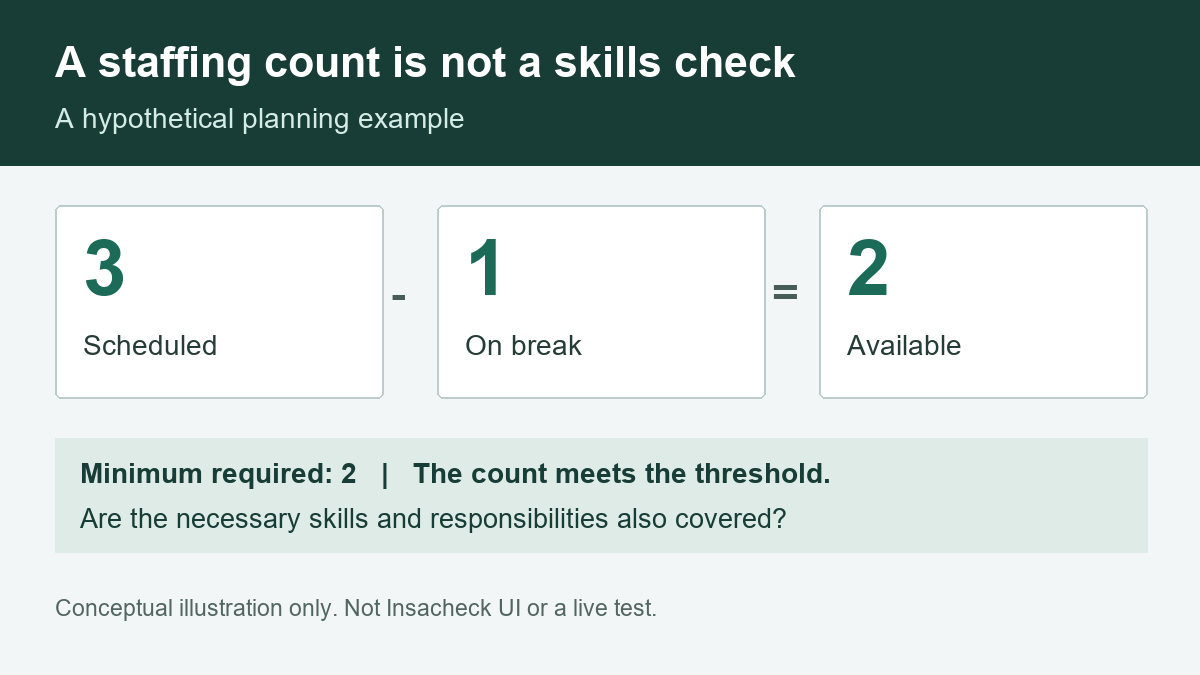
In a hypothetical three-person counter team, one person taking a break leaves two people available. If the chosen minimum is two, that count alone still says nothing about which responsibilities those two can carry. A separate role check is needed. The diagram illustrates only that distinction; its numbers are not measured product results.
What I would ask to see before adopting it
I would ask for a demonstration using a department's own opening hours and break pattern. I would then compare the reported shortfall intervals with a manually checked example, and separately ask the team lead to identify role-specific gaps. These are proposed evaluation steps, not tests I have already performed.
My assessment is that the documented minimum-staff check offers a useful numerical checkpoint, while the manager remains responsible for the skills and responsibilities behind the count. The public guide is in Korean, so language support and suitability for local employment rules or payroll should be verified separately. No Indian statutory compliance or business outcome is claimed here.
Source and further detail: Official Insacheck shift-planning documentation